Frequency Response

Bass roll-off starting at about 70Hz shows diminishing performance in lowest two octaves, slightly below par for a headphone of this type. With a gentle warm tilt, the very even and flat frequency response between 80Hz and 4kHz indicates the well balanced sound as heard in the listening test; this is markedly superior performance for a headphone of this type. Modest deviation in low frequency response during various headphone postionings indicates a headphone that seals and fits repeatable and well. Peaks and valleys 3kHz and above are normal for headphones in general, here the Aviators shows a smoother response than most, with nearly optimal high frequency response for headphones. (Generally, highs should roll off about 15dB in the last octave on the measurement system used.) Total Harmonic Distortion + Noise

Distortion levels and artifacts were quite typical of a good performing headphone of this type, generally running between 0.1% and 0.8%. Rise in low frequency distortion is due to ear-pad seal leakage and driver excursion limitations and is somewhat typical of this size and type; humped shape is generally an indicator of a "loose" sounding bass. 30Hz Square Wave Response
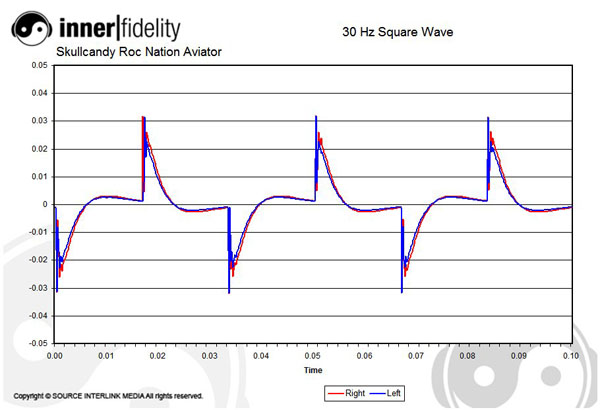
Curvature of square wave top dipping below zero before next transition edge is also typically an indicator of "loose" bass. 300Hz Square Wave
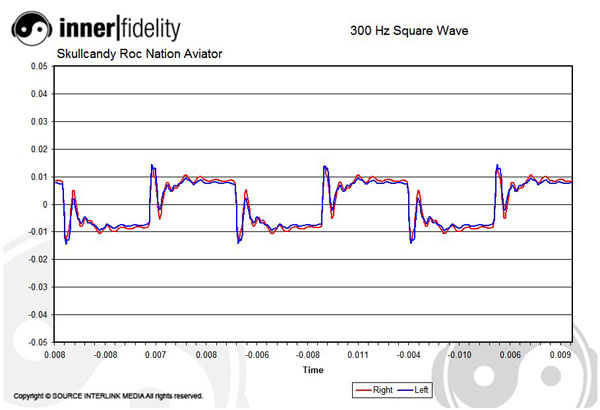
Square wave response at 300Hz is often very telling of headphone harshness; jagged and spiky leading edges are a good indicator of this undesirable attribute. The Aviator 300Hz square wave response is among the best I've seen. The characteristic shown with an overshoot; and smaller undershoot; and then settling quickly to a slightly noisy flat line is ideal. I believe the well controlled behavior of the Aviators in clean but non-fatiguing highs can be seen in this measured response. Impulse Response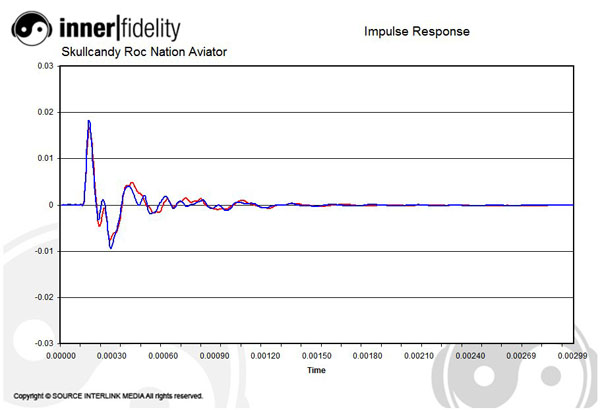
Similar in nature to the 300Hz square wave response, the impulse response here shows the articulate and controlled behavior of a responsive transducer. Electrical Impedance and Phase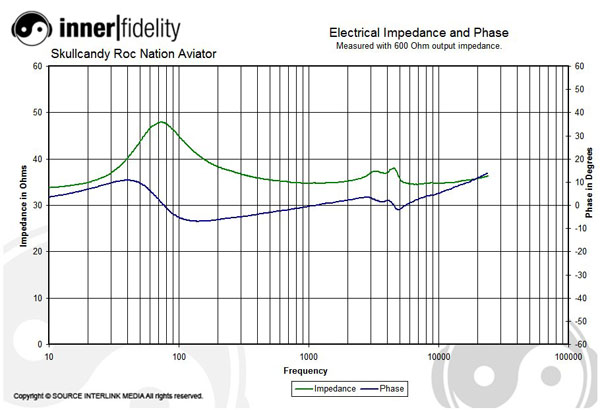
The impedance response shows a 35 ohm driver with fundamental resonance at about 70Hz. Bumps at 2kHz and 3.5kHz on both curves are likely a secondary resonant mode of the driver. Isolation

Isolation in the Aviators is poor, yielding -8dBr broadband attenuation between 100Hz and 10kHz. 55mVrms drive signal is needed to reach 90dB SPL @ 1000Hz, which means this headphone is driven to solid listening levels with portable devices. Measurement Summary
Though low bass performance is somewhat limited in these cans, mid- and high-frequency performance is very good. This is a surprisingly good set of measurements.
Bass roll-off starting at about 70Hz shows diminishing performance in lowest two octaves, slightly below par for a headphone of this type. With a gentle warm tilt, the very even and flat frequency response between 80Hz and 4kHz indicates the well balanced sound as heard in the listening test; this is markedly superior performance for a headphone of this type. Modest deviation in low frequency response during various headphone postionings indicates a headphone that seals and fits repeatable and well. Peaks and valleys 3kHz and above are normal for headphones in general, here the Aviators shows a smoother response than most, with nearly optimal high frequency response for headphones. (Generally, highs should roll off about 15dB in the last octave on the measurement system used.) Total Harmonic Distortion + Noise
Distortion levels and artifacts were quite typical of a good performing headphone of this type, generally running between 0.1% and 0.8%. Rise in low frequency distortion is due to ear-pad seal leakage and driver excursion limitations and is somewhat typical of this size and type; humped shape is generally an indicator of a "loose" sounding bass. 30Hz Square Wave Response
Curvature of square wave top dipping below zero before next transition edge is also typically an indicator of "loose" bass. 300Hz Square Wave
Square wave response at 300Hz is often very telling of headphone harshness; jagged and spiky leading edges are a good indicator of this undesirable attribute. The Aviator 300Hz square wave response is among the best I've seen. The characteristic shown with an overshoot; and smaller undershoot; and then settling quickly to a slightly noisy flat line is ideal. I believe the well controlled behavior of the Aviators in clean but non-fatiguing highs can be seen in this measured response. Impulse Response
Similar in nature to the 300Hz square wave response, the impulse response here shows the articulate and controlled behavior of a responsive transducer. Electrical Impedance and Phase
The impedance response shows a 35 ohm driver with fundamental resonance at about 70Hz. Bumps at 2kHz and 3.5kHz on both curves are likely a secondary resonant mode of the driver. Isolation
Isolation in the Aviators is poor, yielding -8dBr broadband attenuation between 100Hz and 10kHz. 55mVrms drive signal is needed to reach 90dB SPL @ 1000Hz, which means this headphone is driven to solid listening levels with portable devices. Measurement Summary
Though low bass performance is somewhat limited in these cans, mid- and high-frequency performance is very good. This is a surprisingly good set of measurements.