

This review began when I ran into Gary Yacoubian, president of SVS, in a crowded hallway at Las Vegas's Venetian Hotel, during the 2016 Consumer Electronics Show. He smiled and introduced himself. "Larry, I enjoyed your review of our SB13-Ultra. If you liked that subwoofer, we have something coming soon that should really interest you. I can't say anything more now."
He'd gotten my attention. But it wasn't until the next year's CES that I learned about SVS's newest and largest subwoofer, the SB16-Ultra, which deploys a 16" driver and a radically different magnet structure, voice-coil design, and control interface. On paper, its greater power and bass extension seemed a good match for the demands of my large listening room. I requested a review sample.
What it is
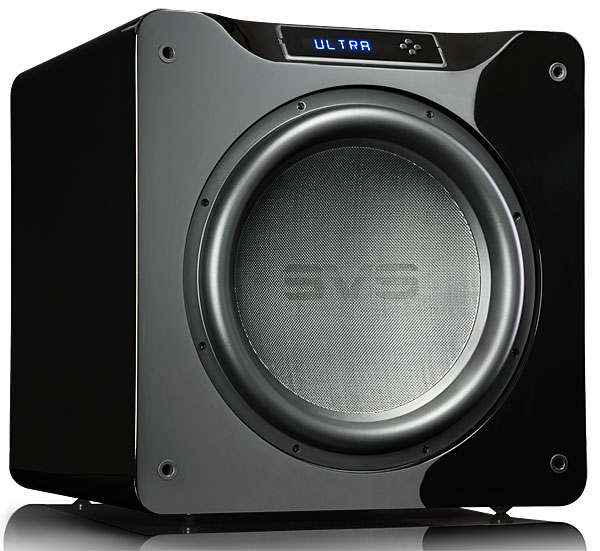
Yacoubian's infomercial on YouTube about the SB16-Ultra ($1999.99) lists the three design features that enabled SVS to build a subwoofer with so large a cone and still meet the design goals of extended, low-distortion bass output and fast transient response: an 8" edge-wound voice-coil in a new motor, a 1500W RMS (>5kW peak) Sledge amplifier with fully discrete MOSFET output (each output device is rated at 200V and 64A), and control and bass management via a smartphone app.
Yacoubian claims that the SB16-Ultra's 8" voice-coil is the largest used to date in a consumer subwoofer. Most large subs have voice-coils 2" to 4" in diameter that sit inside the permanent magnets; the SB16's 8" coil sits outside the magnets. SVS found so large a coil necessary in order to: avoid the cone flexing and the resultant boomy bass produced in and by subwoofers that have cones 15" to 18" in diameter but voice-coils of only 2" to 4"; maintain linear control over so large a cone; better dissipate heat, which lessens thermal compression and so increases a sub's power handling; provide better centering of the voice-coil, with less tilting during large excursions; and to use the permanent magnets most efficiently. The SB16-Ultra's voice-coil is wound with copper-clad aluminum wire (CCAW); CCAW has a number of advantages: it's lighter than pure copper, for lower moving mass; it's stronger than pure aluminum; has higher electrical conductivity; and is more easily soldered, for more durable and reliable connections.
The SB16-Ultra's voice-coil and four large, toroidal magnets are housed in the motor structure that drives the 16" cone, which has a "premium glass fiber laminated dustcap and reinforced composite cone sub-structure [to] ensure a light, rigid, and neutral radiating surface." The cone is held by a deep basket of die-cast aluminum; the motor alone weighs 56.2 lbs, the entire drive-unit 63.9 lbs.
The SB16's Sledge STA-1500D class-D amplifier is specified to output 1500W RMS, or 5160W peak dynamic. Featuring 64A, 200V MOSFET output devices and a switch-mode power supply, the Sledge delivers significantly more current than the 1000W class-D amplifier used in SVS's SB13-Ultra. The Autostart and Green standby modes can be used to switch the amp on quickly when a signal appears at the input terminals. The equalization and all app settings, including the parametric equalizer, are managed with a 50MHz Analog Devices DSP chip with 56-bit filtering.
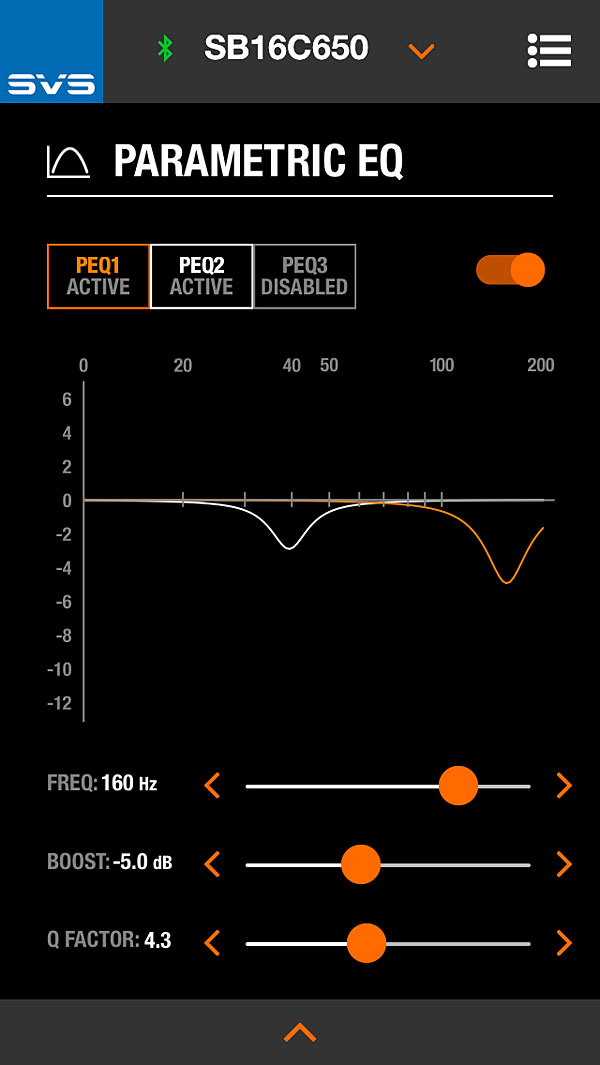
 SVS's smartphone app, available free from iTunes and Google Play, uses a bidirectional Bluetooth wireless link that, unlike an infrared signal, doesn't require that the control device and the device controlled be in each other's line of sight. This means that, via the app, the SB16 can be hidden behind a couch and still be fully controlled from the listening position. The app lets you set the sub's phase, polarity, volume, and room-gain compensation (to reduce bass bloat), and even includes a three-band parametric equalizer that controls the strength and width of the filter (the filter's "Q") over a range of 20–200Hz. Settings can be stored in three presets.
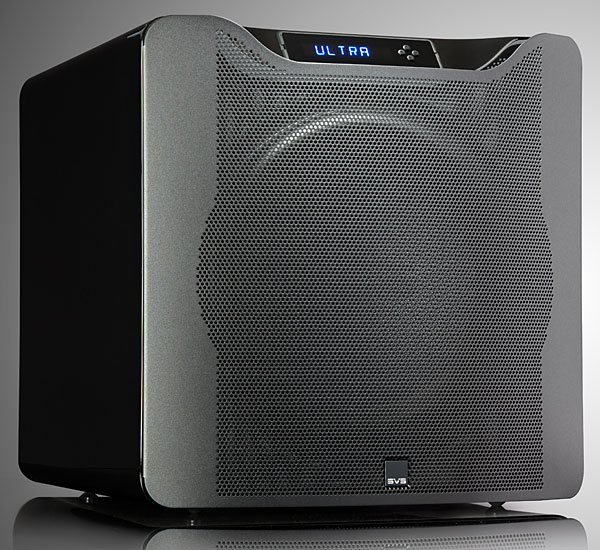
The SB16-Ultra's rear panel is uncluttered—most of the controls are included in the user-friendly app. On the rear panel are only the unbalanced (RCA) and balanced (XLR) inputs and outputs, a trigger input, a Power switch, and an IEC inlet for the detachable power cord. The tilted front-panel LCD display, four directional controls, and tiny IR remote can also be used to set up and control the sub. Because the display uses a larger font than other subs I've reviewed, I could more easily read it from my listening seat.
Setup and use
SVS's smartphone app, available free from iTunes and Google Play, uses a bidirectional Bluetooth wireless link that, unlike an infrared signal, doesn't require that the control device and the device controlled be in each other's line of sight. This means that, via the app, the SB16 can be hidden behind a couch and still be fully controlled from the listening position. The app lets you set the sub's phase, polarity, volume, and room-gain compensation (to reduce bass bloat), and even includes a three-band parametric equalizer that controls the strength and width of the filter (the filter's "Q") over a range of 20–200Hz. Settings can be stored in three presets.
The SB16-Ultra's rear panel is uncluttered—most of the controls are included in the user-friendly app. On the rear panel are only the unbalanced (RCA) and balanced (XLR) inputs and outputs, a trigger input, a Power switch, and an IEC inlet for the detachable power cord. The tilted front-panel LCD display, four directional controls, and tiny IR remote can also be used to set up and control the sub. Because the display uses a larger font than other subs I've reviewed, I could more easily read it from my listening seat.
Setup and use
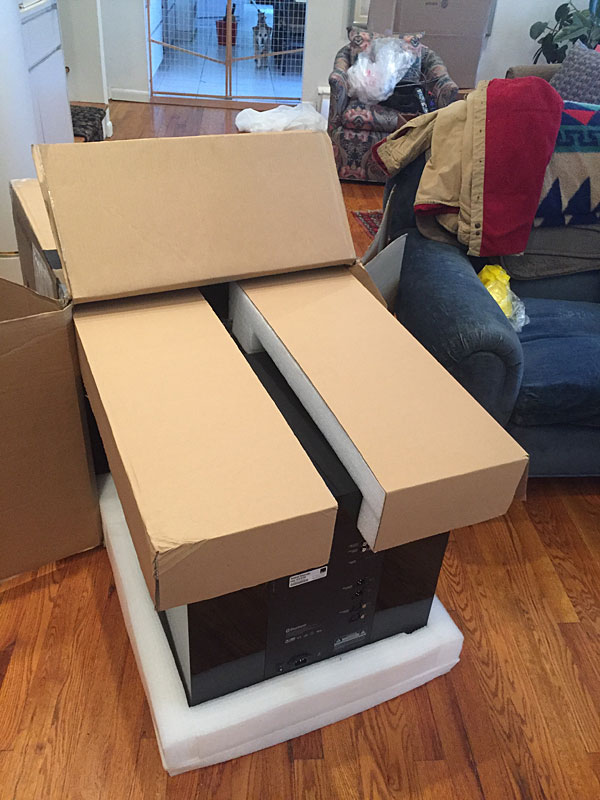
When the SB16-Ultra arrived, I was impressed by its solidity, mass, and size. At 20" high by 19.5" wide by 22.9" deep and 122 lbs, it's 2.6" taller, 2.1" wider, 5.5" deeper, and 30 lbs heavier than the SB13-Ultra, and costs $400 more. SVS's packaging is smart: The SB16 can be slid out of its carton on its packing skids, rather than having to lift it out from the top. After unboxing the sub, I slipped my own Super Sliders under it to protect my hardwood floors, then realized I couldn't move this sub without them.
 My listening room is large—about 25' long by 13' wide, with a semi-cathedral ceiling 12' at its highest—and opens onto a hallway and into the kitchen; the total volume exceeds 5000 cubic feet. On their own, my Quad ESL-989 speakers sound best when they're 8' from my listening seat, 57" from the front wall, and the centers of their front panels are 8' apart and toed in toward me.
Optimally positioning a subwoofer in my room is critical for attaining smooth integration of its output with the Quads' output. I first installed the SB16-Ultra next to the right-channel ESL-989, lining up the subwoofer's driver with the speaker's front panel. I played a brief musical selection and found the sound disjointed—I could easily hear differences in character between sub and satellite speaker. Moving the SB16-Ultra into the room's right front corner, where subwoofers usually go, raised the bass impact and greatly improved the subwoofer's blend with the Quads. This put the sub's cone 10' 8" from my listening chair and 2.5' behind the right Quad's front panel.
SVS's four-page quick-start guide made the rest of the setup process easy. I plugged the SB16's power cord into my Torus Power RM 20 power conditioner. As in many of today's freestanding subwoofers, no high-pass filter is built into the SB16-Ultra to limit the deep-bass signals sent to the main speakers, so I used my Mark Levinson No.526 preamplifier's 80Hz high-pass filter to drive the Quads. When I used my Bryston BP-26 preamp, I also used the high-pass outputs of a JL Audio CR-1 outboard electronic crossover for the Quads. I used balanced interconnects for all connections, and never used SB16's heavy metal grille.
I then downloaded SVS's free app from iTunes to my iPhone 6. Making sure that Bluetooth functions were enabled on the iPhone, I tapped the app. It opened, immediately found the SB16, and paired with it. From my listening seat, I set the sub's low-pass filter to 80Hz, 24dB/octave, and the volume control to –19dB. I then matched the outputs of the sub and the Quad ESL-989s at the crossover frequency, 80Hz. Then, playing a digital track of uncorrelated pink noise, I adjusted the preamplifier's volume until the Quads delivered 75dB at my listening chair, per the SPL meter of Studio Six Digital's AudioTools app. Then I turned off my Mark Levinson No.536 monoblocks, turned on the SB16-Ultra, played the pink-noise track again, and adjusted the sub's volume until it, too, delivered 75dB at my listening seat. Then, with Quads and subs both playing, I confirmed that the SPLs of the pink noise above and below the crossover frequency were equal.
My listening room is large—about 25' long by 13' wide, with a semi-cathedral ceiling 12' at its highest—and opens onto a hallway and into the kitchen; the total volume exceeds 5000 cubic feet. On their own, my Quad ESL-989 speakers sound best when they're 8' from my listening seat, 57" from the front wall, and the centers of their front panels are 8' apart and toed in toward me.
Optimally positioning a subwoofer in my room is critical for attaining smooth integration of its output with the Quads' output. I first installed the SB16-Ultra next to the right-channel ESL-989, lining up the subwoofer's driver with the speaker's front panel. I played a brief musical selection and found the sound disjointed—I could easily hear differences in character between sub and satellite speaker. Moving the SB16-Ultra into the room's right front corner, where subwoofers usually go, raised the bass impact and greatly improved the subwoofer's blend with the Quads. This put the sub's cone 10' 8" from my listening chair and 2.5' behind the right Quad's front panel.
SVS's four-page quick-start guide made the rest of the setup process easy. I plugged the SB16's power cord into my Torus Power RM 20 power conditioner. As in many of today's freestanding subwoofers, no high-pass filter is built into the SB16-Ultra to limit the deep-bass signals sent to the main speakers, so I used my Mark Levinson No.526 preamplifier's 80Hz high-pass filter to drive the Quads. When I used my Bryston BP-26 preamp, I also used the high-pass outputs of a JL Audio CR-1 outboard electronic crossover for the Quads. I used balanced interconnects for all connections, and never used SB16's heavy metal grille.
I then downloaded SVS's free app from iTunes to my iPhone 6. Making sure that Bluetooth functions were enabled on the iPhone, I tapped the app. It opened, immediately found the SB16, and paired with it. From my listening seat, I set the sub's low-pass filter to 80Hz, 24dB/octave, and the volume control to –19dB. I then matched the outputs of the sub and the Quad ESL-989s at the crossover frequency, 80Hz. Then, playing a digital track of uncorrelated pink noise, I adjusted the preamplifier's volume until the Quads delivered 75dB at my listening chair, per the SPL meter of Studio Six Digital's AudioTools app. Then I turned off my Mark Levinson No.536 monoblocks, turned on the SB16-Ultra, played the pink-noise track again, and adjusted the sub's volume until it, too, delivered 75dB at my listening seat. Then, with Quads and subs both playing, I confirmed that the SPLs of the pink noise above and below the crossover frequency were equal.
My first impression of the sound of the SB16-Ultra was tremendous bass solidity and weight—with no muddying of the clarity and transparency of the highs. But there was more improvement to be gained. As I listened, I found that the soundstage was shallower, and voices had more bass emphasis, than with the Quads run full-range by themselves. In the Kyrie of Ariel Ramirez's Misa Criolla, conducted by José Luis Ocejo (CD, Philips 420 955-2), José Carreras's soft, lyric tenor was now too full and rich, and the separation of his voice from the chorus disappeared. The conga drum that begins "Hotel California," from the Eagles' Hell Freezes Over (CD, Geffen GEFD-24725), was blurred, bloated, and less solid. The final pedal note in organist James Busby's performance of Herbert Howells's Master Tallis's Testament, from the compilation Pipes Rhode Island (CD, Riago 101), failed to pressurize my room.
Yacoubian's infomercial on YouTube about the SB16-Ultra ($1999.99) lists the three design features that enabled SVS to build a subwoofer with so large a cone and still meet the design goals of extended, low-distortion bass output and fast transient response: an 8" edge-wound voice-coil in a new motor, a 1500W RMS (>5kW peak) Sledge amplifier with fully discrete MOSFET output (each output device is rated at 200V and 64A), and control and bass management via a smartphone app.
SVS's smartphone app, available free from iTunes and Google Play, uses a bidirectional Bluetooth wireless link that, unlike an infrared signal, doesn't require that the control device and the device controlled be in each other's line of sight. This means that, via the app, the SB16 can be hidden behind a couch and still be fully controlled from the listening position. The app lets you set the sub's phase, polarity, volume, and room-gain compensation (to reduce bass bloat), and even includes a three-band parametric equalizer that controls the strength and width of the filter (the filter's "Q") over a range of 20–200Hz. Settings can be stored in three presets.
The SB16-Ultra's rear panel is uncluttered—most of the controls are included in the user-friendly app. On the rear panel are only the unbalanced (RCA) and balanced (XLR) inputs and outputs, a trigger input, a Power switch, and an IEC inlet for the detachable power cord. The tilted front-panel LCD display, four directional controls, and tiny IR remote can also be used to set up and control the sub. Because the display uses a larger font than other subs I've reviewed, I could more easily read it from my listening seat.
Setup and useWhen the SB16-Ultra arrived, I was impressed by its solidity, mass, and size. At 20" high by 19.5" wide by 22.9" deep and 122 lbs, it's 2.6" taller, 2.1" wider, 5.5" deeper, and 30 lbs heavier than the SB13-Ultra, and costs $400 more. SVS's packaging is smart: The SB16 can be slid out of its carton on its packing skids, rather than having to lift it out from the top. After unboxing the sub, I slipped my own Super Sliders under it to protect my hardwood floors, then realized I couldn't move this sub without them.
My listening room is large—about 25' long by 13' wide, with a semi-cathedral ceiling 12' at its highest—and opens onto a hallway and into the kitchen; the total volume exceeds 5000 cubic feet. On their own, my Quad ESL-989 speakers sound best when they're 8' from my listening seat, 57" from the front wall, and the centers of their front panels are 8' apart and toed in toward me.
Optimally positioning a subwoofer in my room is critical for attaining smooth integration of its output with the Quads' output. I first installed the SB16-Ultra next to the right-channel ESL-989, lining up the subwoofer's driver with the speaker's front panel. I played a brief musical selection and found the sound disjointed—I could easily hear differences in character between sub and satellite speaker. Moving the SB16-Ultra into the room's right front corner, where subwoofers usually go, raised the bass impact and greatly improved the subwoofer's blend with the Quads. This put the sub's cone 10' 8" from my listening chair and 2.5' behind the right Quad's front panel.
SVS's four-page quick-start guide made the rest of the setup process easy. I plugged the SB16's power cord into my Torus Power RM 20 power conditioner. As in many of today's freestanding subwoofers, no high-pass filter is built into the SB16-Ultra to limit the deep-bass signals sent to the main speakers, so I used my Mark Levinson No.526 preamplifier's 80Hz high-pass filter to drive the Quads. When I used my Bryston BP-26 preamp, I also used the high-pass outputs of a JL Audio CR-1 outboard electronic crossover for the Quads. I used balanced interconnects for all connections, and never used SB16's heavy metal grille.
Fig.1 SVS's SB16-Ultra iPhone control app.
SoundMy first impression of the sound of the SB16-Ultra was tremendous bass solidity and weight—with no muddying of the clarity and transparency of the highs. But there was more improvement to be gained. As I listened, I found that the soundstage was shallower, and voices had more bass emphasis, than with the Quads run full-range by themselves. In the Kyrie of Ariel Ramirez's Misa Criolla, conducted by José Luis Ocejo (CD, Philips 420 955-2), José Carreras's soft, lyric tenor was now too full and rich, and the separation of his voice from the chorus disappeared. The conga drum that begins "Hotel California," from the Eagles' Hell Freezes Over (CD, Geffen GEFD-24725), was blurred, bloated, and less solid. The final pedal note in organist James Busby's performance of Herbert Howells's Master Tallis's Testament, from the compilation Pipes Rhode Island (CD, Riago 101), failed to pressurize my room.















