

Sidebar 3: Measurements
I took these measurements while setting up the SVS SB16-Ultra, to optimize its match with my Quad speakers by adjusting the sub's position. Although I used the Fast Fourier Transform (FFT) module of Studio Six Digital's AudioTools, my measurements should not be compared with the in-room responses taken by John Atkinson that accompany all loudspeaker reviews published in Stereophile. Mine were taken in a room very different from his, and JA uses a better microphone, and bases his averaged results on more data points.
I took my measurements with Studio Six Digital's iTestMic (footnote 1), a professional-grade test and measurement microphone for the iPhone 4 and iPad. The mike's connector required an Apple Lightning adapter to plug into my iPhone 6. That done, the mike was auto-calibrated by Studio Six's AudioTools app, v.10.5.6, which stores the microphone's output, then analyzes and plots the results. I drove the SB16-Ultra with a digital file of uncorrelated pink noise supplied by Kevin Voecks, of Revel Speakers.
I took eight measurements at slightly different points around the ear-level position at the back of my listening room chair, and averaged them. I set AudioTools to an 8kHz, 16-bit reading, 1/6-octave, with a 1-second graph decay. The FFT resolution was set to 0.5Hz. I took readings for the low-frequency range of AudioTools (5Hz–2kHz). The SPL readout was C-weighted.
I measured the Quad ESL-989s run full-range, with no external crossover filter (fig.2). Note that the in-room frequency response peaks at 80Hz, begins to fall off at 55Hz, and is down 20dB by 31Hz. There are room-related peaks at 40 and 200Hz. I then added the JL Audio CR-1 external electronic crossover, with its high-pass filter set to 63Hz, 12dB/octave and its low-pass filter set to 43Hz, 24dB/octave. The SB16-Ultra's internal parametric equalizer was used to linearize the response at 43 and 160Hz. The FFT analysis plotted the Quad ESL-989s' room response with the high-pass filter, measured with the sub turned off (fig.3, green line); the SB16-Ultra alone with the low-pass filter (orange); and the Quads and SVS combined (light blue). The Quads plus SVS sub showed a room frequency response of ±3dB, 20Hz–1kHz. A dip in frequency response at 38Hz was somewhat smoothed by pulling the subwoofer out from the corner a few inches into the room, just behind the right ESL-989.
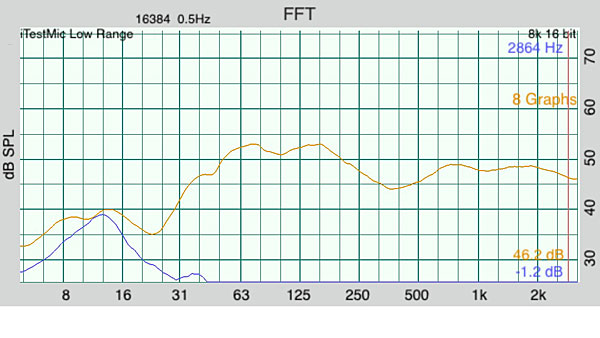
 The use of an extended FFT measurement down to 5Hz revealed a sound (blue line in both figs. 2 and 3) outside my awareness. It was 12dB below the Quad's room response at 31Hz, and peaked at 14Hz. I suspect that this was produced by the radon-mitigation exhaust system in the basement of our house, under the listening room.—Larry Greenhill
Footnote 1: Studio Six Digital's AudioTools, v.10.6.6, is available for download at the Apple App Store for $19.99. The company's iTestMic2 costs $199.99 and can be ordered at http://studiosixdigital.com/audio-hardware/itestmic2/.
Fig.2 Quad ESL-989, room response around ear level at listening chair at 96", averaged across 24" horizontal window (orange trace).
Fig.3 Spatially averaged room responses at 96" of: Quad ESL-989 alone (green), SVS SB16-Ultra alone (orange), and both together (light blue), all with the electronic crossover's high- and low-pass filters on.
Footnote 1: Studio Six Digital's AudioTools, v.10.6.6, is available for download at the Apple App Store for $19.99. The company's iTestMic2 costs $199.99 and can be ordered at http://studiosixdigital.com/audio-hardware/itestmic2/.















