

During my second cup of coffee, while listening to Ito Ema play Bach's Goldberg Variations (CD, MA recordings MO24A), I heard a dip around 120Hz and some boosted energy just above the 1.8kHz crossover point. The 120Hz dip made the left side of Ito's piano seem less corporeal than I prefer. The 2kHz boost made the upper registers sound lively and direct.
With both the Rogue Stereo 100 and now the Schiit Aegir, I would have to describe the Revolution XT 6's sound as pure and focused but slightly soft. Orchestral soundstages were accurately mapped. There were multitudes of fine detail, but that detail was low in contrast. I remember thinking to myself, this is a speaker that might actually benefit from the high damping factor and etched clarity of an amp like the Benchmark AHB2 (footnote 2).
However!
My biggest revelation about the XT 6s came when I played my #1 test track for every audio device: "Buddy & Maria Elena Talking in Apartment (Undubbed Version)" from Down the Line: Rarities (CD, Decca B0011675-02). This mono track, which consists of Buddy Holly and his wife Maria Elena talking in a vibrating sea of living room and NYC street sounds, was recorded by Buddy, in his Fifth Avenue apartment, on an Ampex 401A mono recorder he had purchased from his producer, Norman Petty. This track is composed of Buddy and Mar°a Elena speaking and laughing, with everyday sounds like wind, cars, a ringing telephone, and crumpling paper—myriad low-level information mapping the spatial layout of the room despite the mono recording. On my best headphones, I can feel the air in the room as a textured volume with tangible mass. On this track, the Tannoy XT 6s driven by the modest Schiit Aegir flaunted their coherence, with likely the best voice intelligibility I have heard from a box speaker on a stand.
 Dust-sized detail and textural contrasts were reduced compared to my Falcon LS3/5a or Harbeth P3ESR, but I doubt I have heard these Buddy Holly apartment sounds with a more conspicuous coherence. The only negative was a slight gray haze in the lower treble that reduced contrast and transparency.
While the Schiit Aegir was driving the XT 6s, I decided to try my most difficult test for loudspeaker tone quality: soprano Kirsten Flagstad's Wagner Recital with Hans Knappertsbusch conducting the Vienna Philharmonic Orchestra (LP, Decca LXT 5249). This is a 1956 mono recording, mixed from three microphones; I traced it with a stereo My Sonic Lab Ultra Eminent Ex phono cartridge. It was the most spacious, solid, three-dimensional "mono" I have heard from a stereo hi-fi rig. Imagine an extremely deep soundstage with a multitude of right, left, and back-of-stage details. I suspect this vivid 3D-ness was a result of Decca's three-microphone technique coupled with the Tannoys' exceptional coherence. However, the full pleasures of this well-recorded recital are revealed only when there is absolutely dead-on pitch and timbre, and the XT 6s did that, too.
On a shelf
Dust-sized detail and textural contrasts were reduced compared to my Falcon LS3/5a or Harbeth P3ESR, but I doubt I have heard these Buddy Holly apartment sounds with a more conspicuous coherence. The only negative was a slight gray haze in the lower treble that reduced contrast and transparency.
While the Schiit Aegir was driving the XT 6s, I decided to try my most difficult test for loudspeaker tone quality: soprano Kirsten Flagstad's Wagner Recital with Hans Knappertsbusch conducting the Vienna Philharmonic Orchestra (LP, Decca LXT 5249). This is a 1956 mono recording, mixed from three microphones; I traced it with a stereo My Sonic Lab Ultra Eminent Ex phono cartridge. It was the most spacious, solid, three-dimensional "mono" I have heard from a stereo hi-fi rig. Imagine an extremely deep soundstage with a multitude of right, left, and back-of-stage details. I suspect this vivid 3D-ness was a result of Decca's three-microphone technique coupled with the Tannoys' exceptional coherence. However, the full pleasures of this well-recorded recital are revealed only when there is absolutely dead-on pitch and timbre, and the XT 6s did that, too.
On a shelf
I don't own a bureau, and my desk is too small for the XT 6s, but in the middle of the review period, I installed the XT 6s on the bookshelf just above my desk, replacing my steadfast Dynaudio Excite X12 loudspeakers. As soon as they were installed, I watched the inspiring artist-documentary "Miles Davis: Birth of the Cool," streamed through the Mytek HiFi Brooklyn+ DAC, the XT 6s powered by Mytek's Brooklyn amplifier.
The sound was relaxed and clear. Best of all, the voices, especially the gravelly voice of Miles—as performed by Carl Lumbly—were there in all their textural and tonal glory. This positioning, only 6" from the wall behind them, seemed to make the 50–300Hz octaves smoother, more correct-sounding and better integrated than they were on stands in my floor system. I'm not sure why I wasn't getting similar room reinforcement when they were placed on the stands; maybe the difference comes from the different listening positions. In any case, this should be one of the key takeaways from this review: the XT 6 should sound spectacular on your bureau or desk.
Compared to KEF LS50
While enjoying the Tannoys on the shelf, I decided to spend a couple of days reabsorbing the virtues of KEF's LS50 speakers in the big system. If the XT 6s are to enjoy any great success, they must compete with the broad-ranging abilities of the already classic LS50—noting that the LS50s cost $1500/pair, or 50% more at full retail. On the first day, I noticed the little KEFs' greater bass solidity and also how, in my room, they seemed a couple of dBs up around 120Hz, while the XT 6s had seemed a couple of dBs down at that frequency. The LS50s played Miles Davis's 1969 recording In a Silent Way (Mobile Fidelity Sound Lab LP MFSL 1-377) with more force and density than the XT 6s. On "Shhh/Peaceful," the Tannoys sounded more refined, polished, and subtly detailed than the LS50s, but also a bit indistinct. The Tannoys made Miles's trumpet sound pure and colorful but less direct and powerful than it sounded through the LS50s.
Playing my favorite Miles Davis album, On the Corner (LP, Mobile Fidelity Sound Lab MFSL 1-452), the LS50s made the grooves growl while emphasizing the madly simple demonic energy of Michael Henderson's electric bass. In contrast, the XT 6s delivered more transparency, which gave me a clearer view of John McLaughlin punctuating the mix with his disturbed, dangerous tones—tones that illustrate how far into the heart of darkness American blues had progressed in the 10 years previous to this session.
 The LS50s expressed the bleakness of the On the Corner attitude—the angry street tough part. In contrast, the XT 6s focused my attention on the nuance and beauty of every dying polyrhythm. The LS50 generated force and body. The XT 6 showcased nuance of tone. Both were good. Neither was completely satisfying.
Compared to the Elac Carina BS243.4
The LS50s expressed the bleakness of the On the Corner attitude—the angry street tough part. In contrast, the XT 6s focused my attention on the nuance and beauty of every dying polyrhythm. The LS50 generated force and body. The XT 6 showcased nuance of tone. Both were good. Neither was completely satisfying.
Compared to the Elac Carina BS243.4
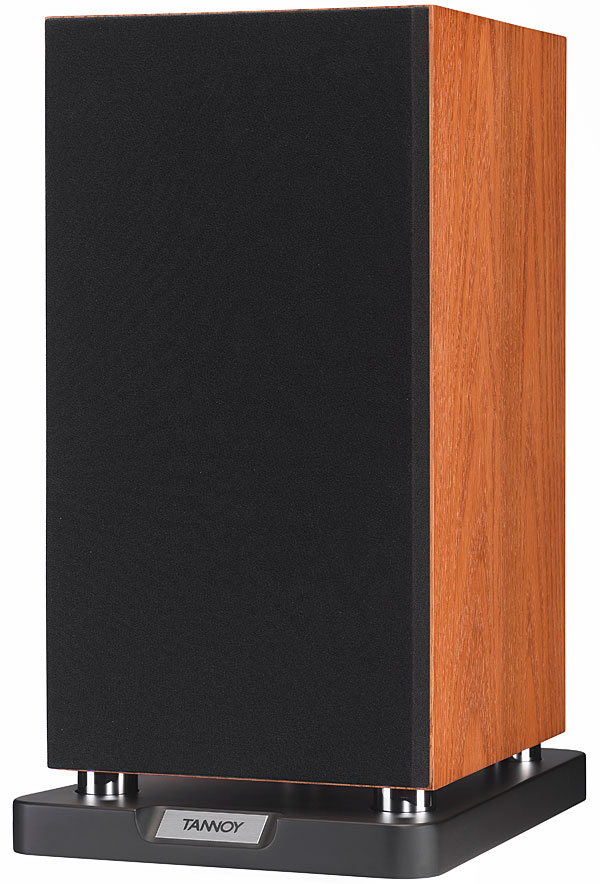
The Tannoy XT 6's separate plinth/base and bottom-firing port reminded me of the $1199/pair Elac Carina BS243.4 I reviewed in January 2020.
When that review appeared on the Stereophile website, an astute reader (Ortofan) noticed that I used these words to describe the Carina BS243.4: "more refined than any similarly priced loudspeaker I know of" and "the word elegant kept forcing itself on me." Ortofan asked if I remembered stating that the comparably priced Wharfedale Linton Heritage speakers "merge a refined, elegantly detailed sound with a magnetic personality that made me want to play records—made me want to listen longer, and to understand more of what I was listening to." He then asked, "So HR, if the sound quality of both speakers is refined and elegant, do the ELAC Carina speakers also have that certain "magnetic personality" that makes you want to play records and listen longer, or not?" My reply was, "I choose my words carefully."
A blunter version of my answer would have been "No." The Elacs were more refined and elegant than the Lintons, but they had less personality. To my taste, they made music too neat and tidy.
I've had a lifelong infatuation with classic British loudspeakers, most especially the Quad ESL, the Rogers LS3/5a, and the Spendor BC1. These speakers deliver a fundamental musical naturalness because of their flaws! Not in spite of them.
In my mind, beauty resides in what I call natural irregularities: dimples, some extra flesh, a gap-toothed smile, a saucy attitude. My beauty needs to show itself as vibrant, rosy-cheeked, and alive. In my room, the Wharfedale Linton Heritage was always vibrant and alive, ready for any music I might throw at them, but they were a little fluffy in the upper bass/lower midrange. At just $1198/pair, I regarded that fluff as a "heritage" pleasure, not a distraction.
The best thing about the Tannoy Revolution XT 6 was that, once they broke in, they never distracted me from enjoying whatever type of music I chose to listen to. In that regard, they reminded me of my beloved but much more expensive Harbeth P3ESRs ($2995/pair). Both small loudspeakers deliver dense textures, accurate timbre, and extraordinary spatial coherence.
The Tannoys and the Elac Carinas—both bottom-ported speakers—feature a precisely managed sound. But, while the Carinas sound buttoned-down, the XT 6s have a sensuous, flirty, seductive side that makes me want to smile, and dream, and listen to one record after another. Highly recommended.
Footnote 2: Unfortunately, the AHB2 was sent back to the factory long ago, so I could not do the experiment.
Dust-sized detail and textural contrasts were reduced compared to my Falcon LS3/5a or Harbeth P3ESR, but I doubt I have heard these Buddy Holly apartment sounds with a more conspicuous coherence. The only negative was a slight gray haze in the lower treble that reduced contrast and transparency.
While the Schiit Aegir was driving the XT 6s, I decided to try my most difficult test for loudspeaker tone quality: soprano Kirsten Flagstad's Wagner Recital with Hans Knappertsbusch conducting the Vienna Philharmonic Orchestra (LP, Decca LXT 5249). This is a 1956 mono recording, mixed from three microphones; I traced it with a stereo My Sonic Lab Ultra Eminent Ex phono cartridge. It was the most spacious, solid, three-dimensional "mono" I have heard from a stereo hi-fi rig. Imagine an extremely deep soundstage with a multitude of right, left, and back-of-stage details. I suspect this vivid 3D-ness was a result of Decca's three-microphone technique coupled with the Tannoys' exceptional coherence. However, the full pleasures of this well-recorded recital are revealed only when there is absolutely dead-on pitch and timbre, and the XT 6s did that, too.
On a shelfI don't own a bureau, and my desk is too small for the XT 6s, but in the middle of the review period, I installed the XT 6s on the bookshelf just above my desk, replacing my steadfast Dynaudio Excite X12 loudspeakers. As soon as they were installed, I watched the inspiring artist-documentary "Miles Davis: Birth of the Cool," streamed through the Mytek HiFi Brooklyn+ DAC, the XT 6s powered by Mytek's Brooklyn amplifier.
While enjoying the Tannoys on the shelf, I decided to spend a couple of days reabsorbing the virtues of KEF's LS50 speakers in the big system. If the XT 6s are to enjoy any great success, they must compete with the broad-ranging abilities of the already classic LS50—noting that the LS50s cost $1500/pair, or 50% more at full retail. On the first day, I noticed the little KEFs' greater bass solidity and also how, in my room, they seemed a couple of dBs up around 120Hz, while the XT 6s had seemed a couple of dBs down at that frequency. The LS50s played Miles Davis's 1969 recording In a Silent Way (Mobile Fidelity Sound Lab LP MFSL 1-377) with more force and density than the XT 6s. On "Shhh/Peaceful," the Tannoys sounded more refined, polished, and subtly detailed than the LS50s, but also a bit indistinct. The Tannoys made Miles's trumpet sound pure and colorful but less direct and powerful than it sounded through the LS50s.
The LS50s expressed the bleakness of the On the Corner attitude—the angry street tough part. In contrast, the XT 6s focused my attention on the nuance and beauty of every dying polyrhythm. The LS50 generated force and body. The XT 6 showcased nuance of tone. Both were good. Neither was completely satisfying.
Compared to the Elac Carina BS243.4The Tannoy XT 6's separate plinth/base and bottom-firing port reminded me of the $1199/pair Elac Carina BS243.4 I reviewed in January 2020.
Footnote 2: Unfortunately, the AHB2 was sent back to the factory long ago, so I could not do the experiment.















