Sidebar 3: Measurements
I used DRA Labs' MLSSA system and a calibrated DPA 4006 microphone to measure the Tekton Design Impact Monitor's frequency response in the farfield, and an Earthworks QTC-40 for the nearfield responses. My estimate of the Impact's sensitivity was 87.5dB(B)/2.83V/m, considerably lower than the specified 94dB. (Speakers with true sensitivities greater than 90dB tend to be rare and expensive.) The impedance is specified as 4 ohms. My measurement of the impedance magnitude (fig.1, solid trace) reveals that while the impedance does drop to 4 ohms in the lower midrange, it otherwise lies above 6 ohms for almost the entire audioband. While the electrical phase angle reaches extreme values in the midbass, the impedance magnitude is high at these frequencies, mitigating the demand for current from the partnering amplifier. Overall, as HR noted, the Impact Monitor is a relatively easy load. The impedance traces suggest that the crossover frequency between the woofers and the tweeter array lies around 1kHz.

 The broad saddle between 30 and 40Hz in the impedance-magnitude trace implies that the large port on the rear panel is tuned in this region. The two woofers behave identically, and their combined output (fig.3, blue trace) has the expected minimum-motion notch at 34Hz. The port's response, again measured in the nearfield (red trace), peaks between 20 and 60Hz, but some resonant peaks are visible in its midrange output. Fortunately, these are low in level, and their audibility will also be reduced by the fact that the port faces to the speaker's rear. The sum of the nearfield outputs of the woofers and port is shown as the black trace below 300Hz in fig.3; the output is down by 6dB at the port tuning frequency, and the apparent peak in the midbass is an artifact of the nearfield measurement technique. Nevertheless, throughout the measuring, the Tekton's low frequencies sounded rather exaggerated.


 In the time domain, the step response on the central tweeter axis (fig.6) indicates that the tweeters and woofers are all connected in positive acoustic polarity, the good integration between the drive-unit outputs correlating with the well-managed crossover in the frequency domain. The cumulative spectral-decay plot on the central tweeter axis (fig.7) is very clean.


Fig.1 Tekton Impact Monitor, electrical impedance (solid) and phase (dashed) (2 ohms/vertical div.).
No discontinuities are visible in the impedance traces. Nevertheless, the enclosure's panels seemed lively when I rapped them with my knuckles. Investigation with an accelerometer found two fairly strong, high-Q resonant modes, at 500 and 617Hz, on the sidewalls (fig.2), and lower-level modes at the same frequencies on the top and rear panels, though the latter two panels were more inert. The Impact Monitor obviously uses effective internal bracing. Fortunately, both the frequencies and Q of these resonances are sufficiently high that they won't be excited by modern-temperament music. The high Q means that a resonance needs to be stimulated for a fairly long time to be fully developed; the frequencies of the Impact's resonances fall "between the notes" in the modern scale so won't necessarily be excited. However, with unpitched sounds, like percussion instruments, they might be excited and perhaps this was the cause for HR's occasional noticing what he called an "overtone of emptiness."
Fig.2 Tekton Impact Monitor, cumulative spectral-decay plot calculated from output of accelerometer fastened to center of sidewall (MLS driving voltage to speaker, 7.55V; measurement bandwidth, 2kHz).
Fig.3 Tekton Impact Monitor, anechoic response on central tweeter axis at 50" (black), averaged across 30° horizontal window and corrected for microphone response, with nearfield responses of woofers (blue), port (red), and their complex sum (black), respectively plotted below 315Hz, 1kHz, and 300Hz.
The farfield response in fig.3 (black trace above 300Hz) was taken on the central tweeter axis, averaged across a 30° horizontal window. This speaker offers a superbly even on-axis output in the midrange and treble, with only a couple of small dips visible in the mid-treble. Fig.4 shows the Impact's lateral radiation pattern normalized to the central tweeter-axis response, which therefore appears as a straight line. The speaker's horizontal dispersion is commendably even below the cursor position at 3.8kHz. The tweeter array becomes gradually more directional as the frequency increases, but in a well-controlled manner up to 15kHz, above which the speaker's output drops very rapidly to the sides of the central tweeter axis.
Fig.4 Tekton Impact Monitor, lateral response family at 50", normalized to response on central tweeter axis, from back to front: differences in response 90–5° off axis, reference response, differences in response 5–90° off axis.
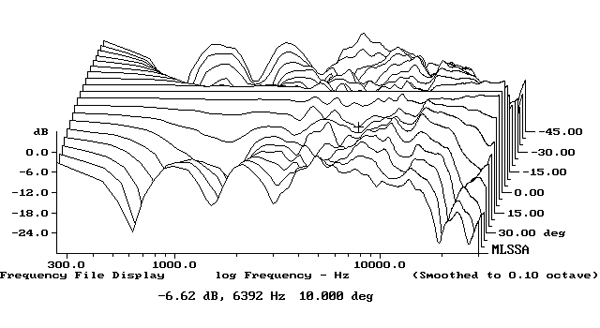
In the vertical plane (fig.5), the use of two woofers spaced relatively far apart leads to major cancellations in the midrange above and below the response on the central tweeter axis, which again appears as a straight line. The Impact Monitor's vertical radiation pattern suggests that the speaker needs to be listened to within a narrow window centered on the central tweeter axis if the midrange balance is not to sound colored.
Fig.5 Tekton Impact Monitor, vertical response family at 50", normalized to response on central tweeter axis, from back to front: differences in response 45–5° above central tweeter axis, reference response, differences in response 5–45° below central tweeter axis.
Fig.6 Tekton Impact Monitor, step response on central tweeter axis at 50" (5ms time window, 30kHz bandwidth).
Fig.7 Tekton Impact Monitor, cumulative spectral-decay plot on central tweeter axis at 50" (0.15ms risetime).
When I first saw the Impact Monitor's array of seven 1" dome tweeters, I wondered how it could possibly work. But its measured performance shows that this unusual design is not compromised—I keep coming back to that superbly even on-axis response—and that the array works well to control the speaker's treble dispersion.—John Atkinson