

Sidebar 3: Measurements
I used DRA Labs' MLSSA system and a calibrated DPA 4006 microphone to measure the Tidal Akira's frequency response in the farfield, and an Earthworks QTC-40 for the nearfield and spatially averaged room responses. I was neither able to move a speaker as large and heavy as this—each Akira's polished stainless-steel base alone weighs 70 lb—out of the listening room, nor raise it off the floor to measure it. I aimed the speaker across the room's diagonal to push back in time the reflections from the sidewalls, but the reflections of the speaker's output from the floor and the 8' ceiling limit the acoustic measurements' resolution below 1kHz.
My estimate of the Akira's voltage sensitivity was 87.5dB/2.83V/m. The Akira's impedance remains above 8 ohms throughout the midrange and treble, but drops below 6 ohms in the upper bass, with a minimum magnitude of 3.5 ohms at 111Hz (fig.1, solid trace). However, the electrical phase angle (fig.1, dashed trace) doesn't reach extreme values, and the Akira will work with amplifiers that are comfortable with 4 ohm loads.
 The saddle centered at 39Hz suggests that the five passive radiators are tuned to this frequency, and the three woofers, measured in the nearfield, all had minimum-motion notches between 39 and 41Hz, as well as a small suckout centered on 90Hz (not shown). They behaved differently at higher frequencies, however. While the bottom woofer rolled off above 120Hz, the upper two woofers maintained their output for crossover to the midrange unit at around 200Hz. The middle woofer is then rolled off more steeply above the crossover region than the top woofer. The passive radiators rolled off rapidly above and below the 30–60Hz region.
The blue trace below 300Hz in fig.2 shows the complex sum of the nearfield drive-unit outputs, taking into account amplitude, acoustic phase, and the fact that the passive radiators are mounted on the speaker's rear, which is 21" behind the front baffle. The integration of the midrange unit's with the woofers' outputs doesn't appear to be as smooth as usual; the usual broad peak in the bass due to the nearfield measurement technique is broken by a lack of energy between 80 and 220Hz.
The saddle centered at 39Hz suggests that the five passive radiators are tuned to this frequency, and the three woofers, measured in the nearfield, all had minimum-motion notches between 39 and 41Hz, as well as a small suckout centered on 90Hz (not shown). They behaved differently at higher frequencies, however. While the bottom woofer rolled off above 120Hz, the upper two woofers maintained their output for crossover to the midrange unit at around 200Hz. The middle woofer is then rolled off more steeply above the crossover region than the top woofer. The passive radiators rolled off rapidly above and below the 30–60Hz region.
The blue trace below 300Hz in fig.2 shows the complex sum of the nearfield drive-unit outputs, taking into account amplitude, acoustic phase, and the fact that the passive radiators are mounted on the speaker's rear, which is 21" behind the front baffle. The integration of the midrange unit's with the woofers' outputs doesn't appear to be as smooth as usual; the usual broad peak in the bass due to the nearfield measurement technique is broken by a lack of energy between 80 and 220Hz.
 Examined in the nearfield, the midrange unit had a 3dB-high step in its output at 1.1kHz, the frequency of one of the discontinuities in the impedance traces. This results in a small peak at that frequency in the Akira's farfield response, averaged across a 30° horizontal window centered on the tweeter axis (fig.2, blue trace above 300Hz). This peak was identical in the left and right speakers. The two speakers do match closely, though the right speaker (red trace) has slightly more energy present between 2 and 9kHz, with a maximum difference of 0.8dB at 7kHz. The left speaker (blue trace), whose tweeter was replaced after the accident, also has a small peak apparent at 15.3kHz that is absent in the right speaker.
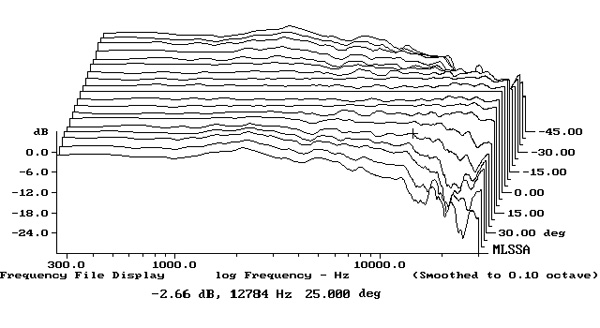
Because I was unable to lift an Akira onto my Outline computer-controlled turntable, I had to assess the speaker's lateral dispersion by positioning the microphone at 5° intervals in an arc centered on the tweeter axis. Because of the proximity of the room's walls, I had to limit the dispersion plot to 45° to the speaker's sides rather than the usual 90°. The result, normalized to the tweeter-axis response (fig.3), reveals that the tweeter starts to become directional above 13kHz. However, the dispersion below the top octave is well controlled and the contour lines are relatively even, this correlating with the precise stereo imaging I heard. In the vertical plane (fig.4, again normalized to the tweeter-axis response), the Akira's response doesn't change appreciably over a relatively wide window. This is a good thing, considering that the tweeter is 45" from the floor, and our research in the 1990s found that 36" is a typical ear height for a seated listener.
Examined in the nearfield, the midrange unit had a 3dB-high step in its output at 1.1kHz, the frequency of one of the discontinuities in the impedance traces. This results in a small peak at that frequency in the Akira's farfield response, averaged across a 30° horizontal window centered on the tweeter axis (fig.2, blue trace above 300Hz). This peak was identical in the left and right speakers. The two speakers do match closely, though the right speaker (red trace) has slightly more energy present between 2 and 9kHz, with a maximum difference of 0.8dB at 7kHz. The left speaker (blue trace), whose tweeter was replaced after the accident, also has a small peak apparent at 15.3kHz that is absent in the right speaker.
Because I was unable to lift an Akira onto my Outline computer-controlled turntable, I had to assess the speaker's lateral dispersion by positioning the microphone at 5° intervals in an arc centered on the tweeter axis. Because of the proximity of the room's walls, I had to limit the dispersion plot to 45° to the speaker's sides rather than the usual 90°. The result, normalized to the tweeter-axis response (fig.3), reveals that the tweeter starts to become directional above 13kHz. However, the dispersion below the top octave is well controlled and the contour lines are relatively even, this correlating with the precise stereo imaging I heard. In the vertical plane (fig.4, again normalized to the tweeter-axis response), the Akira's response doesn't change appreciably over a relatively wide window. This is a good thing, considering that the tweeter is 45" from the floor, and our research in the 1990s found that 36" is a typical ear height for a seated listener.

 In the time domain, the Akira's step response on the tweeter axis (fig.6) reveals that the tweeter and woofers are connected in negative acoustic polarity, the midrange unit in positive polarity. The tweeter's output arrives at the microphone before that of the midrange, which in turn arrives before that of the woofers. The decay of each unit's step blends smoothly with the start of the step of the next lower in frequency, implying optimal crossover design. Other than a small amount of delayed energy associated with the peaks just above 1kHz and at 15kHz noted earlier, the Tidal's cumulative spectral-decay plot (fig.7) is extraordinarily clean.


Fig.1 Tidal Akira, electrical impedance (solid) and phase (dashed) (2 ohms/vertical div.).
That massive cabinet seemed free from any panel resonances, which is why I haven't included my usual accelerometer-derived cumulative spectral-decay plot. However, the small discontinuities at 90Hz, 700Hz, and 1.1kHz in the traces in fig.1 suggest that something is not quite right at those frequencies. Listening to the enclosure walls with a stethoscope while I played test tones from my Editor's Choice CD revealed nothing amiss at those frequencies, but I was still bothered by the discontinuity at 1.1kHz. I therefore repeated the impedance measurement with the other speaker of the pair. It behaved identically, however.
Fig.2 Tidal Akira, anechoic response on tweeter axis at 50", averaged across 30° horizontal window and corrected for microphone response (left speaker blue, right red), with complex sum of nearfield midrange, woofer, and passive radiator responses plotted below 300Hz.
Fig.3 Tidal Akira, lateral response family at 50", normalized to response on tweeter axis, from back to front: differences in response 45–5° off axis, reference response, differences in response 5–45° off axis.
Fig.4 Tidal Akira, vertical response family at 50", normalized to response on tweeter axis, from back to front: differences in response 15–5° above axis, reference response, differences in response 5–10° below axis.
The red trace in fig.5 shows the Akiras' spatially averaged response in my room, generated by averaging 20 1/6-octave–smoothed spectra, taken for the left and right speakers individually using a 96kHz sample rate, in a vertical rectangular grid 36" wide by 18" high and centered on the positions of my ears. For comparison, the blue trace in this graph shows the spatially averaged response of the Wilson Alexia Series 2, which I reviewed in the July 2018 issue, measured in an identical manner and with the speakers in close to the same positions in my room as the Tidals. The two speakers appear to have very similar responses throughout the midrange, but the Tidals have more energy between 1 and 2kHz, the Wilsons more presence-region and top-octave energy. Regarding the latter, the Akiras' behavior is closer to what I've come to hear as being the correct amount of high treble in my room, due to the increasing absorption by the room's furnishings as the frequency rises. (A flat high-treble response is not what you want to see in this kind of measurement.) The Akiras have less upper-bass energy than the Wilsons, and while they excite the lowest-frequency mode in my room to a similar degree, their low-bass output rolls off below the frequency of that room mode, whereas the Wilsons offer a lot more output between 15 and 30Hz.
Fig.5 Tidal Akira, spatially averaged, 1/6-octave response in JA's listening room (red); and of Wilson Alexia 2 (blue).
Fig.6 Tidal Akira, step response on tweeter axis at 50" (5ms time window, 30kHz bandwidth).
Fig.7 Tidal Akira, cumulative spectral-decay plot on tweeter axis at 50" (0.15ms risetime).
Measuring a speaker as large and bulky as Tidal's Akira is always problematic, but overall it offers generally excellent measured performance. I do wonder, however, if the slight degree of "character" I heard in the upper midrange is associated with the behavior I noted between 1 and 2kHz in the midrange unit's output.—John Atkinson















