

The Akira's bass didn't bloom to quite the extent it had with the Wilson Alexia 2s, but was still weighty enough to satisfy. In the October issue, Sasha Matson raved about Ry Cooder's new album, The Prodigal Son (CD, Fantasy FAN00236). After reading that review, I asked Amazon Prime to overnight the CD to me. Robert Francis's bass in Albert Reed's "You Must Unload" provided a firm underpinning with the Tidals. More significant, the Akiras laid bare the atmospheric looped accompaniment in "Nobody's Fault But Mine," contrasting it with the upfront-but-never-too-much balance of Cooder's creaking vocal and virtuosic acoustic guitar. It was the Akiras' ability to separate the threads within each recording that impressed me—they simply stepped out of the way of the music making.
Oops
Disaster. The motherboard of my 2012 MacBook Pro died, and the tech at Mike's Tech Shop, in Manhattan, was doubtful it could be replaced—more of that "we can't repair vintage computers" thing I described in my review of the Roon Labs Nucleus+ server last August. So I bought myself an i7 Mac mini with 16GB of RAM and a 256GB solid-state drive and restored everything I had on the MacBook Pro, apps and data, using the Time Machine backup. I used to run FuzzMeasure 3 app on the laptop, in conjunction with a Metric Halo MIO2882 FireWire audio interface, to examine loudspeakers' in-room behavior, so three weeks or so after I began auditioning the Akiras and had gotten a good handle on their sound, I ran the app on my new Mac mini. What I didn't realize until too late was that the output level wasn't set to –20dB, as usual, but to 0dB—a level ten times greater. I clicked on Measure—only to dive for the Constellation amplifier's power switch as an almighty roar filled the room. Kerblammo! (footnote 1) Though the amplifier blew a fuse before I could turn it off, the left-hand Akira's diamond-diaphragm tweeter was fried. I shamefacedly e-mailed Doug White and Jörn Janczak to explain what had happened.
On receiving the news, White was remarkably coolheaded. He explained that, as Tidal closely matches everything in their speakers, the factory has on file a full record for every drive-unit installed in every Tidal speaker sold. Janczak would therefore have Accuton manufacture a new tweeter that would be a clone of the one I'd destroyed, and White would install it.
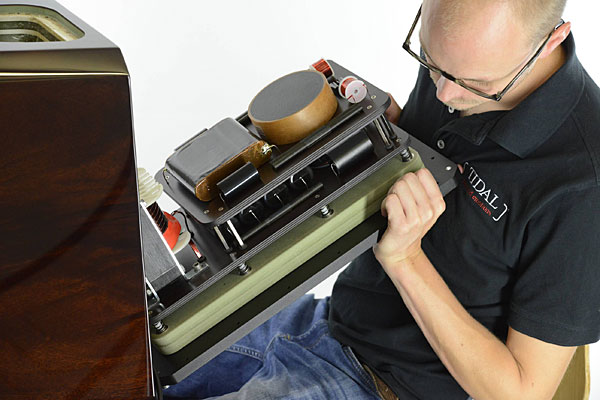
A week later, I was back in action with two working Akiras—and watching White perform the repair had given me a glimpse of the speaker's insides. As beautiful as are the Akira's external finish and appearance, its interior revealed superb attention to details of construction and design that most purchasers will never be aware of.
Back in action
Kerblammo! (footnote 1) Though the amplifier blew a fuse before I could turn it off, the left-hand Akira's diamond-diaphragm tweeter was fried. I shamefacedly e-mailed Doug White and Jörn Janczak to explain what had happened.
On receiving the news, White was remarkably coolheaded. He explained that, as Tidal closely matches everything in their speakers, the factory has on file a full record for every drive-unit installed in every Tidal speaker sold. Janczak would therefore have Accuton manufacture a new tweeter that would be a clone of the one I'd destroyed, and White would install it.
A week later, I was back in action with two working Akiras—and watching White perform the repair had given me a glimpse of the speaker's insides. As beautiful as are the Akira's external finish and appearance, its interior revealed superb attention to details of construction and design that most purchasers will never be aware of.
Back in action
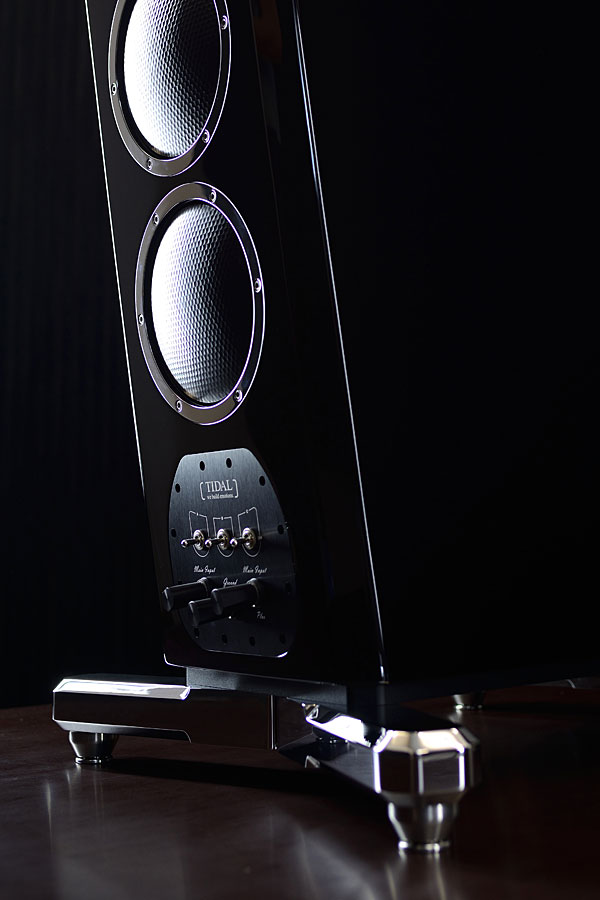
Changes in amplifiers produced larger differences in the sound than I was expecting. I'd begun my auditioning with the Lamm M1.2 monoblocks, which proved a synergistic match with the Tidals. Changing to the Constellation Performance Centaur II 500 stereo amplifier, which I reviewed in our October 2018 issue, was less of a good match. While the Constellation had a more refined sound than the Lamms, it made the Akiras sound a little too lean. Replacing the Constellation with the inexpensive Mytek Brooklyn Amp, reviewed in September 2018 by Ken Micallef, fattened up the low frequencies; and while image depth was reduced, the tiny, 7-lb Mytek acquitted itself better than I'd anticipated. But no, I don't think anyone will be driving $215,000/pair speakers with a $2495 amplifier.
 I then tried the Audio Research Reference 160M tubed monoblocks, which Jason Victor Serinus reviewed in the October 2018 Stereophile. The ARC amplifiers in Triode mode, driving the speakers from their 4 ohm taps, better fleshed out the upper bass than had the Constellation Centaur 500. Christian McBride's solo double bass in the intro to "All or Nothing At All," from Diana Krall's Love Scenes (DSD64 file, Impulse! IMP 12342), had the correct combination of weight and definition with the tubed amps. The Akiras got the scale of recorded instruments right.
The REF 160Ms also preserved the Constellation's well-defined soundstaging. As I write these words, it is almost exactly 20 years since I recorded the Kalichstein-Laredo-Robinson Trio, augmented with Daniel Phillips on second violin and Robert Rinehart on viola, performing Elgar's passionate Piano Quintet at the 1998 Santa Fe Chamber Music Festival. As explained in the booklet for the resulting CD, Bravo!, noise problems in the auditorium meant that I had to use close miking on the instruments, placing the output of each mike into the appropriate places in the overall soundstage captured by a distant pair of omni mikes. As I listened to Bravo! through the Akiras, while there was perhaps a little bit of extra rosin on the four bows, the picture painted by the Tidals was extraordinarily true to my memory of the performance in Santa Fe's St. Francis Auditorium. The hi-fi system as time machine!
I then tried the Audio Research Reference 160M tubed monoblocks, which Jason Victor Serinus reviewed in the October 2018 Stereophile. The ARC amplifiers in Triode mode, driving the speakers from their 4 ohm taps, better fleshed out the upper bass than had the Constellation Centaur 500. Christian McBride's solo double bass in the intro to "All or Nothing At All," from Diana Krall's Love Scenes (DSD64 file, Impulse! IMP 12342), had the correct combination of weight and definition with the tubed amps. The Akiras got the scale of recorded instruments right.
The REF 160Ms also preserved the Constellation's well-defined soundstaging. As I write these words, it is almost exactly 20 years since I recorded the Kalichstein-Laredo-Robinson Trio, augmented with Daniel Phillips on second violin and Robert Rinehart on viola, performing Elgar's passionate Piano Quintet at the 1998 Santa Fe Chamber Music Festival. As explained in the booklet for the resulting CD, Bravo!, noise problems in the auditorium meant that I had to use close miking on the instruments, placing the output of each mike into the appropriate places in the overall soundstage captured by a distant pair of omni mikes. As I listened to Bravo! through the Akiras, while there was perhaps a little bit of extra rosin on the four bows, the picture painted by the Tidals was extraordinarily true to my memory of the performance in Santa Fe's St. Francis Auditorium. The hi-fi system as time machine!
 Toward the end of the time I had the Akiras in my system, the media were celebrating Leonard Bernstein's 100th birthday. To pay my own tribute, while lifting to my lips a glass of a rather nice Pinot Grigio, I played Yes's version of Bernstein's "Something's Coming," from Yes: Deluxe Edition (2003 reissue, 16/44.1 FLAC, Atlantic/Tidal).
I saw Yes live several times at the end of the 1960s and the beginning of the 1970s—in both their hard-rocking club-band phase, with Tony Kaye on organ and Peter Banks on guitar, and in their pomp-rock heyday, with Rick Wakeman on keyboards and Steve Howe on guitar. And Bill Bruford was consistently one of the most intelligent of rock drummers. But not much in the way of recorded prog-rock playback, since those days nearly half a century ago, has approached the experience of hearing Yes live. With the Tidal Akiras driven by the Audio Research monoblocks, it did!
Toward the end of the time I had the Akiras in my system, the media were celebrating Leonard Bernstein's 100th birthday. To pay my own tribute, while lifting to my lips a glass of a rather nice Pinot Grigio, I played Yes's version of Bernstein's "Something's Coming," from Yes: Deluxe Edition (2003 reissue, 16/44.1 FLAC, Atlantic/Tidal).
I saw Yes live several times at the end of the 1960s and the beginning of the 1970s—in both their hard-rocking club-band phase, with Tony Kaye on organ and Peter Banks on guitar, and in their pomp-rock heyday, with Rick Wakeman on keyboards and Steve Howe on guitar. And Bill Bruford was consistently one of the most intelligent of rock drummers. But not much in the way of recorded prog-rock playback, since those days nearly half a century ago, has approached the experience of hearing Yes live. With the Tidal Akiras driven by the Audio Research monoblocks, it did!
 Conclusions
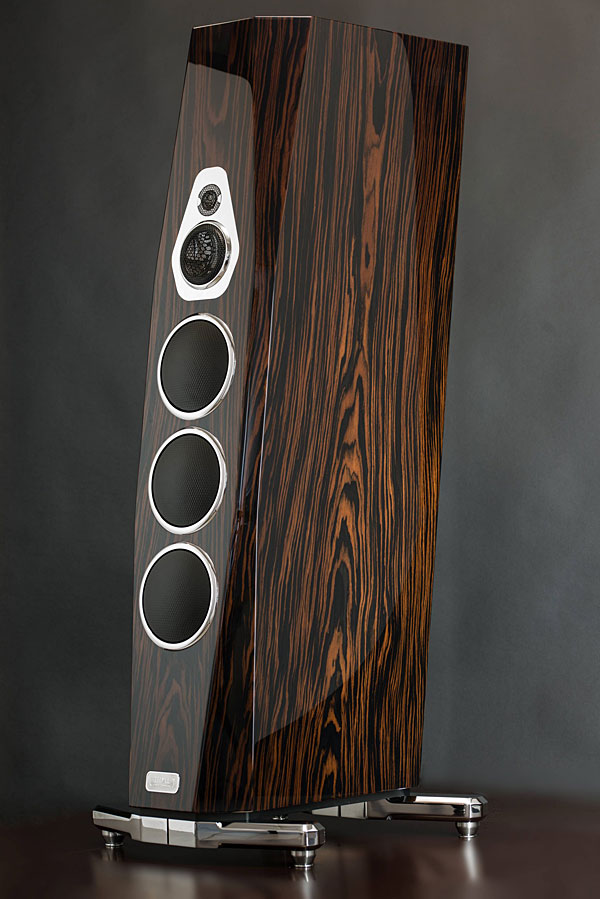
While the Tidal Akiras always sounded superb, throughout my auditioning of these speakers I was never sure I had fully gotten the best from them. Changes in cables and amplifiers were more audible than I had experienced with other speakers; it's possible that further experimentation with ancillary components would have produced even better sound. (After replacing that torched tweeter, Doug White left with me Tidal's Impulse LPX dual-mono solid-state amplifier. It is our policy not to comment on the sounds of products we have not yet reviewed in our review of another product. However, as might be expected, the pairing of Tidal speakers with Tidal amplifier was to the benefit of both.) No matter: The Akiras are the best-looking, best-built, best-sounding speakers I have had in my listening room—as they should be at the price.
Footnote 1: Now that NBC no longer broadcasts Formula 1 races in the US, I do miss commentator David Hobbs's language, this being one of his most colorful declamations.
Disaster. The motherboard of my 2012 MacBook Pro died, and the tech at Mike's Tech Shop, in Manhattan, was doubtful it could be replaced—more of that "we can't repair vintage computers" thing I described in my review of the Roon Labs Nucleus+ server last August. So I bought myself an i7 Mac mini with 16GB of RAM and a 256GB solid-state drive and restored everything I had on the MacBook Pro, apps and data, using the Time Machine backup. I used to run FuzzMeasure 3 app on the laptop, in conjunction with a Metric Halo MIO2882 FireWire audio interface, to examine loudspeakers' in-room behavior, so three weeks or so after I began auditioning the Akiras and had gotten a good handle on their sound, I ran the app on my new Mac mini. What I didn't realize until too late was that the output level wasn't set to –20dB, as usual, but to 0dB—a level ten times greater. I clicked on Measure—only to dive for the Constellation amplifier's power switch as an almighty roar filled the room.
Kerblammo! (footnote 1) Though the amplifier blew a fuse before I could turn it off, the left-hand Akira's diamond-diaphragm tweeter was fried. I shamefacedly e-mailed Doug White and Jörn Janczak to explain what had happened.
Changes in amplifiers produced larger differences in the sound than I was expecting. I'd begun my auditioning with the Lamm M1.2 monoblocks, which proved a synergistic match with the Tidals. Changing to the Constellation Performance Centaur II 500 stereo amplifier, which I reviewed in our October 2018 issue, was less of a good match. While the Constellation had a more refined sound than the Lamms, it made the Akiras sound a little too lean. Replacing the Constellation with the inexpensive Mytek Brooklyn Amp, reviewed in September 2018 by Ken Micallef, fattened up the low frequencies; and while image depth was reduced, the tiny, 7-lb Mytek acquitted itself better than I'd anticipated. But no, I don't think anyone will be driving $215,000/pair speakers with a $2495 amplifier.
I then tried the Audio Research Reference 160M tubed monoblocks, which Jason Victor Serinus reviewed in the October 2018 Stereophile. The ARC amplifiers in Triode mode, driving the speakers from their 4 ohm taps, better fleshed out the upper bass than had the Constellation Centaur 500. Christian McBride's solo double bass in the intro to "All or Nothing At All," from Diana Krall's Love Scenes (DSD64 file, Impulse! IMP 12342), had the correct combination of weight and definition with the tubed amps. The Akiras got the scale of recorded instruments right.
The REF 160Ms also preserved the Constellation's well-defined soundstaging. As I write these words, it is almost exactly 20 years since I recorded the Kalichstein-Laredo-Robinson Trio, augmented with Daniel Phillips on second violin and Robert Rinehart on viola, performing Elgar's passionate Piano Quintet at the 1998 Santa Fe Chamber Music Festival. As explained in the booklet for the resulting CD, Bravo!, noise problems in the auditorium meant that I had to use close miking on the instruments, placing the output of each mike into the appropriate places in the overall soundstage captured by a distant pair of omni mikes. As I listened to Bravo! through the Akiras, while there was perhaps a little bit of extra rosin on the four bows, the picture painted by the Tidals was extraordinarily true to my memory of the performance in Santa Fe's St. Francis Auditorium. The hi-fi system as time machine!
Toward the end of the time I had the Akiras in my system, the media were celebrating Leonard Bernstein's 100th birthday. To pay my own tribute, while lifting to my lips a glass of a rather nice Pinot Grigio, I played Yes's version of Bernstein's "Something's Coming," from Yes: Deluxe Edition (2003 reissue, 16/44.1 FLAC, Atlantic/Tidal).
ConclusionsWhile the Tidal Akiras always sounded superb, throughout my auditioning of these speakers I was never sure I had fully gotten the best from them. Changes in cables and amplifiers were more audible than I had experienced with other speakers; it's possible that further experimentation with ancillary components would have produced even better sound. (After replacing that torched tweeter, Doug White left with me Tidal's Impulse LPX dual-mono solid-state amplifier. It is our policy not to comment on the sounds of products we have not yet reviewed in our review of another product. However, as might be expected, the pairing of Tidal speakers with Tidal amplifier was to the benefit of both.) No matter: The Akiras are the best-looking, best-built, best-sounding speakers I have had in my listening room—as they should be at the price.
Footnote 1: Now that NBC no longer broadcasts Formula 1 races in the US, I do miss commentator David Hobbs's language, this being one of his most colorful declamations.















