

Sidebar 3: Measurements
I used DRA Labs' MLSSA system to measure the Totem Skylight's farfield behavior with a calibrated DPA 4006 microphone. For the speaker's nearfield responses, I used an Earthworks QTC-40 mike, which has a small, ¼"-diameter capsule that doesn't obstruct the sound from the woofer or port.
Totem specifies the Skylight's sensitivity as "88dB," presumably for 1W at 1m. My estimate was 85.4dB(B)/2.83V/m, which is about what I would anticipate from such a small loudspeaker and 1dB higher than that of the KEF LS50. However, while the Totem Skylight's nominal impedance is specified as 8 ohms, the solid trace in fig.1 suggests that 10 ohms would be more accurate; this would increase the sensitivity expressed in terms of watts, but only by about 0.1dB.
 The traces in fig.1 have discontinuities in the midrange and low treble that suggest the presence of panel resonances. When I investigated the enclosure's vibrational behavior with a plastic-tape accelerometer, I found several high-Q modes on the sidewalls (fig.2), the highest in level at 488Hz and others at 800Hz and 900Hz. (The mode at 800Hz was the highest in level on the top panel.) The frequencies of the resonant modes are the same as the wrinkles in the impedance traces. I assume that this behavior is why Totem pays a lot of attention in the Skylight's manual to how the speaker should be coupled to its stand, specifically stating, "Totem recommends decoupling the loudspeaker to break down cabinet resonance for optimum results." I measure a loudspeaker's impedance and panel vibrations with the enclosure supported on three upturned cones, which reveals the speaker's fundamental behavior. As I showed in my 1992 article on the loudspeaker/stand interface, using compliant coupling to the stand can reduce the amplitude of the resonances.


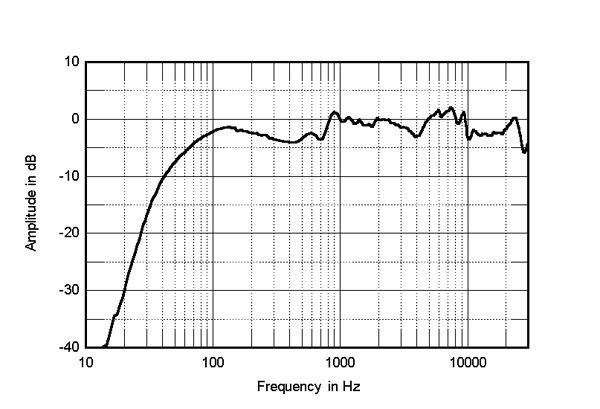
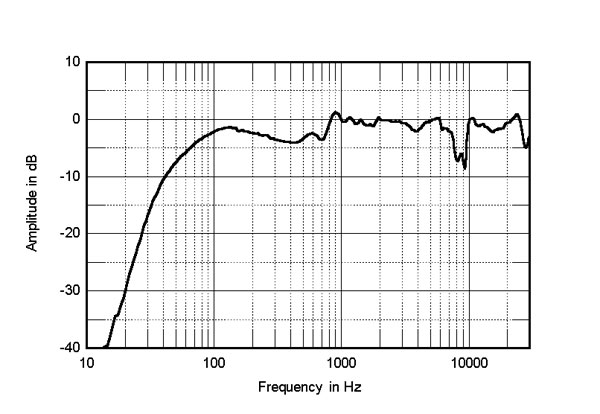 The Skylight's manual doesn't give specific instructions on which listening axis will be optimal, but it does mention that listening below the tweeter is preferred to listening above it. I therefore repeated the farfield response a couple of inches below the tweeter axis, again without the grille. The suckout has filled in (fig.5); indeed, there is now a slight excess of energy in that region.
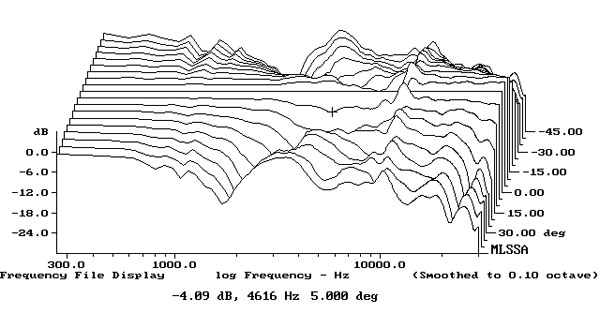
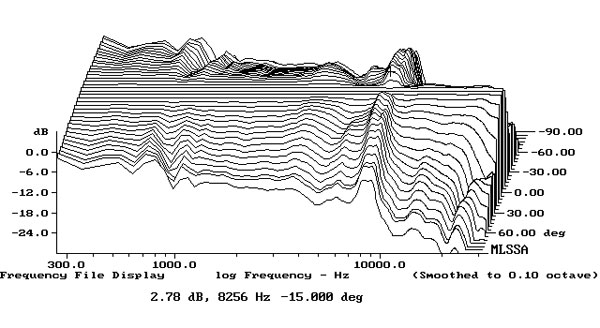
 The plot of the Totem Skylight's vertical dispersion, referenced to the response on the tweeter axis (fig.6), indicates that the speaker's balance does change radically above and below the tweeter axis. Again, the optimal balance will be obtained just below the tweeter, but listening more than 5° lower than the tweeter sucks out the low treble. In the horizontal plane (fig.7), again referenced to the response on the tweeter axis, the on-axis treble suckout fills in to some extent to the sides, which is why there are apparent peaks off-axis in this graph. Other than that, the contour lines in this graph are relatively even throughout the treble, which implies stable stereo imaging.
 In the time domain, the Totem Skylight's step response on the tweeter axis (fig.8) indicates that the tweeter is connected in inverted acoustic polarity, the woofer in positive polarity. The tweeter's step, which arrives first at the microphone, doesn't quite blend smoothly into the start of the woofer's step, which confirms that the optimal balance will be obtained just below the tweeter axis.


Fig.1 Totem Skylight, electrical impedance (solid) and phase (dashed) (2 ohms/vertical div.).
The impedance magnitude remains above 8 ohms for almost the entire audioband, with a minimum value of 7.2 ohms at 230Hz. While the electrical phase angle (dashed trace) is high at some frequencies, the impedance magnitude is also high at those frequencies. The Totem Skylight will be a very easy load for the partnering amplifier.
Fig.2 Totem Skylight, cumulative spectral-decay plot calculated from output of accelerometer fastened to center of sidewall (MLS driving voltage to speaker, 7.55V; measurement bandwidth, 2kHz).
The saddle centered on 43Hz in the impedance magnitude trace suggests that this is the tuning frequency of the port on the Totem's rear panel. This frequency—low for such a small speaker—was confirmed by the fact that it's the frequency at which the nearfield response of the woofer (fig.3, blue trace) has its minimum-motion notch. (The back pressure from the port resonance holds the cone stationary at the tuning frequency.) The nearfield response of the port (red trace) peaks broadly between 30Hz and 80Hz, with initially a clean upper-frequency rolloff. However, its output is disturbed by very high-amplitude peaks at 500Hz, 800Hz, and 900Hz, the frequencies of the discontinuities in the impedance traces and the cabinet panel resonances. I could hear this behavior as a whistle imposed on the noise-like MLSSA signal.
Fig.3 Totem Skylight, acoustic crossover on tweeter axis at 50", corrected for microphone response, with the nearfield responses of the woofer (blue) and port (red), respectively plotted below 500Hz and 1kHz.
Totem's specifications state that the woofer is crossed over to the tweeter at 2.5kHz, with first-order slopes. However, while the tweeter (fig.3, green trace) does roll in at 2kHz, the woofer's output (blue trace) continues at a slightly lower level until it finally rolls off sharply above 10kHz. This overlap in driver outputs makes the Skylight's balance critically dependent on listening axis. The black trace above 300Hz in fig.4 shows the Totem Skylight's farfield response, averaged across a 30° horizontal window centered on the tweeter axis. The upper midrange and treble are respectably flat, though a significant suckout can be seen between 7kHz and 10kHz, this due to interference between the two driver outputs. (This measurement was made without the grille; repeating it with the grille in place slightly widened the frequency region affected by the suckout but didn't otherwise change the response.)
Fig.4 Totem Skylight, anechoic response on tweeter axis at 50", averaged across 30° horizontal window and corrected for microphone response (black), with the complex sum of the nearfield woofer and port responses plotted below 300Hz.
Fig.5 Totem Skylight, anechoic response 3" below the tweeter axis at 50", averaged across 30° horizontal window and corrected for microphone response, with the complex sum of the nearfield woofer and port responses plotted below 300Hz.
The black trace below 300Hz in figs.4 and 5 shows the sum of the Totem's nearfield woofer and port outputs, taking into account acoustic phase and the different distance of each radiator from a nominal farfield microphone position. Not only is the usual excess of upper-bass energy due to the nearfield measurement technique, which assumes that the radiators are mounted on a baffle that extends indefinitely in both horizontal and vertical planes, absent, but almost the entire midrange and bass are shelved down. This speaker's low-frequency balance will benefit from being placed relatively close to the wall behind it. Totem recommends 6"–36".
Fig.6 Totem Skylight, vertical response family at 50", normalized to response on tweeter axis, from back to front: differences in response 45–5° above axis, reference response, differences in response 5–45° below axis.
Fig.7 Totem Skylight, lateral response family at 50", normalized to response on tweeter axis, from back to front: differences in response 90–5° off axis, reference response, differences in response 5–90° off axis.
Fig.8 Totem Skylight, step response on tweeter axis at 50" (5ms time window, 30kHz bandwidth).
Even though I had a compliant rubber sheet placed between the speaker and the stand for this measurement, the decay of the woofer's step is overlaid with regular undulations with a period a little longer than 1ms. This behavior correlates with a ridge of delayed energy centered on 900Hz in the upper midrange in the Totem's cumulative spectral-decay plot (fig.9), this the frequency of one of the resonances I found in both the port and panels. The decay in the treble is cleaner, though the on-axis treble suckout is accompanied by another ridge of delayed energy. (As always with my CSD plots, ignore the small ridge just below 17kHz, which is due to interference from the computer monitor's line-scan frequency.)
Fig.9 Totem Skylight, cumulative spectral-decay plot on tweeter axis at 50" (0.15ms risetime).
The overlap between 2kHz and 10kHz between the outputs of the Totem Skylight's tweeter and woofer will make choosing the optimal listening axis critical. In addition, its low-frequency balance mandates careful experimentation with the distance between the speakers and the walls behind them. While I could readily hear coloration due to the port and cabinet resonances with the MLSSA pseudo-random noise signal, the audibility of this behavior with music will depend not just on the speaker's coupling to the stand but also on the recordings being played. I have found similar behavior in other speakers to be very noticeable with solo piano recordings due to the spectral sparseness and the associated lack of masking, but it might well not be a problem with other kinds of music.—John Atkinson















