

With the low-frequency performance optimized, the next step was to fine-tune each speaker's tilt-back with its three spiked feet—two at the front, one at the back. Whereas the original Wood gave its flattest measured response on the woofer axis, I found that sitting with my ears level with the Wood CT's midrange driver gave the most even treble balance. (The higher I sat, the more the top octaves started to stick out.) Then it was time to adjust toe-in: Each speaker ended up offset 10° to the outside edge of my head.
Listening
Despite its relatively modest size, the Quatro Wood CT is an almost full-range loudspeaker. The 1/3-octave bass warble tones on my Editor's Choice CD (Stereophile STPH016-2) were produced with good weight down to the 40Hz band, though the 125Hz band was quieter than those at 160Hz and 100Hz and the 80Hz band was too loud, even with the settings chosen by Richard Vandersteen. The 32Hz warble tone was significantly exaggerated by the lowest mode in my room; the 25Hz band was easily audible, but the 20Hz band was quieter. The half-step–spaced tonebursts on Editor's Choice spoke clearly and evenly down to 128Hz but then sounded a little hesitant down to 32Hz.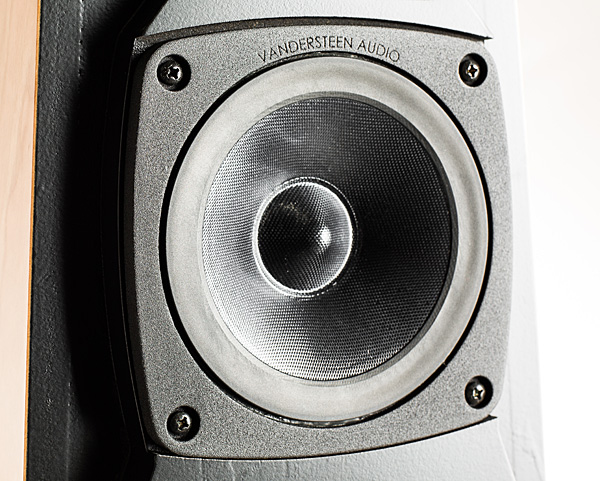 The pink noise track on Editor's Choice sounded uncolored, and the Quatro CTs offered impressive transparency in the midrange and above. The image of Patricia Barber's contralto vocalizing at the beginning of "Secret Love" from Higher, our September 2019 "Recording of the Month" (CD, ArtistShare AS01712), hung between the speakers, nicely separated from Patrick Mulcahy's tumultuous walking, no, running double bass line. And Barber's piano sounded natural, if close.
The more reverberant space around the piano in Rachmaninoff's Variations on a Theme of Corelli, performed by Evelina Vorontsova (16/44.1 ALAC file, ripped from CD, STH Quality Classics CD 1416092), was readily discernible compared with the lighter balance and more forward presentation of the piano in Ingrid Fliter's album of Chopin Nocturnes (24/192 FLAC file, Linn Records CKD 565). The delicate presentation of Simon Trpceski's riveting performance of the first of Brahms's three Intermezzos Op.117 (16/44.1 FLAC, Wigmore Hall Live WHLIVE0081) was presented with convincing clarity. The Quatro Wood CTs dealt well with the low frequencies on the Rachmaninoff piano recording, offering an excellent combination of weight and definition.
As long as I sat exactly equidistant from each loudspeaker, the Vandersteens produced a stable, narrow central image with the dual-mono pink noise track on Editor's Choice. In fact, the Quatro Wood CTs were stereo imaging champs! As I mentioned in my recent obituary of Telarc's late cofounder, recording engineer Jack Renner, I was present for one of the sessions in 1985 for André Previn conducting the Royal Philharmonic Orchestra performing Rachmaninoff's Symphony No.2 in E minor (CD, Telarc 80113). The Quatro Wood CTs took me back into North London's Walthamstow Assembly Hall. Each of the orchestra's instrumental groups was positioned stably and accurately in space, with the brass clearly behind the strings. The images of the solo woodwind instruments in the lyrical third movement, particularly the clarinet and cor anglais, were well-defined but, more importantly, sounded appropriately small compared with the size of the orchestra.
The pink noise track on Editor's Choice sounded uncolored, and the Quatro CTs offered impressive transparency in the midrange and above. The image of Patricia Barber's contralto vocalizing at the beginning of "Secret Love" from Higher, our September 2019 "Recording of the Month" (CD, ArtistShare AS01712), hung between the speakers, nicely separated from Patrick Mulcahy's tumultuous walking, no, running double bass line. And Barber's piano sounded natural, if close.
The more reverberant space around the piano in Rachmaninoff's Variations on a Theme of Corelli, performed by Evelina Vorontsova (16/44.1 ALAC file, ripped from CD, STH Quality Classics CD 1416092), was readily discernible compared with the lighter balance and more forward presentation of the piano in Ingrid Fliter's album of Chopin Nocturnes (24/192 FLAC file, Linn Records CKD 565). The delicate presentation of Simon Trpceski's riveting performance of the first of Brahms's three Intermezzos Op.117 (16/44.1 FLAC, Wigmore Hall Live WHLIVE0081) was presented with convincing clarity. The Quatro Wood CTs dealt well with the low frequencies on the Rachmaninoff piano recording, offering an excellent combination of weight and definition.
As long as I sat exactly equidistant from each loudspeaker, the Vandersteens produced a stable, narrow central image with the dual-mono pink noise track on Editor's Choice. In fact, the Quatro Wood CTs were stereo imaging champs! As I mentioned in my recent obituary of Telarc's late cofounder, recording engineer Jack Renner, I was present for one of the sessions in 1985 for André Previn conducting the Royal Philharmonic Orchestra performing Rachmaninoff's Symphony No.2 in E minor (CD, Telarc 80113). The Quatro Wood CTs took me back into North London's Walthamstow Assembly Hall. Each of the orchestra's instrumental groups was positioned stably and accurately in space, with the brass clearly behind the strings. The images of the solo woodwind instruments in the lyrical third movement, particularly the clarinet and cor anglais, were well-defined but, more importantly, sounded appropriately small compared with the size of the orchestra.
 Rachmaninoff's scoring of this symphony makes use of sustained pedal notes on the low brass and double basses, and these were produced with weight and power by the Vandersteens. I followed the Previn CD with another classical recording currently in heavy rotation chez Atkinson: Vladimir Ashkenazy conducting the Philharmonia Orchestra in Sibelius's Karelia Suite (16/44.1 ALAC file, ripped from CD, London 414 534-2), which was recorded in the same Walthamstow hall around the same time as the Telarc Rachmaninoff by veteran Decca engineer Stan Goodall. Again, the orchestral sound was rich and detailed, though with greater soundstage depth on the brass but less on the solo woodwinds.
Obviously the Quatro Wood CTs love classical orchestral music. What about well-recorded rock? Following the Sibelius, Roon decided I needed to hear "Dazed and Confused" from Led Zeppelin's Celebration Day album, recorded at the band's 2007 tribute concert for Ahmet Ertegun (24/48 FLAC, Atlantic/HDtracks). But "well-recorded" doesn't apply to this album: As much as I love the music, it is a victim of the Loudness Wars. Even so, the Quatros reproduced Jason Bonham's kickdrum and John Paul Jones's bass guitar and keyboard bass lines in full measure, perhaps even more than full measure. I cued up the same track from Led Zeppelin's live album How the West Was Won (24/48 ALAC files ripped from DVD-A, Atlantic 83587-9). Recorded 35 years before Celebration Day, Robert Plant's voice and John Bonham's kickdrum on West have light and shade and dynamics, and the kickdrum has plenty of space around it. And despite the Quatro Wood CT's bass-rich balance, the kickdrum and bass guitar on this album don't interfere with each other.
Amplifiers
Rachmaninoff's scoring of this symphony makes use of sustained pedal notes on the low brass and double basses, and these were produced with weight and power by the Vandersteens. I followed the Previn CD with another classical recording currently in heavy rotation chez Atkinson: Vladimir Ashkenazy conducting the Philharmonia Orchestra in Sibelius's Karelia Suite (16/44.1 ALAC file, ripped from CD, London 414 534-2), which was recorded in the same Walthamstow hall around the same time as the Telarc Rachmaninoff by veteran Decca engineer Stan Goodall. Again, the orchestral sound was rich and detailed, though with greater soundstage depth on the brass but less on the solo woodwinds.
Obviously the Quatro Wood CTs love classical orchestral music. What about well-recorded rock? Following the Sibelius, Roon decided I needed to hear "Dazed and Confused" from Led Zeppelin's Celebration Day album, recorded at the band's 2007 tribute concert for Ahmet Ertegun (24/48 FLAC, Atlantic/HDtracks). But "well-recorded" doesn't apply to this album: As much as I love the music, it is a victim of the Loudness Wars. Even so, the Quatros reproduced Jason Bonham's kickdrum and John Paul Jones's bass guitar and keyboard bass lines in full measure, perhaps even more than full measure. I cued up the same track from Led Zeppelin's live album How the West Was Won (24/48 ALAC files ripped from DVD-A, Atlantic 83587-9). Recorded 35 years before Celebration Day, Robert Plant's voice and John Bonham's kickdrum on West have light and shade and dynamics, and the kickdrum has plenty of space around it. And despite the Quatro Wood CT's bass-rich balance, the kickdrum and bass guitar on this album don't interfere with each other.
Amplifiers
After several weeks auditioning the Quatro Wood CTs with the Vandersteen M5-HPA amplifiers, I switched to my reference Lamm M1.2 Reference monoblocks, which meant using Vandersteen's passive M5-HPB high-pass filters. These have internal DIP switches that can be set for amplifiers having input impedances from 10k ohms to 2M ohms. With the M5-HPB set to "100k," the closest I could get to the Lamm's measured input impedance of 78k ohms, the M1.2's output was down by 3.25dB at 100Hz rather than 3dB, which I didn't think significant. The Lamms played much louder than the Vandersteens due to their 7.3dB higher gain, but once I had adjusted the PS Audio DAC's volume control to account for that, I repeated my auditioning with some of the recordings I mentioned above. The Vandersteen amplifiers had a softer, somewhat darker balance than that of the Lamms. Simon Trpceski's recording of the Brahms Intermezzo had a little more space around the piano with the M1.2s. Stereo imaging was otherwise similar, with well-defined soundstage width and depth. Peculiarly, given that the region below 100Hz is not being handled by either amplifier, the low bass seemed less well-controlled with the Lamms than it had with the Vandersteen amps. That typically "Telarc" bass drum in the big climax around 14:45 in the Previn Rachmaninoff symphony's first movement was a touch too rich with the M1.2s driving the Quatro CTs.
 Overall, I preferred using the Lamm M1.2s with the Vandersteen speakers. However, the differences between the two amplifiers were relatively small and, given that the Lamms currently cost $32,490/pair and need to be used with the $1295/pair Vandersteen high-pass filters, the M5-HPA would still be an excellent choice to use with the Quatro Wood CTs.
Summing up
Overall, I preferred using the Lamm M1.2s with the Vandersteen speakers. However, the differences between the two amplifiers were relatively small and, given that the Lamms currently cost $32,490/pair and need to be used with the $1295/pair Vandersteen high-pass filters, the M5-HPA would still be an excellent choice to use with the Quatro Wood CTs.
Summing up
I very much enjoyed my time with the Vandersteen Quatro CTs, both when they were driven by the Vandersteen M5-HPA amplifiers and by the Lamm M1.2s. This was particularly true with classical orchestral music. I wrote this review during August, when most afternoons I would stream the BBC Proms from the UK with Roon's Internet Radio function. Despite the limited 128kbps bit rate, every afternoon the Quatro Wood CTs opened a clean, wide, deep, detailed window into the acoustic of London's Royal Albert Hall. That's primarily what I want from a pair of loudspeakers—not deep bass (which these Vandersteens do have); not wide dynamics (at which the Wood CTs excel); not clean, uncolored mids and highs (something the Vandersteens readily offer); but a stereo virtual reality engine to connect me with the music I want listen to. On that ground, a pair of Vandersteen's Quatro CTs scores big-time. And at $15,499/pair, they are less expensive than other speakers that do as well in this regard. As for Vandersteen's M5-HPA, this amplifier proved to be a synergistic partner to the Quatro Wood CT. But as its high-pass filter can be set to give a –3dB point as low as 20Hz—equivalent to a measured –1dB at 38Hz— this amplifier could work well with any stand-mounted loudspeakers with a low-frequency cutoff higher than 20Hz. I will examine how the M5-HPA sounds with my reference KEF LS50s and Rogers LS3/5a's in a future issue.
Despite its relatively modest size, the Quatro Wood CT is an almost full-range loudspeaker. The 1/3-octave bass warble tones on my Editor's Choice CD (Stereophile STPH016-2) were produced with good weight down to the 40Hz band, though the 125Hz band was quieter than those at 160Hz and 100Hz and the 80Hz band was too loud, even with the settings chosen by Richard Vandersteen. The 32Hz warble tone was significantly exaggerated by the lowest mode in my room; the 25Hz band was easily audible, but the 20Hz band was quieter. The half-step–spaced tonebursts on Editor's Choice spoke clearly and evenly down to 128Hz but then sounded a little hesitant down to 32Hz.
The pink noise track on Editor's Choice sounded uncolored, and the Quatro CTs offered impressive transparency in the midrange and above. The image of Patricia Barber's contralto vocalizing at the beginning of "Secret Love" from Higher, our September 2019 "Recording of the Month" (CD, ArtistShare AS01712), hung between the speakers, nicely separated from Patrick Mulcahy's tumultuous walking, no, running double bass line. And Barber's piano sounded natural, if close.
Rachmaninoff's scoring of this symphony makes use of sustained pedal notes on the low brass and double basses, and these were produced with weight and power by the Vandersteens. I followed the Previn CD with another classical recording currently in heavy rotation chez Atkinson: Vladimir Ashkenazy conducting the Philharmonia Orchestra in Sibelius's Karelia Suite (16/44.1 ALAC file, ripped from CD, London 414 534-2), which was recorded in the same Walthamstow hall around the same time as the Telarc Rachmaninoff by veteran Decca engineer Stan Goodall. Again, the orchestral sound was rich and detailed, though with greater soundstage depth on the brass but less on the solo woodwinds.
After several weeks auditioning the Quatro Wood CTs with the Vandersteen M5-HPA amplifiers, I switched to my reference Lamm M1.2 Reference monoblocks, which meant using Vandersteen's passive M5-HPB high-pass filters. These have internal DIP switches that can be set for amplifiers having input impedances from 10k ohms to 2M ohms. With the M5-HPB set to "100k," the closest I could get to the Lamm's measured input impedance of 78k ohms, the M1.2's output was down by 3.25dB at 100Hz rather than 3dB, which I didn't think significant. The Lamms played much louder than the Vandersteens due to their 7.3dB higher gain, but once I had adjusted the PS Audio DAC's volume control to account for that, I repeated my auditioning with some of the recordings I mentioned above. The Vandersteen amplifiers had a softer, somewhat darker balance than that of the Lamms. Simon Trpceski's recording of the Brahms Intermezzo had a little more space around the piano with the M1.2s. Stereo imaging was otherwise similar, with well-defined soundstage width and depth. Peculiarly, given that the region below 100Hz is not being handled by either amplifier, the low bass seemed less well-controlled with the Lamms than it had with the Vandersteen amps. That typically "Telarc" bass drum in the big climax around 14:45 in the Previn Rachmaninoff symphony's first movement was a touch too rich with the M1.2s driving the Quatro CTs.
Overall, I preferred using the Lamm M1.2s with the Vandersteen speakers. However, the differences between the two amplifiers were relatively small and, given that the Lamms currently cost $32,490/pair and need to be used with the $1295/pair Vandersteen high-pass filters, the M5-HPA would still be an excellent choice to use with the Quatro Wood CTs.
Summing upI very much enjoyed my time with the Vandersteen Quatro CTs, both when they were driven by the Vandersteen M5-HPA amplifiers and by the Lamm M1.2s. This was particularly true with classical orchestral music. I wrote this review during August, when most afternoons I would stream the BBC Proms from the UK with Roon's Internet Radio function. Despite the limited 128kbps bit rate, every afternoon the Quatro Wood CTs opened a clean, wide, deep, detailed window into the acoustic of London's Royal Albert Hall. That's primarily what I want from a pair of loudspeakers—not deep bass (which these Vandersteens do have); not wide dynamics (at which the Wood CTs excel); not clean, uncolored mids and highs (something the Vandersteens readily offer); but a stereo virtual reality engine to connect me with the music I want listen to. On that ground, a pair of Vandersteen's Quatro CTs scores big-time. And at $15,499/pair, they are less expensive than other speakers that do as well in this regard. As for Vandersteen's M5-HPA, this amplifier proved to be a synergistic partner to the Quatro Wood CT. But as its high-pass filter can be set to give a –3dB point as low as 20Hz—equivalent to a measured –1dB at 38Hz— this amplifier could work well with any stand-mounted loudspeakers with a low-frequency cutoff higher than 20Hz. I will examine how the M5-HPA sounds with my reference KEF LS50s and Rogers LS3/5a's in a future issue.















