Sidebar 3: Measurements
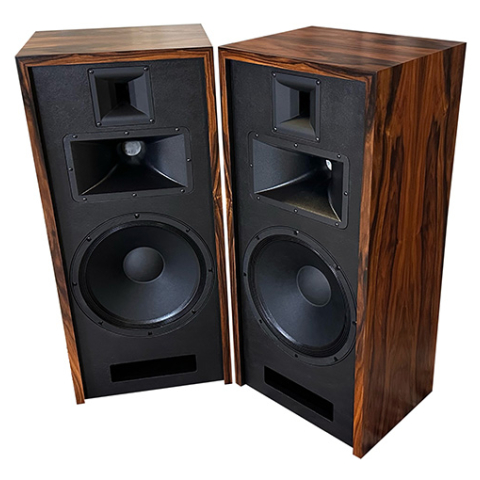
I used DRA Labs' MLSSA system and a calibrated DPA 4006 microphone to measure the Volti Rival's frequency response in the farfield, and an Earthworks QTC-40 for the nearfield responses. (I measured Rival serial no.001.) Before carrying out any measurements, which were performed without the grille, I ensured that all the crossover resistor and capacitor choices on the rear panel were set as recommended in the manual.
The Volti's voltage sensitivity is specified as an unbelievable 100dB/W/m; ie, the Rival will play as loudly when fed 1W as a tiny LS3/5a would when fed 60W (assuming the LS3/5a didn't melt). Nevertheless, my estimate of the Volti's B-weighted voltage sensitivity was close to the specification at 98.2dB/2.83V/m. This is indeed a loud speaker—one of the highest-sensitivity loudspeakers I've measured!
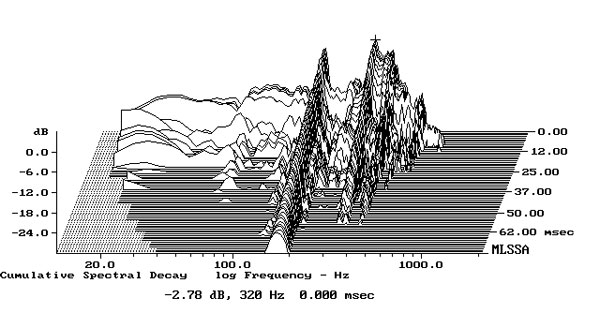
The Rival's plot of impedance magnitude and electrical phase angle against frequency (fig.1) reveals that, other than a dip to 3.26 ohms at 110Hz and a combination of 5 ohms and –50° phase angle at 83Hz, the speaker should be relatively easy to drive. However, a sharply defined discontinuity at 168Hz in both the magnitude and phase traces, and a smaller wrinkle at 320Hz, suggest that cabinet resonances of some kind are present at these frequencies. Testing the behavior of the enclosure's panels with a plastic-tape accelerometer, I found strong resonances at both frequencies at various places, especially on the top panel (fig.2). I would have expected these resonant modes to add congestion and coloration in the lower midrange, but I note that Ken Micallef didn't mention hearing any problems in this region, perhaps due to the Rival's very high sensitivity. (I measure cabinet resonances with a standardized drive voltage, not a standardized sound pressure level.)

 In fig.4, the trace below 300Hz shows the complex sum of the nearfield midrange, woofer, and port responses. While some of the huge peak in the upper bass will be an artifact of the nearfield measurement technique, the Volti's woofer is balanced too high in level to sound natural. Again, this graph indicates that the farfield midrange response is balanced too low in level compared with the bass and treble regions. Predicting the subjective character of this kind of measured response is difficult, as which region the listener takes as a reference will be related to the music played. KM commented that the Rival's bass was "riveting, powerful, and forceful, and as full of tone, texture, and energy, as I've ever heard," and that the high frequencies were "smooth, wide open, and grain-free." I suspect, therefore, that he was referencing his auditioning comments to the bass and treble levels, which is probably why he felt he needed to change the crossover settings from the factory-recommended values.

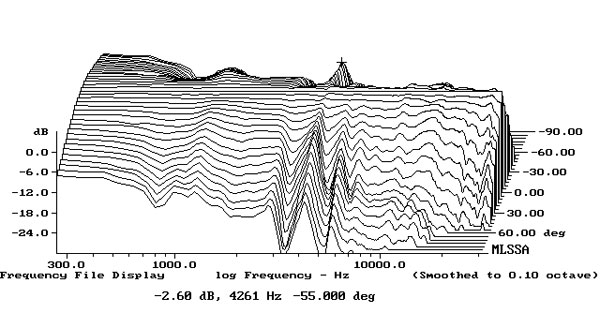


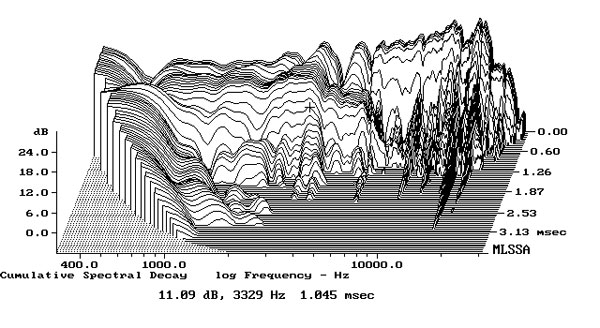
Fig.1 Volti Rival, electrical impedance (solid) and phase (dashed) (5 ohms/vertical div.).
Fig.2 Volti Rival, cumulative spectral-decay plot calculated from output of accelerometer fastened to center of top panel (MLS driving voltage to speaker, 7.55V; measurement bandwidth, 2kHz).
The impedance-magnitude trace (fig.1, solid trace) suggests that the Rival's port resonance is set at 32Hz, and its woofer's output, measured in the nearfield (fig.3, blue trace), indeed has a minimum-motion notch at that frequency (at which the back pressure from the port resonance holds the woofer cone motionless). The port's output (red trace) does peak at 32Hz, but extends higher in frequency than is usually the case, and has strong resonances present at 168 and 320Hz—the frequencies of the discontinuities in the impedance graph—and another at 500Hz. The lower two modes are strong enough to measurably affect the woofer's nearfield response. The woofer itself rolls off rapidly above 450Hz, and its farfield output appears to be set 3–5dB too high in level compared with that of the horn-loaded midrange drive-unit (green trace). The output of the midrange driver rises steadily to the 6kHz crossover point to the horn-loaded tweeter, which then appears to be set too high in level for strict neutrality. (Again, the measurements were performed with the factory-recommended crossover settings.) I suspect that this elevated treble was behind KM's finding the speaker unforgiving of every "pop, tick, and surface-noise goblin on less-than-perfect LPs."
Fig.3 Volti Rival, acoustic crossover on tweeter axis at 50", corrected for microphone response, with nearfield responses of midrange drive-unit (green), woofers (blue), and port (red) respectively plotted in the ratios of the square roots of their radiating areas, below 550, 350, and 800Hz.
Fig.4 Volti Rival, anechoic response on tweeter axis at 50", averaged across 30° horizontal window and corrected for microphone response, with complex sum of nearfield responses plotted below 300Hz (black).
The plot of the Rival's lateral dispersion (fig.5) reveals that the sharply defined suckouts in the mid-treble fill in to the speaker's sides and that the radiation pattern is even, though narrow above 1kHz. In large or well-damped rooms, this will work against the excess top-octave energy on the tweeter axis. In the vertical plane (fig.6), the traces are normalized to the response on the tweeter axis, which is 38" from the floor. Again, the treble suckouts fill in above and below this axis, though more than 5° below the tweeter, a suckout appears in the crossover region between the woofer and midrange.
Fig.5 Volti Rival, lateral response family at 50", normalized to response on tweeter axis, from back to front: differences in response 90–5° off axis, reference response, differences in response 5–90° off axis.
Fig.6 Volti Rival, vertical response family at 50", normalized to response on tweeter axis, from back to front: differences in response 15–5° above axis, reference response, difference in response 5–10° below axis.
The step response on the tweeter axis (fig.7) indicates that all three drive-units are connected in positive acoustic polarity, although, as is usually the case with a horn-loaded speaker with a flat baffle, the output is not time-coincident. The output of the midrange unit arrives at the microphone 0.55 millisecond behind that of the woofer and 0.75ms behind that of the tweeter. The cumulative spectral-decay plot on the same axis (fig.8) is disturbed by ridges of delayed energy at the lower crossover frequency and at 3.3kHz, but is actually cleaner than I expected.
Fig.7 Volti Rival, step response on tweeter axis at 50" (5ms time window, 30kHz bandwidth).
Fig.8 Volti Rival, cumulative spectral-decay plot on tweeter axis at 50" (0.15ms risetime).
Summing up the Volti Rival's measured performance is difficult: Its perceived balance will depend to a greater degree than usual on the listener's choice of music and the size and acoustics of the room. Against those reservations must be balanced the speaker's extraordinarily high sensitivity. I hate it when an audio writer says, "Listen for yourself"—but in the case of the Rival, that's all I can say.—John Atkinson