"Phase 4 stereo can only be described as a marvel of sound, a radically new and dramatically potent concept in the art of high fidelity reproduction . . . it stands for motion and an uncanny sense of spatial realism unapproached by conventional disc standards."
Uh huh. And we have a miraculous vintage tube amp out in the swamps, spanned by the Brooklyn Bridge, that we want to sell you!!!
Phase 4 Stereo, as described above in the liner notes to a newly released boxed set, was introduced by Decca Records and its American subsidiary London Records in 1962 and may have been a sonic bridge too far—at least to most modern ears. It revolved around a huge 20-channel mixing console (expanded early on from its initial 10 tracks) where each channel could be equalized or have reverb added, before being layered onto a four-track tape machine. A combination of Neumann, Telefunken, and Decca-designed and -built mikes were employed. The instrumental forces of Phase 4 were progressively enlarged and engineers got ever more gimmicky. Gain riding was widespread and instruments were spotlighted and moved left and right or backwards and forwards through an enlarged depth of field. The phrase, "kid with a new toy," comes to mind when listening to Phase 4 today. Everything was big and bright and impossible to ignore. It all screamed "We Are Stereo, Hear Us Roar!"
For audiophiles, this was music for testing out speakers or impressing the uninitiated with the ever- evolving miracle of stereo sound. After some initial successes with popular music, most by pianist Ronnie Aldrich, all pop music repertoire suddenly became fair game for a process that one reviewer in High Fidelity magazine said, "comes close to black magic."
The Phase 4 treatment was later applied to orchestral light classical recordings by conductors including Antal Dorati, Leopold Stokowski, and Charles Munch, all of which were assembled in an earlier 2014 boxed set, and remain the subject of much debate to this very day—"too contrived" being the most often heard criticism.
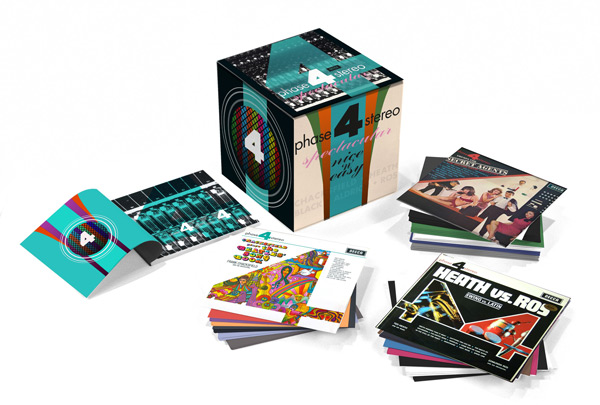
Those initial pop music recordings, however, which sold well and continued being released until 1974, have now been collected in a newly released Universal Music box, Phase 4 Stereo Concert Series which carries the subtitle, "Spectacular, Nice 'N' Easy."
Musically, everything on the popular side of the Phase 4 universe is exactly what most music aficionados mean today when they say (or perhaps hiss) "easy listening." Also known as "mood music," much of it also had a whiff of an Esquivel-like space-age bachelor-padness in its manipulated sound.
Instead of the work of the Boston Pops or the London Symphony Orchestra who appeared on the later Phase 4 classical recordings, the artists here are the aforementioned Aldrich, Mantovani, Stanley Black, Frank Chacksfield, Ted Heath, and Edmundo Ros, to name the most prominent. These "artists," whose names appeared on the spines of these Phase 4 LPs, were sort of hybrid arranger/conductor/envisioners. Most were English and led their own orchestras. It was their vision, often eccentric and tweaky, and the obsessions of series producer Tony D'Amato who adored sweeping motion and shimmering stereo imagery that made these recordings so distinctive and yet such an acquired taste.
Again though, it's easy to see the market for this stuff. If you can transport your ears back in time for a moment, imagine that while the kids were upstairs banging away on their Beatles records—or worse, Led Zeppelin or the Stones—mom and dad, from the Big Band generation who won WWII, were kicking back in the living room, cueing up vaguely-hip-sounding collections like This Way "In" (CD 6) and reveling in the sound of their hi-fi. For those who grew up in the era of 78-rpm discs and mono recording, much of the music in this 40-CD box would sound, at least for a listen or two, like otherworldly sonic wizardry.
Speaking of the Beatles, their songbook, which even Sinatra had to finally break down and mine for material, was obvious catnip for the Phase 4 performers. Chacksfield Plays the Beatles' Song Book (CD 17) is a textbook illustration of the Phase 4 method. " A Hard Day's Night" opens with low brass spotlighted up front playing the melody while an ocean of strings swells in the background. A tambourine, which seems to the most ubiquitous instrument in the entire Phase 4 arsenal of sound, bangs away on the beat throughout the entire piece.
The lush factor increases to Warp 11 on "Norwegian Wood," which opens with a strummed acoustic guitar and flute before embodying the other major trend in Phase 4 popular recordings—massive, string-driven mock pathos. Plucked violins mix with vibraphones and surprisingly raw trumpets before flutes return to play the final notes. Spotlighted tambourines chatter away throughout.
While the Exotic Percussion disc (CD 10), which is all kettle drums, cymbals, harps, and massed wordless vocals, is a fun ride best used to stun non-audiophile civilians and Hair Goes Latin (CD 38) is nearly profound in its weirdness, the best use of Phase 4 may well be film music. Given the fact that film composers have always been able to get away with lush orchestrations and simple, sentimental tunes because the music is meant to accompany a moving image, it is not that big a surprise that Film Spectacular 2 (CD 13) and Film Festival (CD 16), actually work well and are very listenable. The gimmicks somehow fade.
Like its classical predecessor, and most of the Universal Music's classical boxed sets these days, this set is nicely packaged in a square box, with minimal sleeves emblazoned with original artwork and a slick 103- page booklet.
As an illustration of Phase 4 methods here is the Ronnie Aldrich and his Two Pianos version of the theme to the Last Tango In Paris from a collection appropriately titled, Soft & Wicked: