

Janszen Z-600, Z-900, & Z-960 loudspeakers

The Z-600 is the latest of the "console" (as opposed to "bookshelf") systems made by Neshaminy Corp., and using Janszen electrostatic tweeters (footnote 1) and a Neshaminy-designed 11" woofer. The nominal crossover frequency is 1500Hz, with a broad overlap between the woofer's top and the low end of the paralleled tweeters. Tweeter level is not adjustable (footnote 2).
JBL 250Ti loudspeaker
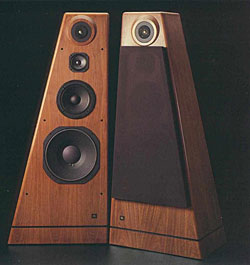 Once upon a time, in audio's infancy, anyone who wanted better than average soundaverage sound during the 1940s being rich, boomy and dullhad no choice but to buy professional loudspeakers. In those days, "professional" meant one of two things: movie-theater speakers or recording-studio speakers. Both were designed, first and foremost, to produce high sound levels, and used horn loading to increase their efficiency and project the sound forwards. They sounded shockingly raw and harsh in the confines of the typical living room.
JBL 4367 Studio Monitor loudspeaker

One day in the mid-1990s, my friend J and I sat sprawled on the carpeted floor of a hi-fi shop in lower Manhattan, playing records. J, who was employed there as a salesperson, had dimmed the lights and locked the door of the listening room behind us to make sure we wouldn't be disturbed by actual customers. Earlier, he had lugged in a pair of homemade speakers that an elderly woman brought to the store, hoping to sell some of her late husband's gear.
JBL Stage A170 loudspeaker

In the realm of loudspeaker reviews, John Atkinson's measurements and my empirical observations have one important equivalency: Both are meaningless abstractions until confirmed by your listening experience.
Both are contingent on factors that are necessarily obtuse and not especially controllable.
JBL Studio L880 loudspeaker
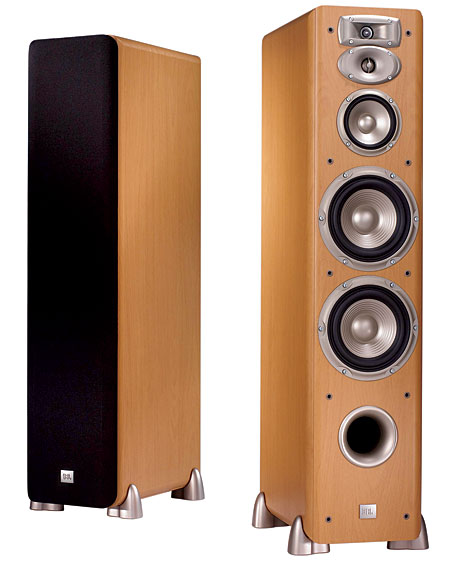
When I reviewedhttp://www.stereophile.com/standloudspeakers/365">reviewed; JBL's S38 loudspeaker for the June 2001 issue of Stereophile (Vol.24 No.6), I was impressed with the performance of this large, inexpensive ($599/pair) bookshelf speaker. When I received a press announcement at the end of 2005 announcing JBL's new affordable speakers, the Studio L series, which incorporates innovations developed for JBL's recording-studio monitors, I began a discussion with JBL's public-relations firm. They promised many significant design innovations and sonic improvements over the S series.
JBL Synthesis 1400 Array BG loudspeaker

JBL was founded 60 years ago, by Jim Lansing. Its history has been amply detailed in the book The JBL Story: 60 Years of Audio Innovation, by the late John">http://www.stereophile.com/news/052107eargle">John Eargle's (JBL Professional, 2006). Although it is primarily known for its pro-audio loudspeakers, the Californian company has offered a steady stream of high-performance domestic loudspeakers to the home market, including the 1971 Paragon, the L100 bookshelf speaker, and the JBL 250Ti floorstander, all of which remained in JBL's catalog for 20 years. In 1990, JBL produced the Project K2 S9500 flagship speaker for the Japanese high-end market. The K2 Project culminated in the $60,000/pair DD55000">http://blog.stereophile.com/ces2007/010907mikeyjbl">DD55000 Everest system, with its cross-firing asymmetric horns, and the subject of this review, the Synthesis 1400 Array BG, was a spin-off from the K2 project. It features horn-loaded midrange and tweeters to attain a flat response out to a claimed 48kHz.
JBL XPL-160 loudspeaker
 A visiting manufacturer recently told us here at Stereophile of an ongoing informal "survey" he was conducting. He would ask strangers to name three brands of loudspeakers. Their responses were not what I would have expected. They almost invariably named Japanese companiestwo of the most commonly mentioned were Hitachi and Panasonic. Other than my spell-checker insisting that I change "Hitachi" to "hibachi," I have nothing in particular against these two manufacturers; they are well-recognized in many product categories. But loudspeakers? I can only guess that the respondents were dredging up the only consumer electronics companies that came readily to mind.
My list for most recognized loudspeaker brands would most certainly have included JBL. How could it not? They have been involved in home high-fidelity since 1954. And for years before that in professional audioprimarily motion picture theater sound, a field in which they are still active. In short, they were around before there was such a thing as "hi-fi."
A visiting manufacturer recently told us here at Stereophile of an ongoing informal "survey" he was conducting. He would ask strangers to name three brands of loudspeakers. Their responses were not what I would have expected. They almost invariably named Japanese companiestwo of the most commonly mentioned were Hitachi and Panasonic. Other than my spell-checker insisting that I change "Hitachi" to "hibachi," I have nothing in particular against these two manufacturers; they are well-recognized in many product categories. But loudspeakers? I can only guess that the respondents were dredging up the only consumer electronics companies that came readily to mind.
My list for most recognized loudspeaker brands would most certainly have included JBL. How could it not? They have been involved in home high-fidelity since 1954. And for years before that in professional audioprimarily motion picture theater sound, a field in which they are still active. In short, they were around before there was such a thing as "hi-fi."JMlab Mezzo Utopia loudspeaker

Loudspeakers are all about balancing conflicting variables: accepting that you can't have electrostatic transparency and horn dynamics; finding something to suit the size of your room and credit rating; and picking the best all-around compromise to suit your particular taste. Goldilocks had the right attitude for loudspeaker reviewing. All that too-soft/too-hard, too-hot/too-cold merely sets the scene; "just right" goes straight to the heart of the matter.
JMlab Utopia loudspeaker

I first met Jacques">http://www.stereophile.com//interviews/274/">Jacques Mahul (the JM in JMlab/Focal) when my wife Kathleen and I traveled to Paris to cover HiFi (Hee-Fee) '96. The sound produced by the JMlab Grand Utopias—on a collection of many-chassis'd YBA electronics—got my enthusiastic vote for best of show (footnote 1). JMlab's large demo room was always packed to the rafters with avid listeners. (As a group, melomanes, as audiophiles are called in France, exactly mirror their stateside brethren in appearance and general demeanor. Yes, they're a raucous and demanding bunch!)
Joseph Audio Perspective loudspeaker
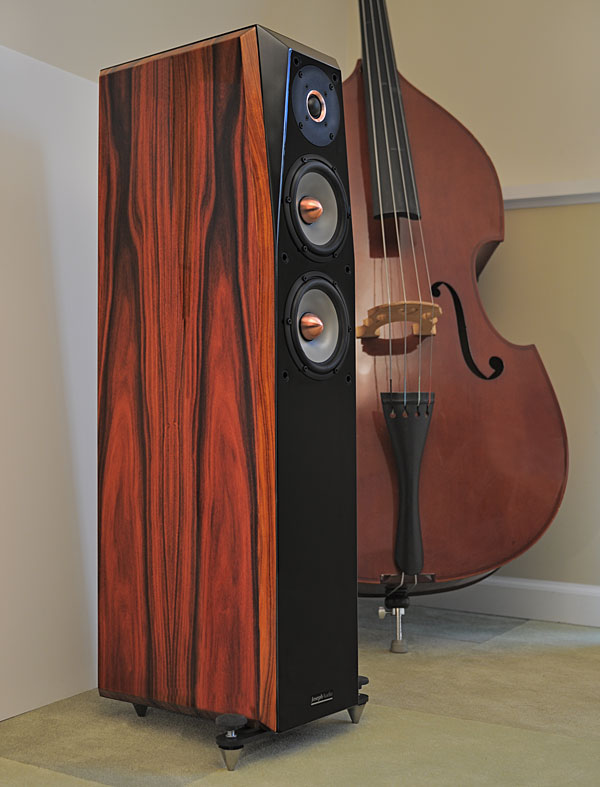
For exhibitors, showing off their products at audio shows is a crap shoot. The vagaries of arbitrarily assigned hotel rooms with unpredictable acoustics can play havoc with the sound of even the best-sounding systems. But over the years I've been attending shows, Joseph Audio's dems have always impressed me with how Jeff Joseph manages to set up his speakers so that they work with instead of against a hotel room's acoustics. Yes, Joseph's setup skills, going back to his days in audio retail, play an important role here. But his speakers, too, need to be of sufficiently high quality to benefit from those skills. And if they can be made to sing in a hotel room, they will also stand a better-than-usual chance of doing so in audiophiles' homes.