

Energy Connoisseur C-2 loudspeaker

Reality check number one. Tired of reading about the latest and greatest $65,000 loudspeakers? Or even the current hot ticket at $2500? Such loudspeakers promise to bring you the audio truth, or the golly-gee-whiz, honest-to-gosh, absolutely positively real sound. And some of them do seem to come awfully close, though truth be told, we're still a long way from replicating reality—and will never do it with just two channels.
Energy Connoisseur CB-10 loudspeaker
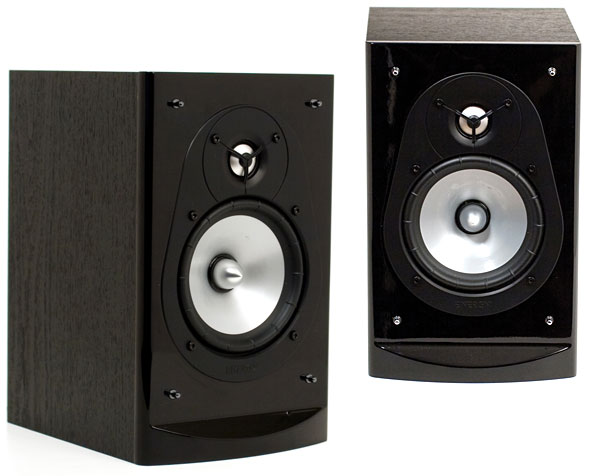
The two-way Energy CB-10 ($269.99/pair) is a bass-reflex design. A large rear-firing port has an internal diameter of 2" and flares out to 2.75". The speaker uses a 1" aluminum-dome tweeter and a 5.5" woofer with a ribbed elliptical surround, the latter said to increase excursion, decrease distortion, and create a larger piston area for greater efficiency, making the CB-10 an easy match for amplifiers. The CB-10's frequency range is listed as 66Hz20kHz, its in-room sensitivity as 90dB, and its nominal impedance as 8 ohms. In Energy's Convergent Source Module design, the tweeter and woofer are meant to act as a coincident source working together to provide wide bandwidth, constant dispersion, and a flat frequency response. In theory, this would all add up to easy setup and satisfying listening from anywhere in the room.
Epos Elan 10 loudspeaker

I've long kept an eye on Michael Creek's loudspeakers (Epos) and electronics (Creek). He's always moving forward, with either updates of current designs or a revamp of an entire product line. And though I've found that many of his new-product ideas tend to feature evolutionary rather than revolutionary sonic improvements, I've found that they always represent excellent sound quality for the dollar in an increasingly competitive marketplace.
Epos ELS-3 loudspeaker
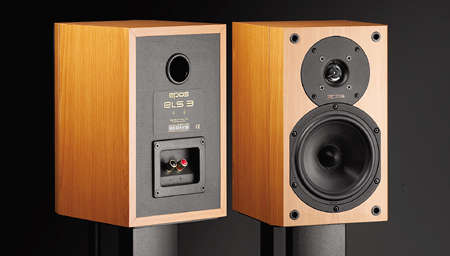
Roy Hall, of Music Hall, US distributor of the Creek and Epos brands, called me one day a few years back. He was hawking review samples of Epos speakers.
Epos Epic 2 loudspeaker

Roy Hall has his famous Music Hall MMF (Make Money Fast) turntables made for him in the Czech Republic.
Roy has also long been associated with Epos Limited, since a chap named Robin Marshall started the company in 1983. Their first product was the ES-14 loudspeaker, followed by the smaller ES-11. Both were largish, stand-mounted models, and both offered a lively, expressive, unstuffy sound. The speakers have always been fun to listen to, even if they lackedand still lackthe refinement of some far more expensive speakers.
Epos ES 14 loudspeaker

Americans might be forgiven if they haven't heard of Epos. A small, British specialist loudspeaker manufacturer, it was founded in 1983 by its designer, Robin Marshall—an ex-BBC engineer and a onetime consultant to Monitor Audio, according to Roy Hall of Epos's US importer, Music Hall. Their first model, the ES 20, didn't make it to the US, and was apparently a bit too pricey in the UK to make much of a splash there (about £700, $1300 at the current rate of exchange—a mint in a country with the patent on sub-$500/pair (UK prices!) two-ways). In 1986 or thereabouts, the new, smaller ES 14 was introduced, using updated versions of the same drivers in a smaller, ported cabinet. Music Hall only recently began importing the Epos into the US.
Epos ES12 loudspeaker
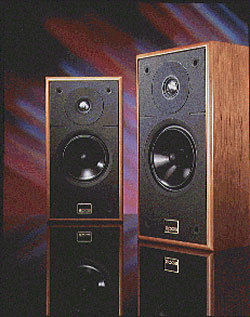
Blind loudspeaker listening tests are hard work, not least because usually, most of the models being auditioned fail to light any musical sparks. But back in the spring of 1991, when a small group of Stereophile writers were doing blind tests for a group speaker review, one speaker did light up smiles on the listeners' faces, including my own. (We don't talk during our blind tests, but it's more difficult to keep body language in check.) Once the results were in, we learned that the speaker that got the music right in that test was the diminutive ES11 from Epos in England (footnote 1).
Epos M5 loudspeaker

Following my favorable experience with Epos Ltd.'s entry-level loudspeaker, the ELS-3 ($329/pair; see my January">http://www.stereophile.com/loudspeakerreviews/104epos">January 2004 review), Roy Hall, of importer Music Hall, called me with some excitement about the new Epos M5 ($650/pair). In a crowded room at the Home Entertainment 2004 show in New York, I did a quick comparison of the M5 and ELS-3 under suboptimal conditions of multiple speakers in the room and Roy answering consumers' questions while pouring scotch for his dealers. Still, I was able to hear enough from the M5 to intrigue me, and with high expectations, I asked for a pair for review.
Epos M5i loudspeaker
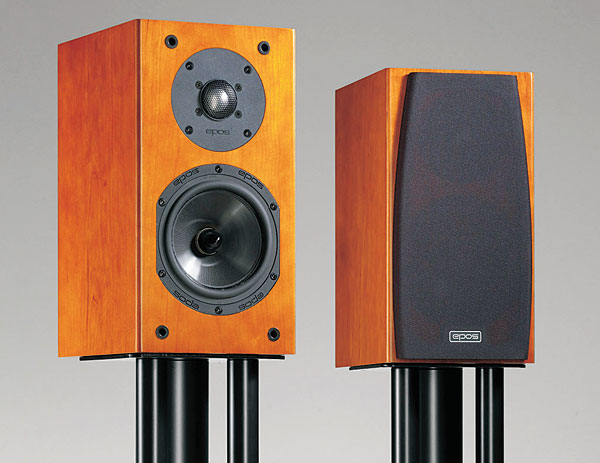
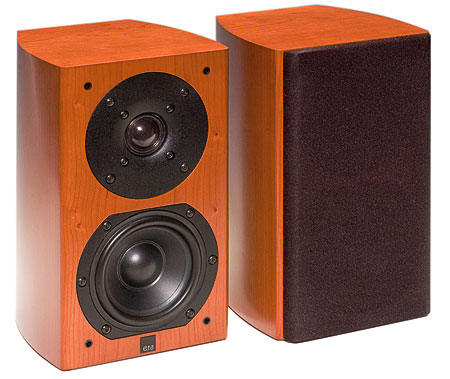
The M5i, basically a two-way bookshelf version of the 21½-way M16i, has the same tweeter, woofer, and footprint as the larger model, less its larger cabinet and second mid/woofer, and incorporates all of the i-series updates included in the M16i. The speakers look very similar; like the M16i, the M5i is available in gorgeous cherry veneer or basic black. The price ($899/pair) is $249/pair higher than the original M5. I placed the M5is on Epos's dedicated stands.
Era Acoustics Design 4 loudspeaker & SUB10 subwoofer
The first time I attended the Las Vegas Consumer Electronics Show, in January 1986, I didn't get there until the second day of the Show. Still, by the beginning of the fourth and final day I'd managed to visit every high-end audio exhibit, and still had time to go back for seconds to the rooms that had sounded the best. Twenty years later, CES has grown so much that it's impossible for a single writer to visit even a quarter of the exhibits in which he might be interested. And even with the sort of team">http://blog.stereophile.com/ces2007/">team reporting Stereophile now practices, covering the Show has become an exercise in applied logistics for the busy journalist: "Should I wait for the free shuttle bus? Should I get a taxi—though I might get caught in Las Vegas's increasing traffic jams, or even just get stuck at the city's interminable traffic lights? Or should I take the new monorail—though that goes nowhere near the hotel in which [insert name of hot company] is demming its products?"