

Franco Serblin Accordo Goldberg loudspeaker
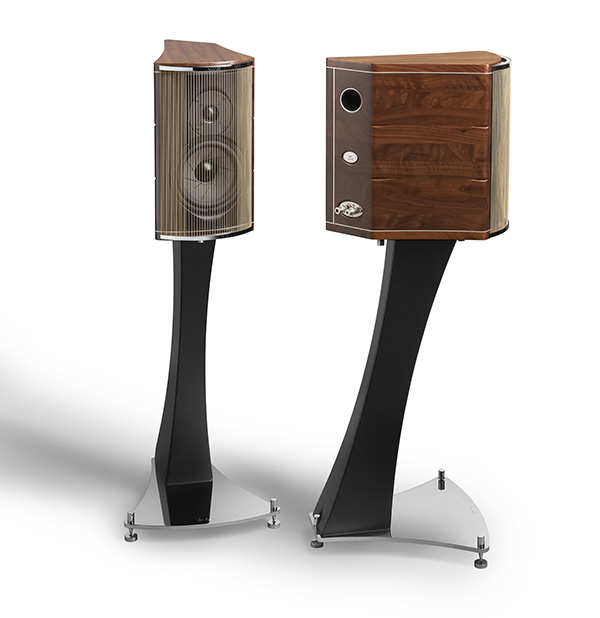
As founder and chief designer of Sonus Faber, Franco Serblin designed and manufactured many loudspeakers of acclaimed high quality, mainly in box form. Nevertheless, he remained painfully aware that such conventional rectangular parallelepiped constructions inevitably possessed an inherent and hard-to-suppress resonant signature characteristic of box-form cabinetry, significantly differing from that for a musical instrument. Franco had long obsessed over the sound and construction of classical string instruments, violins, violas, and cellos made by grand masters over centuries. He valued highly those richly resonant, expressive, complex sonic signatures.
Fried Compact 7 loudspeaker

Fried Products Corporation's Compact 7 is a two-way, standmounted loudspeaker with a 1" ring-radiator tweeter and a 7" woven glass-fiber–coned mid-woofer in a "line tunnel" enclosure. Its cabinet is substantial and well made, with handsome real-wood veneers. The speakers come in mirror-imaged pairs, the tweeters offset toward the inside. The Compact 7 is unusual in that its mid-woofer is above its tweeter, which is likely related to the line-tunnel bass loading. Fried insists that the speakers be placed at least 28" above the floor, which dictate I followed.
Fried Q/4 loudspeaker

During the late 1970s and early '80s, I worked my way through college by selling hi-fi, or more precisely, mid-fi. During those years, I heard and sold several hundred different loudspeakers costing under $1000/pair. Despite the fact that I experienced them under less than ideal conditions, I was nevertheless able to get a feel for their relative performance. When switching between speakers, the differences between them were drastically juxtaposed. No two loudspeakers sounded even remotely similar tonally, indicating that they all had severe colorations.
Fujitsu Ten Eclipse TD712z loudspeaker

All right, it's time for a pop quiz in Loudspeaker Design 101. Answer the following, and justify your answer.
Fulton Musical Industries Model 80 & "J-Modular" loudspeakers

In the last issue we published a rather enthusiastic "Quickie" report on a small, $190/pair speaker system from a new company—the FMI Model 80. It was virtually devoid of low end, even as a stereo pair (pairing effectively doubles bass output), and slightly rough as well as a shade soft at the high end, but it had a quality of "aliveness" to it that almost defied belief. Was it a breakthrough in design? A new transducing principle? No, it was neither. In fact, the Model 80 looks like any one of those hundreds of little bookshelf systems that clutter, the pages of Stereo Review's "Hi-Fi Directory" in tedious profusion.
Fyne Audio F301 loudspeaker

Located outside Glasgow, in a geographical area that's also home to Linn Products and Tannoy Ltd.and also near the storied whisky distilleries of Aberfeldy and Blair AthollFyne Audio got off to a fast start. A mere three years after the company's 2017 founding, Fyne already has distribution deals in 50 countries and offers 24 products in seven series.
Fyne Audio F500SP loudspeaker
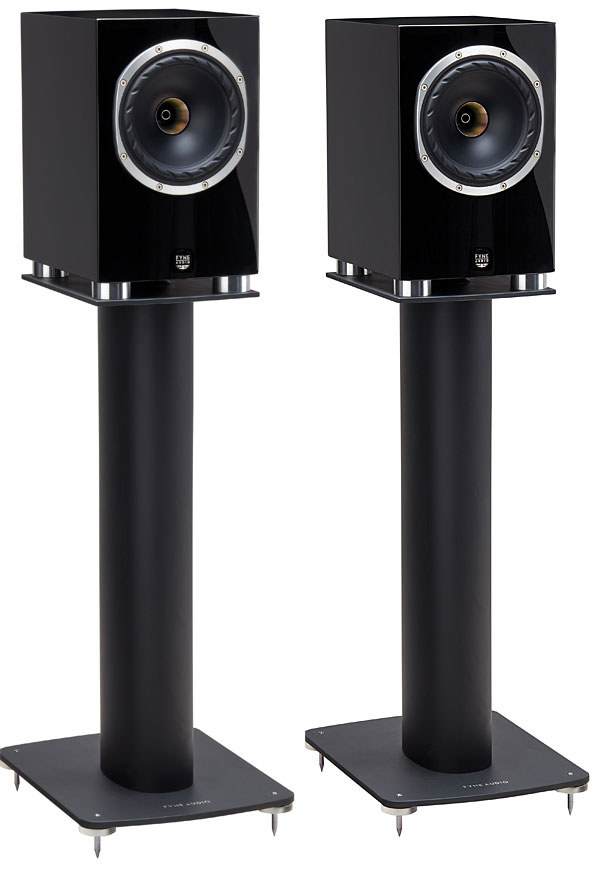
In my April 2020 review of Fyne Audio's inexpensive F301 standmount loudspeakers, I wrote, "The Fyne F301s impressed with their exceptional rendering of soundstage width and depth, reasonably wide dynamic range, extended low end (for their size), and exuberant, I-can't-stop-spinning-records presentation. The Fynes presented a finely layered, spatially convincing soundstage with images that were solid, if small."
Gale GS402 loudspeaker
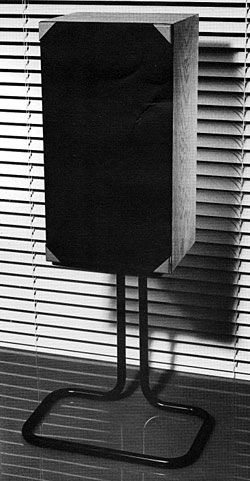 The Gale loudspeaker dates back to the early 1970s. As I understand it, the basic design resulted from a collaboration of Ira Gale and Sao Win, who were college classmates at the time. Their speaker proved very popular in England and was subsequently imported to the USA during the mid-1970s by Audio Technica. Recently, Techport (the folks who import the Perreaux line) has taken over US distribution.
While the Gales have undergone same changes through the years, their distinctive appearance and, according to some, their equally distinctive sonic "flavor," have continued to earn the respect of critical listeners all over the world. Nonetheless, these speakers have also sustained their fair share of criticism; not everybody likes them. This sort of continuing disagreement usually means that what is at issue is a "different" kind of sounda product that sounds quite unlike others, yet somehow offers a high enough degree of musical satisfaction to appeal to a lot of serious audiophiles. Of such products are cults made.
The Gale loudspeaker dates back to the early 1970s. As I understand it, the basic design resulted from a collaboration of Ira Gale and Sao Win, who were college classmates at the time. Their speaker proved very popular in England and was subsequently imported to the USA during the mid-1970s by Audio Technica. Recently, Techport (the folks who import the Perreaux line) has taken over US distribution.
While the Gales have undergone same changes through the years, their distinctive appearance and, according to some, their equally distinctive sonic "flavor," have continued to earn the respect of critical listeners all over the world. Nonetheless, these speakers have also sustained their fair share of criticism; not everybody likes them. This sort of continuing disagreement usually means that what is at issue is a "different" kind of sounda product that sounds quite unlike others, yet somehow offers a high enough degree of musical satisfaction to appeal to a lot of serious audiophiles. Of such products are cults made.Genelec G Three active loudspeaker

My review samples of Genelec's G Three powered loudspeaker came with a little hand-sized green and tan cardboard card featuring a poem in bold black letters dated 1898:
At the cottage window a little bird sang.
And the light of the window did flicker.
And look. The roof up it sprang and the cottage became a house bigger.
Look. Into a world the cottage grew and the vast and wide too and filled with song was the air and like new was the sun's flare.
And the light of the window did flicker.
And look. The roof up it sprang and the cottage became a house bigger.
Look. Into a world the cottage grew and the vast and wide too and filled with song was the air and like new was the sun's flare.
Genelec Studio Monitor 1031A loudspeaker & Studio Monitor 1092A powered subwoofer

Which loudspeakers do audio professionals listen to? And why should we care? After all, it's not as if recording engineers are the kind of refined, sensitive, music-loving types who read Stereophile. As much as they may love music, many audio pros appear only to view the original sounds of musical instruments as raw materials to be creatively reshaped and manipulated. (Okay, there are exceptions. But recordists who care about the sounds of real instruments usually record them in real acoustic spaces rather than in studios, and use as little signal processing as they can get away with.)