

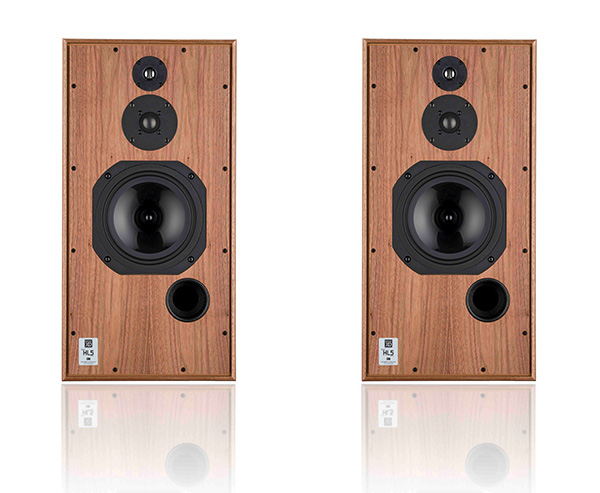
Harbeth Super HL5plus XD loudspeaker
What Were Once Vices Are Now Habitsthe 1974 album by those San Jose yacht-rock sages the Doobie Brotherscould also describe an audiophile's life.
The journey begins with booze and bong money spent instead on an entry-level turntable and cartridge; it did for me anyway. Then starts the churn, through many components and configurations seeking that elusive, blissful audio fix until finally we find our audio oasis, our own sonic peace, our gearhead nirvana. We achieve a system that satisfies our listening indulgences, whether it be based on streaming or spinning, class-D or tubes, with Belden wire or 0.999999% pure-silver single-strand wire that costs more than a Range Rover. It doesn't last.
In Praise of a Classic: the BBC LS3/5A

If there's one article in Stereophile that generated more reader response than any other, it was Peter Breuninger's review of the classic Fisher 500-C tubed receiver in June 2005. Peter reviewed another classic component from the 1960s, the Bozak B-410 Concert Grand loudspeaker; my involvement in the review, in the October 2005 issue, brought home to me with a vengeance how much the science of speaker design has evolved in the 40 years since this armoire-sized model was introduced.
Infinity Intermezzo 2.6 loudspeaker

You can bet Infinity plans on selling a respectable number of $8000/pair Prelude">http://www.stereophile.com//loudspeakerreviews/295/">Prelude MTS speakers (reviewed in the May 2000 Stereophile) over this ambitious, full-range design's anticipated lifespan. But will the company make enough money to recoup the megabucks spent on researching, designing, and developing the all-new CMMD (Ceramic Metal Matrix Diaphragm) drivers, BASH (Bridge Amplifier Switching Hybrid) powered subwoofer, and RABOS (Room Adaptive Bass Optimization System) bass-equalization system? NOWAY (Never Over-Estimate What Acronyms Yield).
Infinity Modulus loudspeaker & Modulus subwoofer
As much as I'm tempted by the impressive sweep and scale with which some of the large, full-range loudspeakers endow music, for some reason I find myself more at home with more compact examples of the breed. This is not through lack of familiarity with large speakers, a pair of B&W">http://www.stereophile.com/floorloudspeakers/506">B&W Matrix 801s occupying pride of place in our living room (which also serves as my wife's listening room). Yet I find myself hankering after that ultimate soundstage precision that only minimonitors seem capable of producing: the loudspeakers totally disappearing, vocal and instrumental images hanging in space, truly solid—the prefix "stereo-" is derived from the Greek word stereos, which means solid—so that a rectangular, totally transparent window into the concert hall opens at the rear of your room. In addition, the necessarily limited low-frequency extension offered by small speakers makes it much easier to get the optimum integration with the room acoustics below 100Hz.
Infinity Primus 150 loudspeaker
It was 20 years ago that I began audio reviewing as a second career. It was also 20 years ago that I made my first very expensive audio purchase: a pair of Infinity RS-1b speakers. The RS-1b was a landmark speaker in its day, and very costly for the time at $5500/pair. (I think my dentist has just spent more than that on a TV.) In retrospect, the RS-1b was an extraordinary value. With four large towers, more than 30 drivers, and a servo network and a passive crossover, the Infinity RS-1b resolved a significant amount of detail, was capable of large dynamic swings, had pinpoint image specificity on a wide, deep soundstage, and was capable of reproducing a convincing bottom octave in the right room when paired with the right associated equipment. Its main weaknesses were a relative lack of coherence due to its use of three different types of drivers to cover the various frequency ranges, and both the midrange/tweeter towers and woofer columns were picky about amplifier matching.
Infinity Primus P162 loudspeaker

Home">http://blog.stereophile.com/he2007">Home Entertainment 2007 was a blast for me, as it is every year. Not only did I get to perform with two jazz bands, Attention">http://www.stereophile.com/musicrecordings/907att">Attention Screen and the John Atkinson Trio, but I enjoyed good to extraordinary sound in every room I visited. I've been attending hi-fi shows more than 20 years, so I'm rarely surprised, but HE2007 had two big surprises in store. First, the percentage of rooms sporting analog front-ends—vinyl and open-reel tape—was the highest I've seen at a show in over a decade. Second, there was a surprising number of very expensive loudspeakers. In fact, I counted more speakers costing over $50,000/pair than I did costing under $500/pair.
JBL 18Ti loudspeaker

Introduced in 1985 as the smallest model in JBL's "Ti" range, the 18Ti ($590/pair) shares with its larger siblings, like the JBL 250ti (recently reviewed by J. Gordon Holt), a high-tech tweeter that uses a one-piece ribbed titanium-foil dome/surround just 25µm thick. This is both rigid and of very low mass, pushing its first-breakup mode up to the region of 30kHz. The tweeter is mounted above the polypropylene-cone woofer, offset a little to one side to make room for the 45mm diameter port (though the speakers are not supplied as a handed pair). The 10-liter internal volume box is well-constructed from 20mm chipboard, covered in real-wood veneer.
JBL 4329P active loudspeaker

Hi-fi is at a crossroads. One road takes us toward modernized versions of the gear we grew up with, stuff that has been around since the 1950s. The other road faces the future. While sometimes accommodating physical media, including vinyl records, that's not where that road leads. On that road, streaming is the norm, and equipment may be hooked up with traditional signal cables or with no cables at all, just GHz-range electromagnetic radiation, the digital kind. In the more extreme cases, the music may remain digital all the way to the amplifiers, which themselves are likely to be class-D.
I keep a foot on both paths, hoping they don't diverge so much that they split me in two. I've got a substantial collection of physical discs, black and silver, and I play them often. But I love the convenience of my network-attached storage (NAS) appliance, Qobuz, even lossy Spotify, especially when I want my world filled with music for hours with no thought or action on my part.
JBL S38 loudspeaker
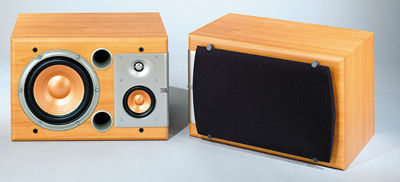
JBL speakers remind me of college.
Jean-Marie Reynaud Twin Mk.III loudspeaker

I love dealing with the colorful characters of high-end audio. One such individual is Victor (Veekh-tor) Goldstein, who has distributed high-quality European audio gear from his New York City headquarters, Fanfare International, for 23 years. A nuclear engineer by training, Goldstein transitioned into audio when the Three Mile Island incident reduced the demand for his services. (I guess he felt his skills were transferable to single-ended triode amplifiers.) Most of all, Goldstein is a passionate lover of music with a vinyl collection that numbers well into five figures, and a fixture at many of the significant classical performances at New York's major concert halls.