

KEF RDM Two loudspeaker
Stereophile is, in one sense, like a family—us younguns have to make do sometimes because the house is straining at the seams. When I first arrived in Santa Fe, for instance, I was told not to come to the office for a few days—the good news, John Atkinson informed me, was that I had a desk; the bad news was that nobody had a clue where to put it. The dilemma was solved in Solomon-like fashion by shoehorning my desk into the "listening room," which was already serving double-duty as audition space and speaker-measurement lab. If manufacturers visited, we'd sweep up all the acoustic damping from the floor and stash it in JA's office; and if JA needed to take measurements, I would be asked to work at home. It was a manifestly fair solution: inconvenient for everyone involved.
KEF Reference 201/2 loudspeaker

In the waning days of 2007, I delivered some small audio doohickey to John Atkinson one weekend afternoon. "Come down to the listening room," he said. "I want you to hear something."
Kii Audio SEVEN active loudspeaker system
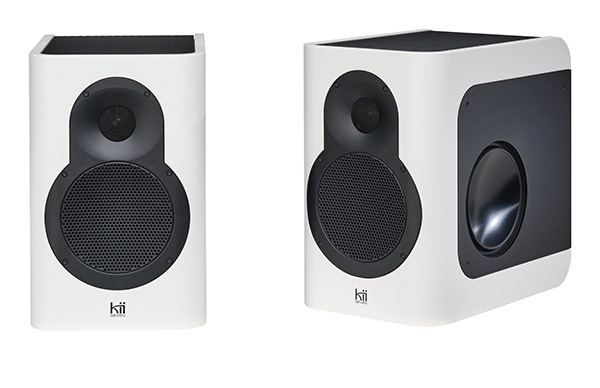
I reviewed the Kii THREE digital active loudspeaker in the September 2017 issue of Stereophile and was totally smitten. It was cutting edge in supporting analog and digital sources, direct-wired and network connections, and streaming.
Kii Audio Three loudspeaker

At the risk of offending nearly every designer and manufacturer of loudspeakers, I think we have not seen anything really new in a long time. Casting a gimlet eye at Stereophile's "Recommended Components" reveals some electrostatic and planar-magnetic models, a few horns, and lots and lots of cones and domes in boxes. Those cones and domes have voice-coils inductively driven by permanent magnets, and overwhelmingly use passive crossovers. Innovation in speakers mostly takes the form of advancements in materials science and, to a much lesser degree, cabinet shape. All helpful, but not revolutionary.
Kirksaeter Silverline 60 loudspeaker
One of the nicest surprises at any audio show is encountering a new—to me, at least—manufacturer whose products seem to stand out from the competition. At the 2002 Consumer Electronics Show, one such standout was the Kirksaeter line of loudspeakers from Germany. I spent quite a few minutes listening to and enjoying the performance of these modestly sized and priced speakers, but since my writing assignment was electronics, I tucked the experience away in the back of my mind and moved on.
KLH Model Five loudspeaker

In May of 2019, I heard about a promising jazz vinyl and hi-fi estate sale happening on New York's Upper East Side. Little did I know then what treasures the dig would yield.
Jazz Record Center's Fred Cohen had called from the UES apartment, the former residence of late CBS Records and Sony Entertainment mastering engineer Harry N. Fein. Fred said, "The records are kind of beat, but the apartment is jammed with tape decks, turntables, cartridges, tubes, midcentury modern furnitureget up here."
KLH Model Three loudspeaker

"Dear audio enthusiast." Those were the user manual's introductory words, not "Dear audiophile." I stared at them for a few seconds, letting the implication of that greeting sink in. I don't know if it was meant this wayperhaps notbut for me, this was a whistle call announcing that the KLH Model Three ($1799.98/pair) was not intended for those obsessed with having the best at all costs; it was meant for people who dig quality sound, period. It was also meant for people who dig that vintage-American-speaker look.
Klipsch Palladium P-17B loudspeaker

Every audiophile is born sometime, somewhere. My audio birth happened on a family visit to my Uncle John's house, when he played Information Society's "What's On Your Mind (Pure Energy)" through his brand-new Klipsch Heresy IIs. Uncle John did three things at this listening session that turned 12-year-old me into the audiophile I am today: he played music I liked, he played it really loud, and afterward, he took the time to explain how his system worked and why it sounded so good. His Klipsches were powered by Nelson Pass–influenced Nakamichi gear—I'd never before heard speakers play music with such ease or such startling dynamics. I was immediately hooked. In many ways, nothing I've heard since that day has impressed me as much, or been as revelatory of what home audio can do. That single experience set me on a path of caring about re-creating musical performances in my own home.
Klipsch RB-15 loudspeaker

Bob Reina has been doing more than his share of reviewing inexpensive speakers in the past couple of years. I thought it only fair to shoulder some of the load, therefore, by reviewing a small design that had sounded interesting when I heard it at a press preview, the Klipsch RB-15.
Klipsch Reference Premiere RP-600M loudspeaker

If you've ever dipped your toe into some form of high-performance motor sport, you know: The best race-car engines spin torque and exhale horsepowerwith intoxicating ease. They're engineered to be responsive. Depress the clutch, toe the throttle, and watch the tachometer instantly pin itself. Engage the clutchyour chest contracts and your head gets light. Then later . . .
Back in your Ford Fiesta, its revving engine sounds distant, muffled. Your body can't feel the powerplant's power. In gear, the Ford feels soft and hesitant, not responsive.