

McIntosh ML1 MkII loudspeaker
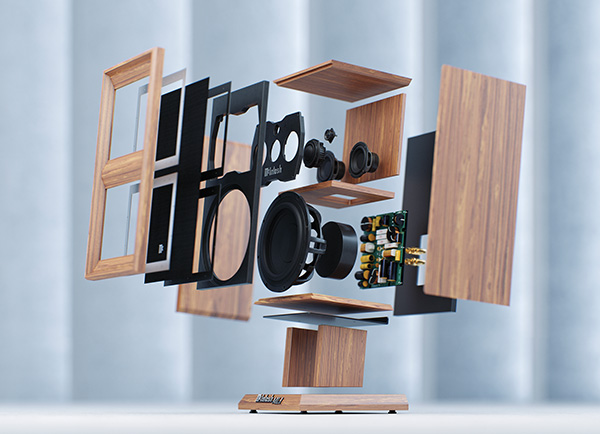
What was old is new again. McIntosh Laboratories has been in business long enough that they are able to bring new design thinking, materials, and construction methods to products from their extensive back catalog. Example: McIntosh's first successful loudspeaker, the ML1. The venerable Binghamton, New York, hi-fi company recently released a redesigned "Mk II" version ($12,000/pair, stands included).
In this, McIntosh is not unique; KLH, JBL, Klipsch, and other companies have rethought and reworked vintage products for the current marketplace, employing new approaches and technologies. Think of it as remastering classic hardware.
Mirage MRM-1 loudspeaker
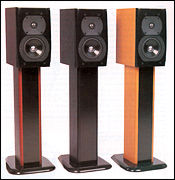
The Mirage OM-6 loudspeaker, from Canadian manufacturer Audio Products International, mightily impressed Stereophile's Tom Norton when he reviewed it back in November 1997. But with its "omnipolar" design and powered woofer, the OM-6 wasn't a speaker for those of us with more conventional tastes in speaker design. So when I heard that Mirage's Ian Paisley was working on a high-performance two-way minimonitor based on the OM-6's drive-unit technology, I asked API's affable PR man, Jeff Percy, for review samples.
Mission 770 loudspeaker

Some audio experiences stick in your memory. For me, one such was in 1978, which I reminisced about in a 1987 review for Stereophile of the Mission PCM 7000 CD player, Mission 780 Argonaut loudspeaker, and Cyrus Two integrated amplifier. Mission founder Farad Azima (footnote 1) was a driving force in the UK audio scene in the late 1970s, when I was deputy editor of the English magazine Hi-Fi News & Record Review.
Mission Cyrus 782 loudspeaker
 Cyrus is the name given to the higher-priced line of loudspeakers made by England's Mission Electronics. The entire Mission loudspeaker line includes six products under the Mission label and three under Cyrus. Mission also manufactures a wide range of electronics and CD players. The company has a long history of audio innovations, both in loudspeaker and electronic design. Among Mission's claimed "firsts" are the first polypropylene-cone drive-unit used in a product (1978), first widespread use of MDF loudspeaker enclosures (1981), and first CD player from a specialist manufacturer. Interestingly, Mission also makes IBM-compatible personal computers.
The $900/pair Cyrus 782 is a two-way design employing dual 7" (175mm) polypropylene-cone woofers and a single ¾" (19mm) fabric-dome tweeter. The drivers are arranged in a D'Appolito configuration to simulate point-source radiation characteristics. Both woofer and tweeter were designed from scratch by Mission. The polypropylene woofer cones include a "mineral loading" that reportedly increases cone rigidity, thus decreasing cone breakup. Additional woofer design features include a shaped pole piece to increase linearity during high cone excursions, rigid steel chassis to reduce driver resonances, and a tight tolerance between the voice-coil and magnet to increase sensitivity.
Cyrus is the name given to the higher-priced line of loudspeakers made by England's Mission Electronics. The entire Mission loudspeaker line includes six products under the Mission label and three under Cyrus. Mission also manufactures a wide range of electronics and CD players. The company has a long history of audio innovations, both in loudspeaker and electronic design. Among Mission's claimed "firsts" are the first polypropylene-cone drive-unit used in a product (1978), first widespread use of MDF loudspeaker enclosures (1981), and first CD player from a specialist manufacturer. Interestingly, Mission also makes IBM-compatible personal computers.
The $900/pair Cyrus 782 is a two-way design employing dual 7" (175mm) polypropylene-cone woofers and a single ¾" (19mm) fabric-dome tweeter. The drivers are arranged in a D'Appolito configuration to simulate point-source radiation characteristics. Both woofer and tweeter were designed from scratch by Mission. The polypropylene woofer cones include a "mineral loading" that reportedly increases cone rigidity, thus decreasing cone breakup. Additional woofer design features include a shaped pole piece to increase linearity during high cone excursions, rigid steel chassis to reduce driver resonances, and a tight tolerance between the voice-coil and magnet to increase sensitivity.
Mission m71 loudspeaker
I haven't been shy in these pages regarding my love for the Mission 731i loudspeaker (reviewed in November 1996, Vol.19 No.11). It quickly became my reference standard for an entry-level audiophile speaker. Subsequent to my review, Mission significantly improved the speaker by introducing a silk-dome tweeter (see Follow-Up in April 1998, Vol.12 No.4). I bought three pairs: one for my home recording studio, one for my faux outdoor summer-home system (guest bedroom windowsills, pointing outward), and one for portable use to drag to friends' parties when their sound systems are not up to snuff.
MoFi Electronics SourcePoint 10 loudspeaker

"A 10" two-way?!?!" I couldn't help gasping in surprise when I unboxed the MoFi Electronics SourcePoint 10 standmounted loudspeakers, which cost $3699/pair.
Some background is in order. Using a large-diameter woofer endows a conventional two-way speaker with potentially high sensitivity and extended low frequencies. However, the large woofer's radiation pattern narrows at the top of its passband, whereas that of a tweeter mounted on a flat baffle is at its widest at the bottom of its passband. Even if the drive units' outputs are well-matched in the speaker's on-axis response, this discontinuity in the speaker's off-axis behavior results in an in-room balance that will sound bright. This is why favorably reviewed two-way designs tend to use a woofer with a 6.5" or even smaller diameter.
MoFi Electronics SourcePoint 8 loudspeaker

When I got these new speakers for review, they were so new that, at the time I unpacked them, no official user manual was included or posted on the manufacturer's website, and the promised matching stands didn't exist. Yet, I have the abiding feeling that I am getting to the party long after it has started. The Mobile Fidelity SourcePoint 8 is the newer, smaller sibling of the SourcePoint 10 reviewed by John Atkinson in Stereophile's February 2023 issue, with a follow-up by Ken Micallef in June.
Monitor Audio Gold Signature GS10 loudspeaker
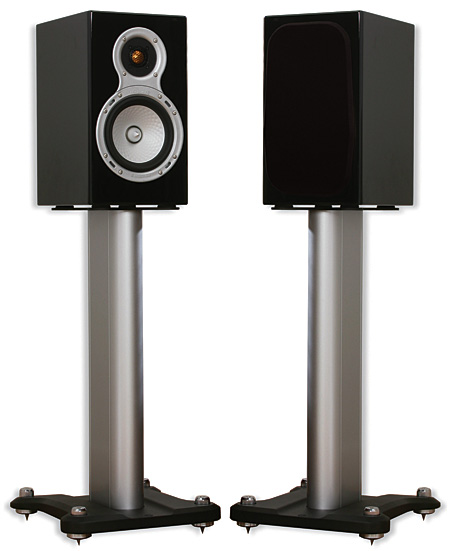
I had intended that my recent exploration of what was available in the world of high-performance minimonitors—the Era">http://www.stereophile.com/floorloudspeakers/107era">Era Acoustics Design 4 ($600/pair) in January, the Stirling">http://www.stereophile.com/floorloudspeakers/361/index12.html">Stirling LS3/5a V2 ($1695/pair) and Harbeth">http://www.stereophile.com/floorloudspeakers/1293harbeth/index5.html">H… HL-P3ES2 ($1850/pair) in April, the PSB">http://www.stereophile.com/floorloudspeakers/507psb">PSB Alpha B1 ($279/pair) in May—was to end in July, with my review of the American">http://www.stereophile.com/floorloudspeakers/707aad">American Acoustic Development Reference Silver-1 ($1550/pair). But there was one more real-world–priced, stand-mounted model that piqued my interest before I return to cost-no-object floorstanders in the substantial form of Sonus Faber's new Cremona Elipsa ($20,000/pair): the Gold Signature GS10 from Monitor Audio ($1495/pair).
Monitor Audio Monitor 7 loudspeaker
And now for something completely different.
Monitor Audio R300/MD loudspeaker
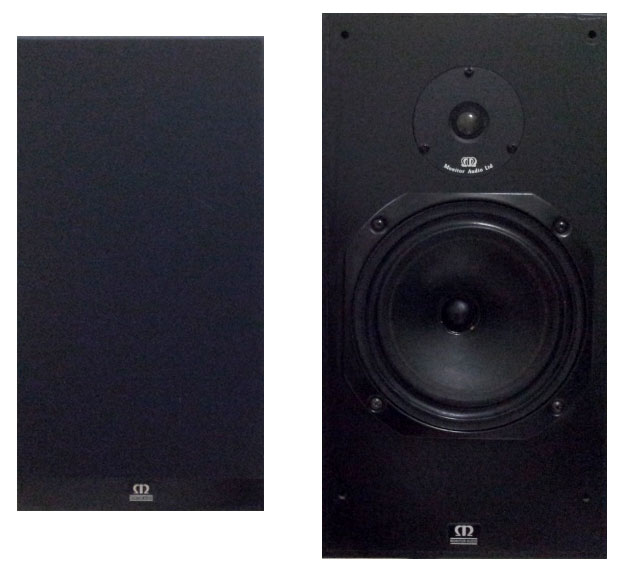
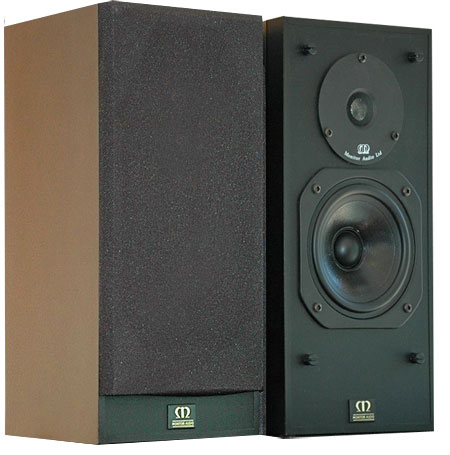
The Monitor Audio R300/MD ($669/pair) debuted at the 1988 SCES in Chicago. English company Monitor Audio is one of the pioneers in spreading the use of metal-dome tweeters in relatively low-cost loudspeaker systems. The tweeters they have designed in conjunction with SEAS and British manufacturer Elac may have now found their ways into a number of designs from competing manufacturers, but there is no doubt that Monitor leads the way. The new R300/MD features a new ¾" version of the SEAS 1" aluminum-dome unit Monitor introduced with their R652/MD (reviewed in Vol.10 No.5), in conjunction with an 8" doped paper-cone woofer.