

NHT Classic Three loudspeaker
When reviewing affordable speakers, it's critical to have benchmarks and comparisons for various price points. Inexpensive speaker designs are exercises in tradeoffs and compromises, especially for the least costly products. In all of my reviews, I try to compare the speaker in question with other designs close to the review sample's price, chosen from my list of previously reviewed speakers. From time to time, if a speaker particularly impresses me, I ask the manufacturer if I can keep the speakers around a while longer, so that it can serve as a comparison reference for a certain price point. That's not to say that any speaker I don't keep around is less desirable—there's just not enough room in my house to keep a sample of every speaker I like. An audio reviewer's wife puts up with enough as it is.
NHT Model 1.3 loudspeaker
 Now Hear This (NHT) was founded to produce low-cost loudspeakers a breed apart from the mass-market variety often found at the lower price points. Co-founder Ken Kantor has a long history in the hi-fi business as a designer at Acoustic Research, NAD, and as a design consultant to some large Japanese manufacturers. NHT's line ranges from the $180/pair Model Zero to the $1200 Model 100.
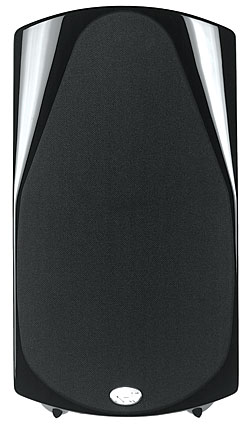
At $480/pair, the Model 1.3 is midway in NHT's product line. Finished in a gloss-black high-pressure laminate, the 1.3 is elegant, even beautiful, and is distinguished by its unusual angled front baffle. This design means that the rear baffle is nonparallel to the driver, thus reducing the amount of internal cabinet energy reflected back toward the woofer. This is said to improve imaging and midrange purity by reducing comb filtering. In addition, the angled baffle puts the listener directly on-axis with the loudspeakers pointing straight ahead. This increases the ratio of direct-to-reflected sound reaching the listener and further improves imaging.
Now Hear This (NHT) was founded to produce low-cost loudspeakers a breed apart from the mass-market variety often found at the lower price points. Co-founder Ken Kantor has a long history in the hi-fi business as a designer at Acoustic Research, NAD, and as a design consultant to some large Japanese manufacturers. NHT's line ranges from the $180/pair Model Zero to the $1200 Model 100.
At $480/pair, the Model 1.3 is midway in NHT's product line. Finished in a gloss-black high-pressure laminate, the 1.3 is elegant, even beautiful, and is distinguished by its unusual angled front baffle. This design means that the rear baffle is nonparallel to the driver, thus reducing the amount of internal cabinet energy reflected back toward the woofer. This is said to improve imaging and midrange purity by reducing comb filtering. In addition, the angled baffle puts the listener directly on-axis with the loudspeakers pointing straight ahead. This increases the ratio of direct-to-reflected sound reaching the listener and further improves imaging.
NHT SB-3 loudspeaker
I first met NHT co-founder Ken">http://www.stereophile.com//interviews/232/">Ken Kantor in 1975 when we were both undergraduates at MIT. Kantor was sponsoring an extracurricular class entitled "Musical Ideas." The concept was to stick a dozen or so musicians in a classroom for free improvisation and hope to create music à la Miles Davis' Bitches Brew. The result was a mess; although talented guitarist Kantor meant well, there was no common vision or consistency of musical talent. Nevertheless, I had a blast trying to simulate a tamboura drone with a Hohner Clavinet, phase shifter, and volume pedal.
NHT SuperZero loudspeaker & SW2 subwoofer

What makes someone a good hi-fi reviewer? A fine critical sensibility? A good technical background? Ears? Eyes? Nose? Throat? So many different people are reviewing audio gear these days that it's downright impossible to characterize a good reviewer. But I do know that Beavis and Butt-head would make killer hi-fi reviewers!
NHT Xd active loudspeaker system

NHT's Xd system is what audiophiles have been saying they want: a matched loudspeaker system that optimizes the performance of its components for a real-world domestic listening environment. But with their dollars they've voted against just such systems for years. If we put our money where our mouths are, active speaker systems such as Meridian's DSP or those used in recording studios would dominate the High End.
Ohm Acoustics CAM 16 loudspeaker

I like Brooklyn. I even got married under the shadow of the Brooklyn Bridge! (Almost the exact spot where Cher's grandfather let his dogs howl at the moon in Moonstruck. And if you're ever in the Park Slope area, check out McFeeley's for brunch.) I could be forgiven, therefore, for having a soft spot for any Brooklyn manufacturer, including Ohm Acoustics. Except that the only Ohm model I have heard was the omnidirectional Ohm Walsh 5 (favorably reviewed by Dick Olsher in Stereophile in 1987, Vol.10 No.4, and 1988, Vol.11 No.8), and the omni principle is something that I have never found to work, or at least to give me what I feel necessary in reproduced sound. The Ohm Model 16, however, is one of three more conventional Coherent Audio Monitor (CAM) speakers intended to offer good sound at an affordable price: $300/pair
Opera Callas loudspeaker

Colleen Cardas strongly urged me to try the Callas loudspeaker from Opera Loudspeakers (whose products she also distributes in the US), which she claimed was an ideal match for the Unison S6 amplifier I reviewed last August. In my experience, the stand-mounted Callas ($5000/pair) is unique among loudspeakers in being the logical contrapositive (inverted and flipped, so to speak) of the usual D'Appolito driver array of midrange-tweeter-midrange (MTM).
Paradigm Atom Monitor v.5 loudspeaker

When folks visit from out of town, they frequently remark that my Brooklyn neighborhood reminds them of "a real neighborhood" from their neck of the woods. "Except that we know all our neighbors and talk to them when we're cutting the grass, watering the lawn, and walking the dog. You probably don't even know the names of any of yours."
Paradigm Atom v.3 loudspeaker
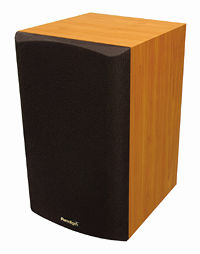
I had mixed feelings about reviewing the $189/pair Paradigm Atom loudspeaker. Although in the past I've been favorably impressed with Paradigm's speakers—the $600/pair Reference">http://www.stereophile.com//loudspeakerreviews/628/">Reference Studio/20 remains one of my favorite affordables—Budget Bob tends to get a bit nervous when a speaker's price drops below $250/pair. In my experience, even when the most talented speaker designers attempt to make a speaker to sell at such a low price, the result is often a very small cabinet with limited bass extension and inferior high-level dynamics.
Paradigm Control Monitor loudspeaker
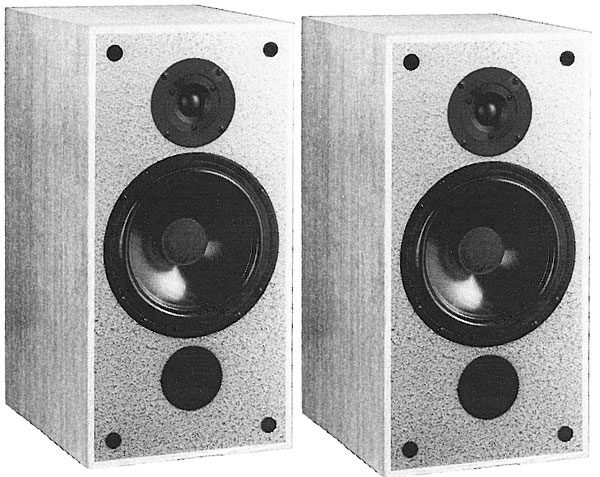
If speakers were cars, the Infinity IRS Beta and B&W 801 Matrix would represent the luxury end of the mass market, with perhaps the Celestion SL700, Quad ESL-63, and MartinLogan Sequel II analogous to rather hairy, temperamental sports carsthe Porsche 911, for example. But most people don't buy Porsches, or even Lincoln Town Cars; they buy Hyundai Excels and Ford Escorts. In the same way, when the car is garaged for the night, they don't sit down in front of IRS Betas; in all likelihood they listen to their records with a compact two-way design. If competently designed, a small two-way can give a great deal of musical satisfaction, and, to take a current hobbyhorse of mine out for a trot, if a designer can't produce an at least competent two-way loudspeaker, he or she has no business trying to design larger, more ambitious modelsthere's nowhere to hide your lack of talent if all you have to play with is a tweeter, a woofer, a rectangular enclosure, and a handful of crossover components.