

Reference 3a Royal Master Control loudspeaker
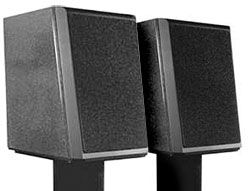 The match between amplifier and speaker for single-ended operation is critical, which is why John Atkinson suggested I let Wavelength's Gordon Rankin lead when it came to choosing a speaker to partner his special-edition Cardinal amplifiers. If you're not talking roughly 92dB sensitivity and a fairly benign load, say no lower than 6 ohms, you're just not talking single-ended. That precluded running the Cardinals on the big Avalon Ascents with their lowish 86dB sensitivity (in spite of the relatively benign impedance curve).
After more discussion it became evident that the best speakers to use were the very ones Gordon employed in his own reference systemthe Swiss-made Reference 3A Royal Master Control loudspeakers.
The match between amplifier and speaker for single-ended operation is critical, which is why John Atkinson suggested I let Wavelength's Gordon Rankin lead when it came to choosing a speaker to partner his special-edition Cardinal amplifiers. If you're not talking roughly 92dB sensitivity and a fairly benign load, say no lower than 6 ohms, you're just not talking single-ended. That precluded running the Cardinals on the big Avalon Ascents with their lowish 86dB sensitivity (in spite of the relatively benign impedance curve).
After more discussion it became evident that the best speakers to use were the very ones Gordon employed in his own reference systemthe Swiss-made Reference 3A Royal Master Control loudspeakers.Reference MM de Capo i loudspeaker

As names go, "Reference 3A" is awful. It sounds less like a company than it does a model number, as in the Dudco Reference 3A (on sale now wherever Fourier speakers used to be sold); I find it hard not to expect a Reference 3B with each new year. Add to that a cumbersome and somewhat meaningless model designation, "MM de Capo i"—what do the Ms stand for? what does the i stand for? haven't there been other de Capos in audio recently?—and my poor brain becomes utterly confused. And the older I get, the less I can tolerate being confused. Forgive me if, during the course of this review, I get lazy and fall back on the lazy and admittedly somewhat Clintonesque this speaker.
Revel Home Theater (SGHT Review)
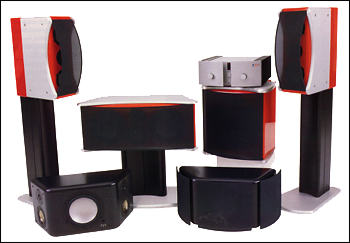
Revel. Interesting name for a new speaker company. The most apt definition of the word from my old dictionary is "to take much pleasure; delight." Or perhaps those who chose the name were intrigued by the wordplay they could make with "revel-ation."
Revel Performa M20 loudspeaker

Loudspeaker lore has it that a "good big'un will always beat a good small'un." But my experience has been that the traditional wisdom is often wrong. Price for price, large speakers often have larger errors compared with minimonitors, the smaller speakers offering more rigid cabinets, better-defined stereo imaging, and, because the owner can experiment with stand height, a better chance of being optimally sited in a room. So while I was as impressed as Stereophile reviewer Kalman Rubinson with what I heard from the floorstanding, $3500/pair Revel Performa F30 (footnote 1) when we visited the Revel facility in California's San Fernando Valley in spring 2000 (footnote 2), it was the big speaker's smaller sibling, the $2000/pair Performa M20, that caught my eye—and ear.
Revel Performa3 M106 loudspeaker

"Kevin Voecks is a genius, no ifs, ands, or buts." I wrote those words nearly 30 years ago, in a review of the Mirage 750, where I had also recommended Mirage's 350 bookshelf model. The 350, which costs $300/pair, was the first affordable bookshelf loudspeaker whose sound actually excited me. When I think now of how that speaker sounded back then, I chuckle. By today's standards, the Mirage 350 had some shortcomings.
Revel Ultima Gem loudspeaker & Ultima Sub-15 subwoofer

A dream I have had since I discovered the pleasures of music is to possess a time machine. Not a fancy one, just a small device that would allow me to escape modern music-making and drop in to hear what must have been some of the greatest musical experiences of all time. Classical music presents no problems: Off to 18th-century Leipzig on Sunday, of course, to hear J.S. Bach play the organ in church, after an early 19th-century Saturday evening spent in Vienna listening to Beethoven improvising at the pianoforte. During the week it would still be Vienna, but forward 80 years or so to hear Brahms premiere one of his chamber works after afternoon cocktails at the Wittgensteins', with perhaps a trip to England's Three Choirs Festival just before the Great War to hear the first performance of Elgar's Dream of Gerontius. And the time machine would have to have transatlantic range—I couldn't miss Mahler conducting the New York Philharmonic around the same time. But with jazz and rock—music that is reborn every time in performance to a greater extent than in classical—there is a bewildering choice of live events from which to choose.
Rogers LS7t loudspeaker

The English loudspeaker manufacturer Rogers [no connection with the contemporary US company Rogers High Fidelity] has had an illustrious history since being founded in 1947 by veteran designer Jim Rogers. Absorbed by the Swisstone company in 1976, it has since gone from strength to strength, the main creative work now being done by the respected English engineer Richard Ross. Noteworthy for keeping the miniature BBC LS3/5a design in continuous production for nearly 15 years, Rogers also makes a range of polypropylene-cone woofers and midrange units which are used in other models in its range.
Rogers Studio 3 loudspeaker
Back in the early 1970s, the BBC needed a physically unobtrusive, nearfield monitor loudspeaker for use in outside-broadcast trucks. Accordingly, they instructed their design department, which at that time featured such luminaries as Dudley Harwood (the "father" of the polypropylene cone, who went on to found Harbeth) and the late Spencer Hughes (the "father" of the Bextrene cone, who went on to found Spendor), to produce such a model. Thus, not only was what was then probably the finest collection of British speaker-design talent involved in its development, there were no commercial constraints placed on the design. The only limitations were intended to be those arising from the necessarily small enclosure and the absence of the need for a wide dynamic range under close monitoring conditions.
Ruark Equinox loudspeaker
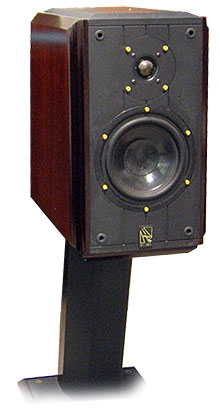
Ever since the 1960s, when I built a pair of Altec A7 clones, I've had a preference for relatively big speakers. Yes, I was seduced by the Stax F-81 electrostatics because of their incredibly low coloration, but inevitably I felt the need to return to something that would move more air. Regardless of the type of music (I do like the big stuff) or the sound levels, unless the sound has solidity and size, I can't easily suspend disbelief.
Ruark Sabre-R loudspeaker
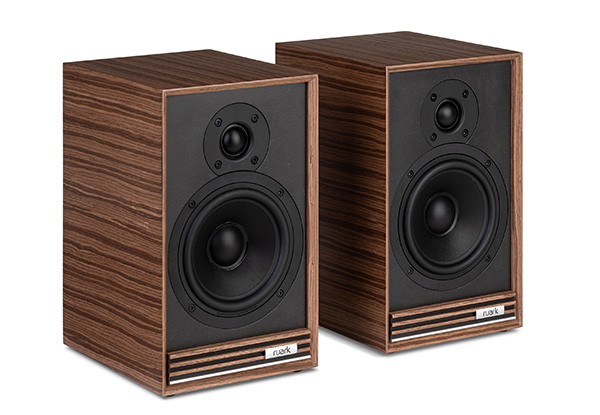
Like many aging American music lovers, my earliest memories include watching the televised supernova that was The Beatles performing on The Ed Sullivan Show in 1964. Immersion in various British pop groups followed, including the melodically graceful Chad & Jeremy, the polished Peter and Gordon, and sentimental pop purveyors Gerry and the Pacemakers.