

Siefert Maxim III loudspeaker
 While it is not quite accurate to say that $500/pair loudspeakers are a dime a dozen, they are by no means unusual. And since this is a price area where major design compromises are mandatory (footnote 1), the sound of such loudspeakers tends to vary all over the map, from pretty good to godawfuldepending on what performance areas the designer chose to compromise and by how much.
I approached this latest half-grander with little enthusiasm, despite Siefert's persuasive literature, I have, after all, been reading such self-congratulatory hype abiout new products for longer than most Stereophile readers have been counting birthdays. This, I must admit, was ho-humsville.
While it is not quite accurate to say that $500/pair loudspeakers are a dime a dozen, they are by no means unusual. And since this is a price area where major design compromises are mandatory (footnote 1), the sound of such loudspeakers tends to vary all over the map, from pretty good to godawfuldepending on what performance areas the designer chose to compromise and by how much.
I approached this latest half-grander with little enthusiasm, despite Siefert's persuasive literature, I have, after all, been reading such self-congratulatory hype abiout new products for longer than most Stereophile readers have been counting birthdays. This, I must admit, was ho-humsville.
Signet SL280 loudspeaker
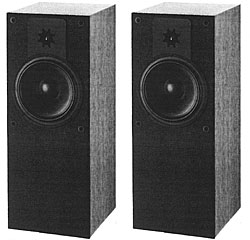 Audio journalists tend to wander the corridors of a CES in a minor state of shell-shock. There are no carnival-barkers outside the rooms enticing one to enter (not yet, at any rate), but the sounds and reputations oozing from the open doorways yield little to the "hurry, hurry, hurry" crowd. The Signet room has always, it seems, been one of the quieter oases, often eschewing sound altogether while contentedly displaying their phono cartridges, cables, and various accessories. On a recent CES hunt, I was therefore intrigued to find them demonstrating two new loudspeakers, of all things, to the milling throngs.
Silverline Audio Minuet loudspeaker

I always look forward to Stereophile's Home Entertainment Shows, where I scout out interesting new models of affordable loudspeakers. At HE2007">http://blog.stereophile.com/he2007">HE2007 in New York City, I was struck by the Silverline Audio room—not only by the sound I heard there, but by the way Showgoers reacted to that sound.
Sjöfn HiFi (the clue) loudspeaker
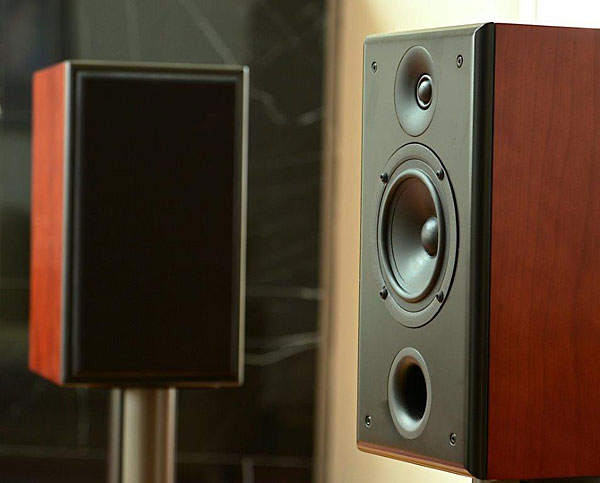
I was sitting in my high chair, eating strained peas. My father was walking around the kitchen with a wooden box in one hand and a cord with a plug in the other. The box and the cord were attached to each other. I was inspired to utter my first actual sentence: "Plug it in over there!" Moments later, a man with a disturbing voice began squawking from inside the wooden box. It was a radio. Schnapps, our dachshund, barked angrily. I started to cry. Ever since, I've been charmed, fascinated, and mostly annoyed by wooden boxes that talk to me.
Snell Acoustics LCR7 XL loudspeaker
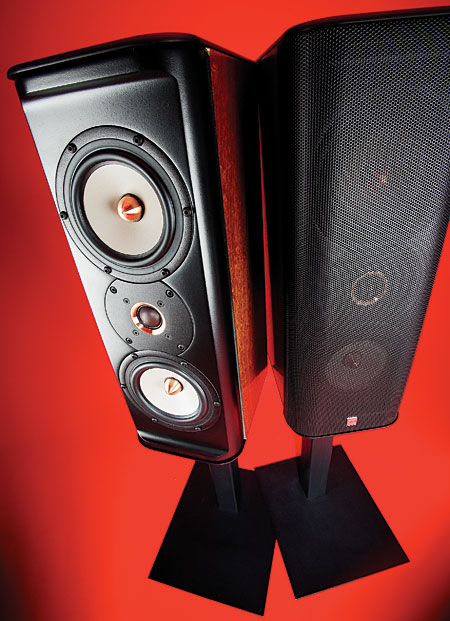
When someone is described as having "written the book" on a subject, it is generally taken as a figure of speech. But veteran speaker designer Joseph D'Appolito, PhD, quite literally "wrote the book." His Testing Loudspeakers (Audio Amateur Press, 1998) is an invaluable resource for those of us who, lacking any talent for designing speakers ourselves, nevertheless find the subject of speaker performance endlessly fascinating. So when Snell's PR consultant, Bryan Stanton, contacted me a while back about reviewing the LCR7, the first design D'Appolito had seen through from start to finish for the Massachusetts-based company since he had replaced David Smith as Snell's chief engineer, I suffered from more than a little anxiety.
Snell Type K/II loudspeaker
In some ways, building an inexpensive yet musical two-way loudspeaker is a greater design challenge than creating a cost-no-object reference product. Although the latter is a much more complex endeavor, the venerable two-way box seems to bring out the creativity and resources of the designer. Rather than throw money at the product in the form of more expensive drivers, enclosures, or components, the designer of a low-cost two-way is forced to go back to the basics, rethink closely-held tenets, and rely on ingenuity and sheer talent to squeeze the most music from a given cost. Consequently, the inexpensive two-way is the perfect vehicle for designers to develop their skills. If one has mastered this art form, one is much more likely to achieve success when more ambitious designs are attempted.
Sonics Anima loudspeaker

"I have a really special loudspeaker I want you to hear," said Immedia's Allen Perkins at Home Entertainment 2006.
Sonus Faber Electa Amator loudspeaker

Solamente una faccia bella?
At first glance, the Sonus Faber (pronounced Fah-bear) Electa Amator appears to be a typical minimonitor: a small vented box with two drivers. The speaker is significantly better-looking than Franco Serblin's first speaker system, the Snail, a subwoofer with two satellites attached via arms (see photograph in Vol.11 No.3, p.34). And, like the Oracle Delphi turntable or Goldmund Apologue speakers (the latter also an Italian design), the Amator's appearance has received at least as much attention as its performance. But is it just another pretty face?
At first glance, the Sonus Faber (pronounced Fah-bear) Electa Amator appears to be a typical minimonitor: a small vented box with two drivers. The speaker is significantly better-looking than Franco Serblin's first speaker system, the Snail, a subwoofer with two satellites attached via arms (see photograph in Vol.11 No.3, p.34). And, like the Oracle Delphi turntable or Goldmund Apologue speakers (the latter also an Italian design), the Amator's appearance has received at least as much attention as its performance. But is it just another pretty face?
Sonus Faber Extrema loudspeaker

Sonus Faber was founded in 1981 by Franco">http://www.stereophile.com//loudspeakerreviews/870/index2.html">Franco Serblin. Real wood has always featured strongly in the construction of this company's evolving range of costly, compact loudspeaker systems (footnote 1). The first was called the Parva, now in its FM4 form. This was followed by the Minima, a Tablette-sized model. The upmarket Electa came through in the last few years, followed by the Amator-Electa. This series increases in size and weight with each new introduction—for example, the Minima weighed 6kg, the Electa 12kg, the latest Extrema a massive 40kg or 88 lbs.
Sonus Faber Guarneri Evolution loudspeaker

At present, my writing chores are divided between two fields: domestic audio and lutherie. Having invested considerable time in both, and having by now met a number of builders who are distinguished in one or the other, I can say with all confidence that the best share a simple, single point of view: Everything makes a difference.