

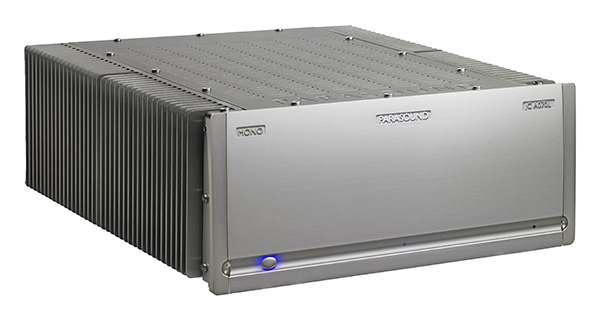
Parasound Halo JC 1+ monoblock power amplifier

Soon after I took over preparing Stereophile's biannual Recommended Components listing from the magazine's founder, J. Gordon Holt, in 1986, I ran into a problem. With so many products listed, the magazine was running out of the necessary pages to include them all. To solve this problem, I looked at how long a typical product remained on the market before being updated or replaced. The answer was 34 years. I therefore implemented a policy that unless one of the magazine's editors or reviewers had continued experience with a product, it would be dropped from Recommended Components after three years.
Parasound HCA-3500 power amplifier

Just in case you didn't know this when you bought the Parasound HCA-3500, it says on the cover of the owner's manual: "Designed in California, USA by John Curl." Described as an "audio design legend," an appellation with which he seems quite uncomfortable, John Curl has certainly been around the audio business longer than most. He's been employed by or has consulted for some of the biggest names in consumer and professional audio—including Harman/Kardon, Ampex, and Mark Levinson—and was the designer of at least two classic products: the Mark Levinson JC-2 preamplifier and his own Vendetta">http://www.stereophile.com/phonopreamps/640">Vendetta Research phono stage, still considered by many people to be the best phono stage ever built.
Parasound JCA100 Tribute monoblock power amplifier
In December 2023, I took the train from New York to Los Angeles to attend the Los Angeles & Orange County Audiophile Society's 30th annual Gala. I took the trip because it is both stimulating and satisfying to spend an afternoon in the company of more than 200 audiophiles and music lovers; I also wanted to see John Curl presented with the Society's fourth Innovation Award, by George and Carolyn Counnas of Zesto. John was given the award "for his groundbreaking contributions to the field of solid-state audio amplifiers, circuit innovation, mastering recorders and much more."
I first met John more than 40 years ago, at a Consumer Electronics Show in Chicago, where I was blown away by John's intuitive and innovative approach to circuit design.
Pass Aleph 1.2 monoblock power amplifier

We all have biases. The trick is knowing your biases so they don't get in your way. Mine are pretty obvious. I don't like "fussy" gear that demands special care and feeding. I'm lazy—I want to just turn stuff on and begin listening. Perhaps that's why I have a positive bias toward Nelson">http://www.stereophile.com/interviews/1191pass">Nelson Pass's designs. They're reliable, untweaky, and usually sound good.
Pass Laboratories Aleph 0 monoblock power amplifier

The Aleph Null, or 0, represents Nelson Pass's maiden product under the Pass Laboratories banner. When he left Threshold several years ago, Pass had the luxury of starting over with a clean slate, and decided immediately that he wanted to design a single-ended MOSFET amp. The result is aptly named after Georg Cantor's first transfinite number: Aleph Null, the gateway to higher-order infinities. Just as Cantor's transfinite mathematics stretched minds with its novel conceptual view of the infinite, the Pass Aleph 0 tantalizes the imagination with a new dimension in the future of solid-state amplification: a single-ended output stage.
Pass Laboratories XA200.8 monoblock power amplifier
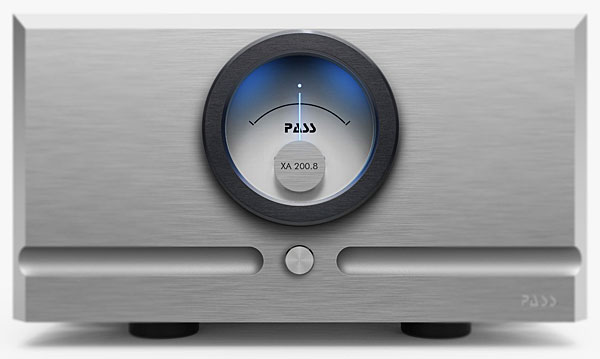
It was almost seven years ago that Nelson Pass, whose talks and exhibits I'd covered at many a Bay Area Burning Amp DIY event and audio show, surprised me with a loan of two Pass Laboratories' XA 160.5 class-A monoblock amplifiers. Ten months later, after I'd commented that my system had challenged the XA 160.5s in the bass department, he sent me a pair of XA200.5 monos. I connected those bigger babies to Wilson Audio Sophia 3 loudspeakers and some now-discontinued digital components with Nordost Odin 1 interconnects and speaker cables. Then came my way, toward the end of 2016, the XA200.8 monoblocks ($42,000/pair).
Pass Laboratories XA25 power amplifier
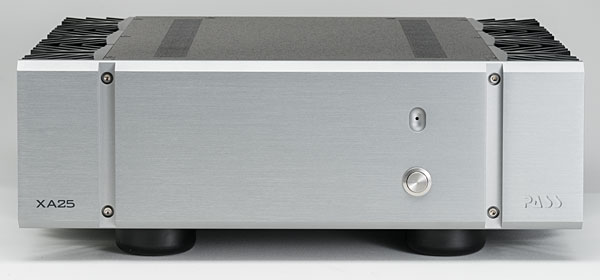
The XA25 stereo amplifier is the latest addition to Pass Laboratories' XA series of amplifiers and, at $4900, the lowest priced. It weighs only 45 lbs, has single-ended inputs only, and outputs 25Wpc into 8 ohms, 50Wpc into 4 ohms, or 100Wpc (!) into 2 ohms. According the XA25's well-written owner's manual, it will deliver 50W peaks into 2, 4, or 8 ohmsin class-A.
Pass Laboratories XA60.8 monoblock power amplifier

Years ago, when I was young and foolish (instead of old and foolish, as now), I was hanging out with a friend at a strip-mall strip club in a small southeastern city. A youngish lady approached our table in G-string and pasties and did a tableside dance. My friend's jaw scraped the floor; I, noting her lack of enthusiasm, was unmoved. The stripper noted my impassivity and stated, with irony that at the time I somehow missed, "You're a hard man."
John Atkinson, too, is a hard man, at least when it comes to audio gear. When, in January 2014, he reviewed the Pass Laboratories XA60.5 monoblock amplifier, he concluded, "It is the best-sounding amplifier I have ever used." High praise.
Pass Labs Aleph 3 power amplifier
Everyone's going crazy for single-ended power amplifiers. What's the big deal? What is it about these relatively low-powered contraptions that could make everybody so nutso? And has Pass Labs' Nelson Pass completely lost his marbles, selling a 30Wpc amplifier for a price that can buy a high-quality 200Wpc amp? Isn't that 200W amp seven times as loud—and seven times as good—as a 30W amp?
Pass Labs X1000 monoblock power amplifier
Pass Laboratories' X amplifier series represents the efforts of designer Nelson Pass to prove that simple linear amplifier topologies can be scaled to provide high-quality audio performance at very high power levels. The handsome X1000 monoblock under scrutiny here, the largest and most powerful amp in the Pass stable, makes 1000W into 8 ohms and a mighty 2000W into 4 ohms. The amplifier has no global negative feedback, and only two gain stages: the front-end provides all the voltage gain and feeds a high-current follower stage.