

Mytek HiFi Brooklyn AMP+ power amplifier
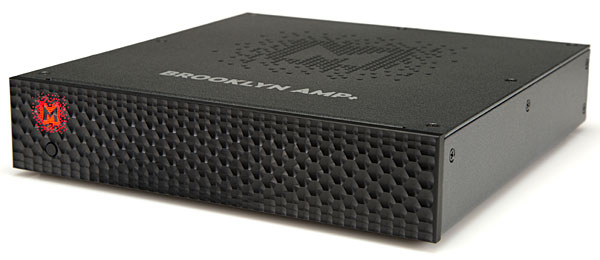
Big changes are afoot at Mytek. First up: The Mytek Brooklyn AMP+, the newest version of the compact, class-D Brooklyn AMP. The AMP+ is already in production.
In my 2018 review of the original Brooklyn AMP, I wrote that the class-D amplifier exuded "a consistent sense of truthfulness, striking resolution that was never analytical, spacious soundstages, superb dynamics, and some of the 'blackest' backgrounds I've ever heard...with the right recordings." I continued, "The AMP let me revel in its reproduction of the low end, with zero overhang or bloat, and profoundly impressive retrieval of micro- and macrodetailbut in doing all this, its touch was always light and never surgical."
NAD 218 THX power amplifier

The story of New Acoustic Dimensions, aka NAD, begins in the late 1970s. The company was founded as a dealer distribution collective to design and market reasonably priced serious high-end gear to cost-constrained audiophiles. By eliminating needless features and focusing manufacturing in low-cost production facilities, NAD has successfully delivered audiophile-quality gear for 20 years at prices little more expensive than mass-market department-store schlock.
NAD C 298 power amplifier

Power amplifiers should be boring. They have a single, well-defined function: Make the input signal large enough to run a loudspeaker so that it makes sound at levels suitable for listening to music. Generally, controls and features are few or none. Peter Walker of Quad famously defined the ideal amplifier as a "straight wire with gain." That's just one feature: gain.
NAD M2 Direct Digital integrated amplifier

A decade ago, many predicted that amplifiers with switching or class-D output stages would come to dominate high-end audio. In a postPeak Oil world in which the price of energy would always continue to rise, a class-D amplifier's very high efficiency in converting AC from the wall outlet into speaker-driving power would be a killer benefit. Although a conventional push-pull class-B amplifier has a theoretical efficiency of 78.5%, which would seem usefully high, this efficiency is obtained only at the onset of clipping; the need for the output devices to carry a standing bias current reduces that efficiency considerably, typically to around 50%. Class-A amplifiers are even less efficient, with a maximum of 25%; ie, three times as much power is dissipated by the amplifier as waste heat as is used to drive the loudspeaker (see "Sam's Space" in this issue).
NAD Masters Series M22 power amplifier

In the January 2015 edition of "Music in the Round," I reviewed NAD's latest Masters Series preamplifier-processor and multichannel power amplifier, respectively the M17 ($5499) and M27 ($3999). I was taken with both, but the M27 made a special impression. In many ways, it personified what a modern power amp should be: quiet, transparent, cool running, and compact. Its neat package of seven 180W channels inspired me to consider that stereo or mono versions of such a thing could supplant the ungainly monster amps I was using in my main system. So I asked NAD to send me not just one but two samples of their new two-channel power amplifier, the Masters Series M22 ($2999): Although this is a review of a stereo amplifier, I did want to have my front three speakers identically voiced.
Naim Classic 200 Series NAP 250 power amplifier
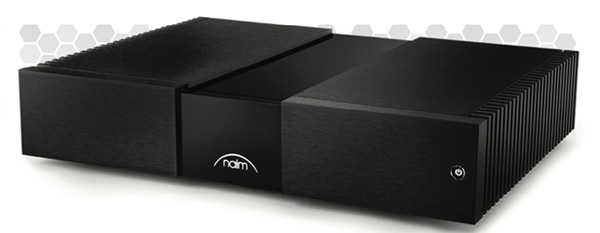
For this modular audio component seta review of the matching NSC 222 streamer preamp with a matching NPX 300 power supply is forthcomingwe first cover the standalone NAP 250 100Wpc stereo power amplifier, a new version of Naim's 200-series amplifier, now so extensively revised that it must be regarded as a new model.
Naim Audio's enduring, compact 200-series stereo power amplifier has been relaunched as the NAP 250, a key component of their new 200 Series. It has been updated massively in its technology and the compatibility of its connections, yet the primary circuit concept, which dates to the mid-1970s, is essentially unchanged. Recent development work has focused on helping the amplifier match up well with the new NSC 222 streamer-preamp, the NAP 250's intended companion. The new 200-series power amplifier is now called, simply, NAP 250, dropping the "DR" of the previous model. But while the suffix is now omitted, the ultralow-noise DR technology has been retained in the active, fully regulated power supplies; indeed, it has been improved.
Naim NAC 62 preamplifier & NAP 140 power amplifier

Back in 1970, one Julian Vereker decided to record some musician friends in his house in Salisbury, England. Using standard, off-the-shelf electronics and tape machines, he was startled at how dissimilar the recording was to the sound of live instruments. As a result, he started designing his own recording electronics, including a recording console, of which he sold several to local broadcast facilities.
Onkyo Grand Integra M-508 power amplifier

"Grand Integra" is the name Onkyo has given to its line of perfectionist-oriented audio products, and the M-508 is the cheaper of Onkyo's two Grand Integra power amplifiers. (The flagship model is the $4200 M-510, reviewed by Larry Greenhill in Vol.8 No.8, featuring "high current capability," and rated at 300W continuous per channel.)
Parasound Halo A 21+ power amplifier
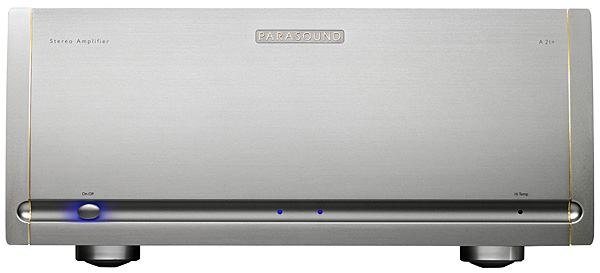
The components I needed to choose for my first system were never in doubt: a turntable or record changer, an integrated amplifier, and a speaker. One of each, please, in those mono days.
Today, even in stereo, that trinity would be regarded as rather traditionalor, if you prefer, purist. Digital has exploded the range of source options and loudspeaker options. Yet amplifiers have not changed much in how and what they do.
Parasound Halo JC 1 monoblock power amplifier
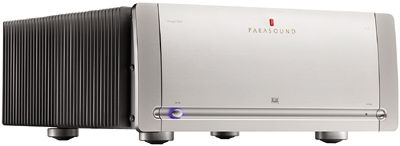
Thirty years ago, the upstart audio company NAD revolutionized the manufacturing of consumer-electronics components by "internationalizing" the process. Instead of physically making products, NAD hired a project team in one location to design a product that was then built at a sub-contracted factory located elsewhere. The arrangement allowed NAD to go into business with relatively little capital outlay and low overhead. Other companies have since copied this ingenious business model, and, as transportation and communication have improved, doing so has become easier and more efficient. It has brought prices down and quality up—mostly in the low and middle segments of the high-end audio and video markets.