

Moscode 402Au power amplifier
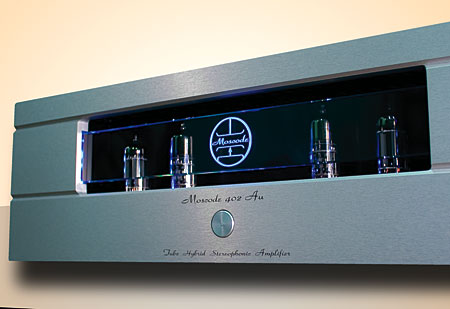
It seems as if I came of audiophile age in the George Kaye era. The first truly high-end system I ever heard contained a pair of Julius Futterman OTL monoblocks that Kaye had "finished" after Futterman's death in 1979 (footnote 1). In the mid-1980s, I owned both an New York Audio Labs (NYAL) Superit phono section and a Moscode 300 amplifier—two lovely examples of high-value high-end. Both components were far from perfect, but they were fun—and, unlike most of the other components that were then highly regarded by magazines and listeners, I could afford them.
Muse Model 150 monoblock power amplifier
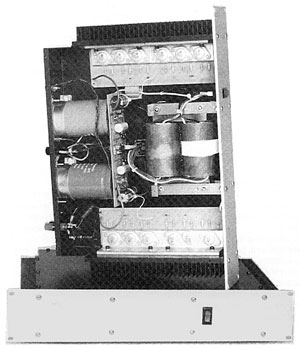 The name Muse Electronics is probably unfamiliar to most audiophiles, requiring some background on the company. Muse is the hi-fi offshoot of a company called Sound Code Systems, a manufacturer of professional sound-reinforcement speaker cabinets and power amplifiers. Founded in 1980, SCS enjoyed some success with its line of MOSFET professional power amplifiers. In 1988, SCS's Michael Goddard and Kevin Halverson, both audiophiles and tube aficionados, redesigned their amplifier for the high-end hi-fi market.
The results are the Model One Hundred (a 100Wpc stereo power amplifier) and the Model One Hundred Fifty ($1900/pair), the 125W monoblock reviewed here. According to Michael Goddard, the primary design goal was to achieve a tube sound with the reliability and ruggedness of transistors. MartinLogan CLS speakers were used extensively during the design/listen/design cycle. As a result of their listening auditions and redesign, many of the changes have now been incorporated into their professional products.
The name Muse Electronics is probably unfamiliar to most audiophiles, requiring some background on the company. Muse is the hi-fi offshoot of a company called Sound Code Systems, a manufacturer of professional sound-reinforcement speaker cabinets and power amplifiers. Founded in 1980, SCS enjoyed some success with its line of MOSFET professional power amplifiers. In 1988, SCS's Michael Goddard and Kevin Halverson, both audiophiles and tube aficionados, redesigned their amplifier for the high-end hi-fi market.
The results are the Model One Hundred (a 100Wpc stereo power amplifier) and the Model One Hundred Fifty ($1900/pair), the 125W monoblock reviewed here. According to Michael Goddard, the primary design goal was to achieve a tube sound with the reliability and ruggedness of transistors. MartinLogan CLS speakers were used extensively during the design/listen/design cycle. As a result of their listening auditions and redesign, many of the changes have now been incorporated into their professional products.
Muse Model One Hundred power amplifier

"I've know I've seen this amp before," I thought to myself when I lifted the $1200 Muse Model One Hundred out of the box, and I wasn't thinking of Robert Harley's review of the identical-looking Muse Model One Hundred Fifty reviewed in January 1990, either. No, I'd seen this amp before, somewhere else, in some other magazine, but with a different manufacturer's name.
Musical Fidelity 550K Supercharger monoblock power amplifier
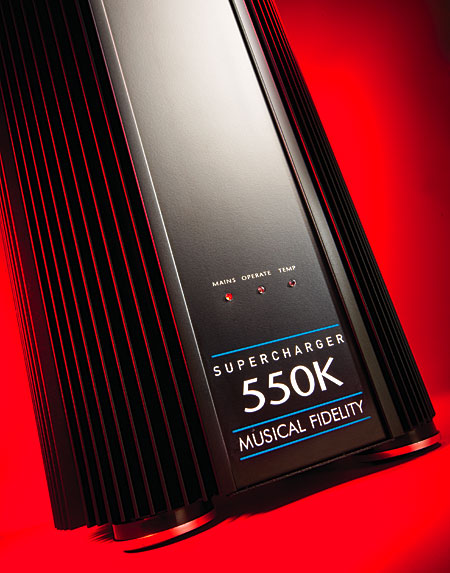
How much amplifier power do you need? Most audiophiles figure a maximum of a few hundred watts per channel—beyond that, you're wasting your money or showing off. Others think that anything more than a few watts will mess up an amplifier's musical coherence or "purity," so they stop there and find uncommonly sensitive speakers, usually compression horns with cone woofers.
Musical Fidelity 750K Supercharger monoblock power amplifier
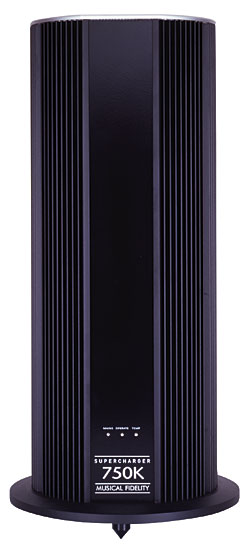
Musical Fidelity's "Supercharger" concept is simple, which is perhaps why no one had thought of it before: If you love the sound of your low-powered amplifier but your speakers are insensitive, or you just need more loudness, you insert the high-power Supercharger amplifier between your low-powered amp and speakers. The Supercharger loads the small amplifier with an easy-to-drive 50 ohms, and, in theory, has so little sonic signature itself that it passes on the sonic signature of the small amp unchanged, but louder.
Musical Fidelity AMS100 power amplifier

"That's just silly on so many counts, Antony."
I was talking last winter to Musical Fidelity's Antony Michaelson, who had been enthusing about his forthcoming stereo amplifier, the AMS100. It would be physically enormousalmost a yard deepand commensurately heavy at 220 lbs. Despite its bulk, its maximum rated output would be just 100Wpc into 8 ohms. It would also be expensive, at $19,999. And to cock a snoot at environmentalists and their concerns, the AMS100's output stage would be biased into class-A up to its rated 8 ohm power, meaning that, even when not playing music, it will draw around 10 amps from a typical US wall supply of 120V. This also means that it will run very hot, making the amplifier impracticable for summer use in homes without central air-conditioning. Like mine.
Musical Fidelity kW Hybrid line preamplifier & kW750 power amplifier

Not every audiophile needs an amplifier powerful enough to tax a small town's power grid while simultaneously draining his or her bank account. So, having quickly sold out of its ultra-limited-edition, extravagantly powered and priced combo of kWp preamplifier ($14,995) and kW power amp ($27,995) that I reviewed">http://www.stereophile.com/tubepoweramps/104mf">reviewed in January 2004, Musical Fidelity (footnote 1) set about capitalizing on the enthusiastic reviews earned by those giants with less expensive, less powerful, "real-world" replacements.
Musical Fidelity Nu-Vista 300 power amplifier

Nothing like scarcity to create demand, right? Well, there's been a scarcity of Nuvistors out there for decades, and hardly any demand. Do you know about the Nuvistor, aka the 6CW4? It was a tiny triode tube smaller than your average phono cartridge. Enclosing its vacuum in metal rather than glass, the Nuvistor was designed as a long-lived, highly linear device with low heat, low microphony, and low noise---all of which it needed to have any hope of competing in the brave new solid-state world emerging when RCA introduced it in the 1960s.
Musical Fidelity Titan power amplifier
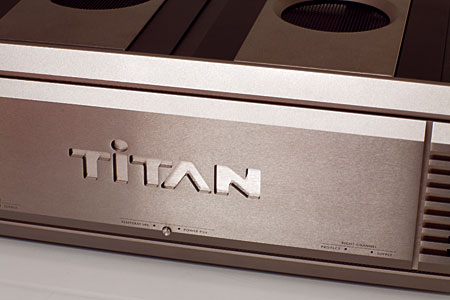
Musical Fidelity's founder, Antony">http://www.stereophile.com/features/575/index3.html">Antony Michaelson, arrived at my house to help me set up the two chassis of his sleek, limited-edition, $30,000 Titan power amplifier. (The task requires at least two people.) A week later, a representative of Musical Fidelity's US importer, KEF America, dropped by to listen and to deliver three of Musical Fidelity's new V-series products: a phono preamp, a DAC, and a headphone amp. All three fit comfortably into a small paper bag; the price of the three was $700.
Mytek Brooklyn Amp power amplifier
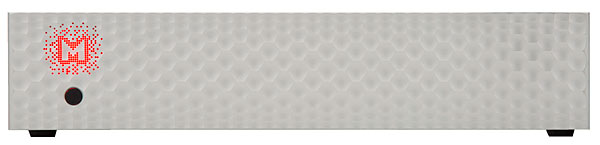
Designed in New York City, manufactured in Poland, and barely bigger than a thick paperback, the Brooklyn Amp ($2495) is Mytek's first power amplifier. Like all of their products, it's sleek to behold, with a powerful look that suggests the company's pedigree: in addition to high-end consumer electronics, Mytek makes gear for the pro-audio market, where exceptional build quality and space-saving design are the norm.
Consistent with that last characteristic is the Brooklyn Amp's output architecture: it operates in class-D, a technology that remains controversial.