

Recording of April 2025: Humble Pie: Smokin'

Humble Pie: Smokin'
Analogue Productions APP 168 (LP). 1972/2024. The Pie, prods.; Alan O'Duffy, Keith Harwood, Kevin Gray, engs.
Performance ****
Sonics ****½ The ultimate indication that an audiophile reissue is worth paying for lies in its resale value on the secondary markets, especially eBay and Discogs. If there are lots of copies for sale that are open and played, it's usually a sign that folks are disappointed. On the other hand, if a reissue titleand this covers Analogue Productions' 2009 reissue of Humble Pie's Smokin'routinely fetches upwards of $100 on the secondary market (and sealed copies above $200), it means, first, that the pressing has probably sold out (a good sign) and, second, that it's probably worth the lucre. In October 2024, AP repressed its much-sought-after 180gm reissue of Smokin', mastered by Kevin Gray from a ½" flat-tape copy of the original master tape. As this review was being written, copies were still available. It comes packaged in a Stoughton Printing tip-on jacket. It's a high-quality product all around.
Analogue Productions APP 168 (LP). 1972/2024. The Pie, prods.; Alan O'Duffy, Keith Harwood, Kevin Gray, engs.
Performance ****
Sonics ****½ The ultimate indication that an audiophile reissue is worth paying for lies in its resale value on the secondary markets, especially eBay and Discogs. If there are lots of copies for sale that are open and played, it's usually a sign that folks are disappointed. On the other hand, if a reissue titleand this covers Analogue Productions' 2009 reissue of Humble Pie's Smokin'routinely fetches upwards of $100 on the secondary market (and sealed copies above $200), it means, first, that the pressing has probably sold out (a good sign) and, second, that it's probably worth the lucre. In October 2024, AP repressed its much-sought-after 180gm reissue of Smokin', mastered by Kevin Gray from a ½" flat-tape copy of the original master tape. As this review was being written, copies were still available. It comes packaged in a Stoughton Printing tip-on jacket. It's a high-quality product all around.
Recording of April 2026: Lucinda Williams: World's Gone Wrong
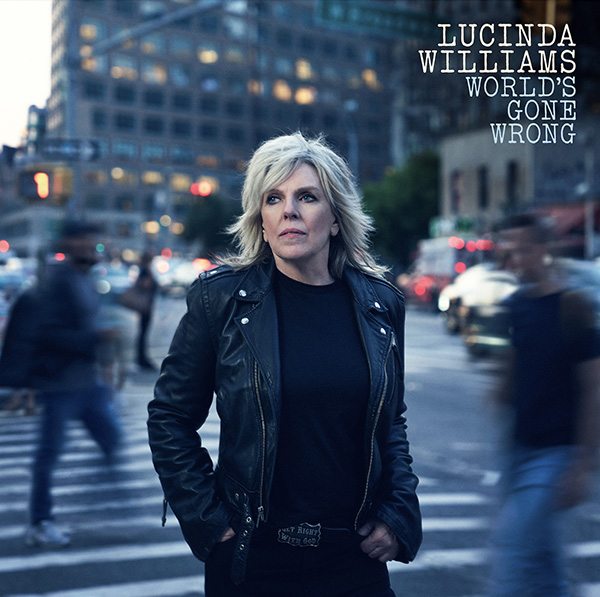
Lucinda Williams: World's Gone Wrong
Highway 20 Records/Thirty Tigers H20015LP (LP). 2026. Ray Kennedy, Tom Overby, prods.; Kennedy, John Rooney, engs.
Performance ****½
Sonics ****½
Highway 20 Records/Thirty Tigers H20015LP (LP). 2026. Ray Kennedy, Tom Overby, prods.; Kennedy, John Rooney, engs.
Performance ****½
Sonics ****½
Recording of August 1963: Nielsen: Symphony No.5
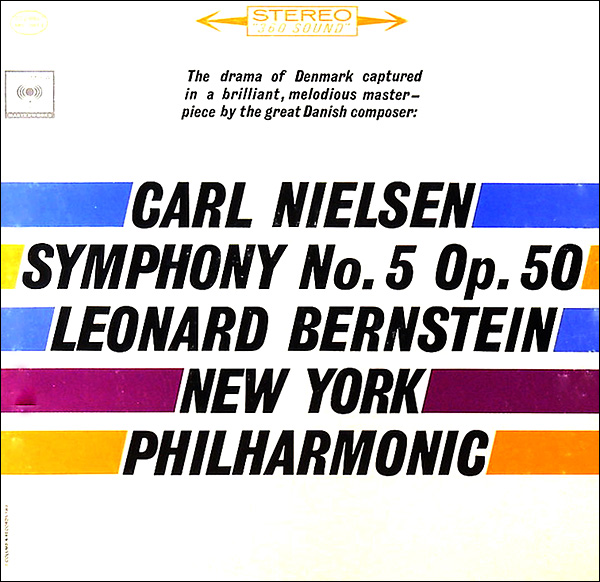
Nielsen: Symphony No.5, Op.50
New York Philharmonic Orchestra, Leonard Bernstein, conductor
Columbia MS-6414 (LP). John McClure, prod. TT: 33:10 This is surely one of the most exciting works written in the twentieth century. and if there is going to be an upsurge of interest in the works of this great Danish composer as a result of this recording, then Mr. Bernstein and the New York Philharmonic will have rendered music lovers an invaluable service.
New York Philharmonic Orchestra, Leonard Bernstein, conductor
Columbia MS-6414 (LP). John McClure, prod. TT: 33:10 This is surely one of the most exciting works written in the twentieth century. and if there is going to be an upsurge of interest in the works of this great Danish composer as a result of this recording, then Mr. Bernstein and the New York Philharmonic will have rendered music lovers an invaluable service.
Recording of August 1964: Vaughan Williams: Symphony No.2
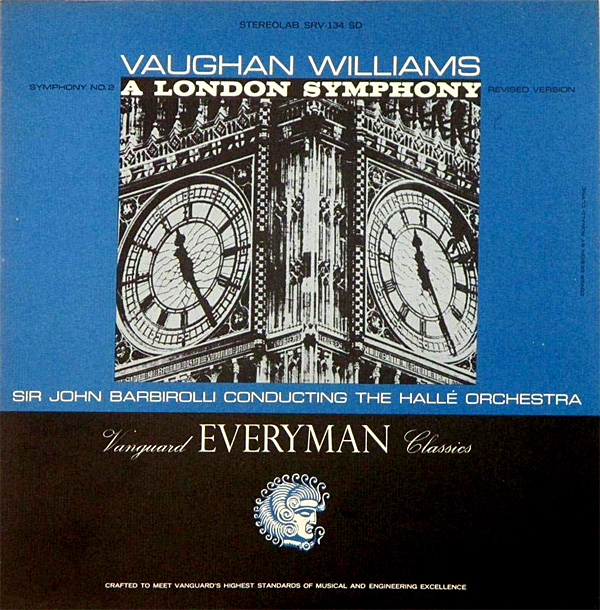
Vaughan Williams: Symphony No.2 (A London Symphony)
Hallé Orchestra, Sir John Barbirolli, conductor.
Vanguard Everyman, SRV-134-SD (1963 LP). Reissued in 1982 as PRT Collector GSGC 2035 (LP). Recorded by Pye (UK) in 1957. This is undoubtedly the best London Symphony that's been committed to stereo to date, and I wouldn't be surprised if it held top place for years to come. I can find nothing to criticize about the performance, and the recording is awe-inspiringrich, warm and natural, with some phenomenally low bass and very wide dynamic range, yet without the slightest audible trace of breakup during crescendos.
Hallé Orchestra, Sir John Barbirolli, conductor.
Vanguard Everyman, SRV-134-SD (1963 LP). Reissued in 1982 as PRT Collector GSGC 2035 (LP). Recorded by Pye (UK) in 1957. This is undoubtedly the best London Symphony that's been committed to stereo to date, and I wouldn't be surprised if it held top place for years to come. I can find nothing to criticize about the performance, and the recording is awe-inspiringrich, warm and natural, with some phenomenally low bass and very wide dynamic range, yet without the slightest audible trace of breakup during crescendos.
Recording of August 1975: The Complete Firesign Theater Recordings

You have probably read speaker reports that suggested that you audition with natural sounds like clanking chains, storms, animals and other things that give an easy reference to live experience. The problem is that most sound-effects albums are a real bore, dominated by reject Walt Disney announcers with adenoid problems.
Recording of August 1976: Britten: Orchestral Music

Britten: Orchestral Music
Four Sea Interludes & Passacaglia from Peter Grimes; Sinfonia da Requiem
London Symphony Orchestra, André Previn, conductor.
Angel S-37142. (Stereo/SQ LP). Christopher Bishop, prod.; Christopher Parker, eng. EMl/Angel have come up with demonstration quality sound on this one. The "Sea Interludes" have stood well on their own as a concert piece, and previous recordings have been by Britten (Decca/London) and Giulini (EMI/Angel). Previn's earlier Sinfonia da Requiem with the St. Louis Symphony has recently been reissued on Odyssey, but that version, good as it is, must defer to the new reading and sonics. There are timpani thumps on this disc that literally bolted me upright from my chair! The dynamic range is tremendous.
Four Sea Interludes & Passacaglia from Peter Grimes; Sinfonia da Requiem
London Symphony Orchestra, André Previn, conductor.
Angel S-37142. (Stereo/SQ LP). Christopher Bishop, prod.; Christopher Parker, eng. EMl/Angel have come up with demonstration quality sound on this one. The "Sea Interludes" have stood well on their own as a concert piece, and previous recordings have been by Britten (Decca/London) and Giulini (EMI/Angel). Previn's earlier Sinfonia da Requiem with the St. Louis Symphony has recently been reissued on Odyssey, but that version, good as it is, must defer to the new reading and sonics. There are timpani thumps on this disc that literally bolted me upright from my chair! The dynamic range is tremendous.
Recording of August 1980: Capriccio Italien & Capriccio Espagnol
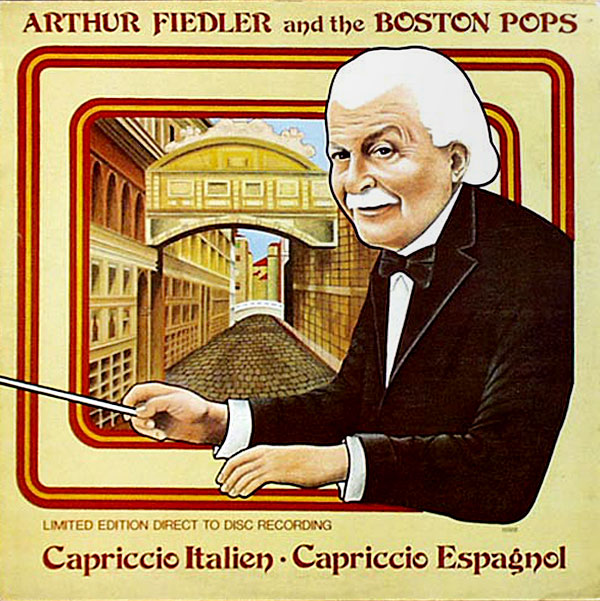
TCHAIKOVSKY: Capriccio Italien
RIMSKY-KORSAKOV: Capriccio Espagnol
Boston Pops conducted by Arthur Fiedler.
Crystal Clear CCS-7003 (Direct-cut LP). Ed Wodenjak, prod.; Bert Whyte, eng.; George Piros, Richard Simpson, Stan Ricker, mastering; John Meyer, special equipment; John Curl, console design. One of Crystal Clear's earlier releases (1978), this has very distant, directionally vague sound, but the sound (stupendous by standards of only a few years ago) cannot stand in the way of two of the most exciting performances of these potboilers that have ever been committed to disc.
RIMSKY-KORSAKOV: Capriccio Espagnol
Boston Pops conducted by Arthur Fiedler.
Crystal Clear CCS-7003 (Direct-cut LP). Ed Wodenjak, prod.; Bert Whyte, eng.; George Piros, Richard Simpson, Stan Ricker, mastering; John Meyer, special equipment; John Curl, console design. One of Crystal Clear's earlier releases (1978), this has very distant, directionally vague sound, but the sound (stupendous by standards of only a few years ago) cannot stand in the way of two of the most exciting performances of these potboilers that have ever been committed to disc.
Recording of August 1982: Prokofiev: Piano Sonata No.6
 Prokofiev: Piano Sonata No.6 Op.82
James Boyk, piano
Performance Recordings PR-3 (LP). James Boyk, prod., Michael Fraser, eng., Doug Sax, mastering eng. James Boyk has become something of a phenomenon. Not only is he a Professor of Music (at Cal Tech) who teaches how to listen to reproduced sound and writes articles about sound reproduction (for New West magazine), he is also a virtuosic pianist who produces perfectionist-caliber recordings of his own recitals. This recording, Mr. Boyk's third LP (footnote 1), is of one of Prokofiev's later works, and is a magnificent piano recording. Much credit must be given to both Mr. Boyk and his recording engineer, Michael Fraser. The instrument seems to be right in front of one, with as accurate a sound as any piano reproduction I have heard. It is interesting to note that the recording was made with ribbon mikes (the legendary Coles 4038s, perhaps?) and all-tube electronics "from mike to grooves."
Recording of August 1983: West Side Story
 Andre Previn and His Pals: West Side Story
Andre Previn, piano; Shelly Manne, drums; Red Mitchell, double bass.
Mobile Fidelity Sound Lab MFSL 1-095 (LP). Lester Koenig, prod. TT: 38:16 Aaron Copland has called jazz "contemporary chamber music," and this is certainly true of these improvisations by Previn and his friends. I consider this chamber jazz at its best, varying in mood and tempo but never losing interest. The program consists of eight variations on themes from Bernstein's well-known musical, and includes "Maria," "Jet Song," "I Feel Pretty," and "Something's Coming."
Recording of August 1984: Saint-Saëns & Ravel Orchestral Works
 Saint-Saëns: Carnival of the Animals
Ravel: Mother Goose Suite
Pittsburgh Symphony Orchestra, André Previn, cond.
Philips CD 400-016 2 (CD). The whimsical Carnival, with its nose-thumbing at Saint-Saëns' contemporaries (eg a lugubrious "Can-Can" and a stately cello rendition of Berlioz's Dance of the Sylphs, from The Damnation of Faust), is given a delightful treatment here, and put on one of the best-sounding CDs I've heard to date from a major record company. Philips has been less up-front about the roots of its CDs than most other record manufacturers, If fact, they have been downright sneaky about it. This releasebilled prominently on the CD jacket as a "Digital Recording"sounds very much as if it was analog-mastered. The is certainly nothing Philips should ashamed of, because this is a better-sounding recording than most digitally mastered ones.