

Gordon Rankin, Wavelength's Single-Ended Man
Jonathan Scull: Gordon, please tell us what you see as the basic difference between single-ended and push-pull.
Guy Clark: For the Sake of the Song

As songwriters go, Guy Clark has been touched by the muse more than most. Unfortunately, in recent years he's also been visited by illness and heartache. In June 2012, his wife of 40 years, Susanna Clark, who was both a songwriter ("Easy from Now On") and an artist (the cover of Willie Nelson's Stardust), died in Nashville. In the past several years Clark, 72, has battled lymphoma, had his knees replaced, and undergone an arterial replacement in one leg. He was being treated for skin cancer when I visited his home, south of Nashville, in October 2013.
HDCD: Keith Johnson, Pflash Pflaumer, Michael Ritter
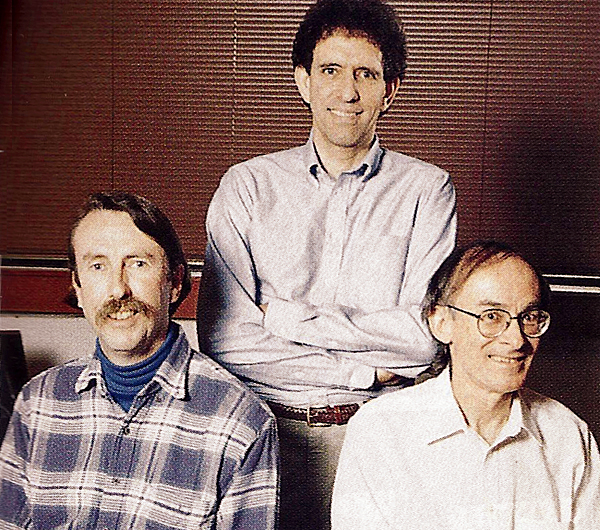
The men behind HDCD (LR: Pflash Pflaumer, Michael Ritter, Keith Johnson
High Definition Compatible Digital® (HDCD®), the proprietary process for improving the sound of 16-bit digital audio, has finally arrived. More than a dozen digital processors using the technology are on the market, and the professional encoder used to master HDCD discs is following closely behind.Henry Azima: A Mission to Succeed
 In its first three years, UK hi-fi manufacturer Mission Electronics employed a number of engineers to reinforce the creative talents of founder and hi-fi enthusiast Farad Azima. The lineup included John Bicht, now with Versa Dynamics, and Stan Curtis, now heading up Cambridge Audio. But when Farad's brother Henry"Henry" is actually a nickname and I am sure you can see the derivationjoined the company in 1979, he brought both a much-needed stability, and initiated a considerable degree of commercial success for the company's products. Now resident in Canada, he spends his time commuting between his laboratory in Toronto and the company's headquarters near Cambridge, England (footnote 1). Prior to joining Mission, however, Henry had served in the Iranian Navy for 15 years, an unusual training for an audio engineer. I asked him if this had been an appropriate preparation for the world of hi-fi.
Henry Azima: I had actually been a student in the UK, studying electronic engineering at the University of Surrey in Guildford. When I left the Navy in 1979 after the revolution in Iran, I moved to the UK and got a job with my previous University as an Assistant Lecturer and Researcher. However, Farad then asked me out of the blue to join Mission. I said, "Well, I have no idea about hi-fi, and stuff like that." He said, "You will learn, there's no problem!"
In its first three years, UK hi-fi manufacturer Mission Electronics employed a number of engineers to reinforce the creative talents of founder and hi-fi enthusiast Farad Azima. The lineup included John Bicht, now with Versa Dynamics, and Stan Curtis, now heading up Cambridge Audio. But when Farad's brother Henry"Henry" is actually a nickname and I am sure you can see the derivationjoined the company in 1979, he brought both a much-needed stability, and initiated a considerable degree of commercial success for the company's products. Now resident in Canada, he spends his time commuting between his laboratory in Toronto and the company's headquarters near Cambridge, England (footnote 1). Prior to joining Mission, however, Henry had served in the Iranian Navy for 15 years, an unusual training for an audio engineer. I asked him if this had been an appropriate preparation for the world of hi-fi.
Henry Azima: I had actually been a student in the UK, studying electronic engineering at the University of Surrey in Guildford. When I left the Navy in 1979 after the revolution in Iran, I moved to the UK and got a job with my previous University as an Assistant Lecturer and Researcher. However, Farad then asked me out of the blue to join Mission. I said, "Well, I have no idea about hi-fi, and stuff like that." He said, "You will learn, there's no problem!"
Hiroyasu Kondo: Audio Notes

Our interview with Hiroyasu Kondo—founder of Audio Note Japan, and a legendary figure in his own time—took place during HI-FI '96 last June at the Waldorf=Astoria. It seemed very natural; the crowd at the Show was very internationalist. Herb Reichert of Audio Note New York found us a quiet corner after lunch, and we sat down to talk.
Home-Grown: Michael Kelly of Aerial Acoustics
To get some background information both on Aerial Acoustics and on the 10T loudspeaker that I review">http://www.stereophile.com//loudspeakerreviews/466/">review this month, I gave Aerial's Michael Kelly a call. When had he got involved in loudspeakers, I asked...
Ikonoklast: Linn's Ivor Tiefenbrun
In July 1877, Thomas Edison wrote that he was sure he would "be able to store up & reproduce at any future time the human voice perfectly," and the word phonograph soon began showing up in his lab notes. By the time Ivor Tiefenbrun stepped onto the audio industry soundstage, nearly a century had passed, and even discriminating listeners took the record player for granted. But Tiefenbrun had discerned sonic differences among players, and he knew that his LP12—he had built a prototype for personal use—was a superior performer. When people told him that turntables do no more than go 'round and 'round, he would rebut them by pointing out that speakers merely go in and out.
Iván Fischer: The Maestro on Multichannel
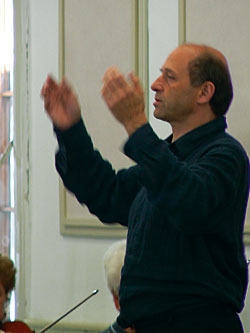
Iván Fischer, founder and conductor of the Budapest Festival Orchestra, has performed with many major orchestras and recorded for a number of major labels, most significantly with Philips, from 1995 to 2004. Fischer/BFO made the first multichannel orchestral recording for SACD, which Philips used as a demonstration disc for their first SACD players. I still treasure that disc—it demonstrates many of the advantages of the medium with a wide and varied program—but it has never been commercially released.
Jack Renner of Telarc: Direct from Cleveland!

Kathleen (K-10) and I first met Jack Renner—Telarc's Chairman, CEO, and Chief Recording Engineer—at Iridium, a tony jazz club here in New York. He was recording Benny Golson and the Jazz Messengers doing a rousing a tribute to Art Blakey. Now what would you think a guy who's won 31 Grammys over 21 years would be doing, exactly? Maybe feet up, a cigar languidly tracing curlicues in the air while directing his minions?
Jackson Browne: Enter The Natural
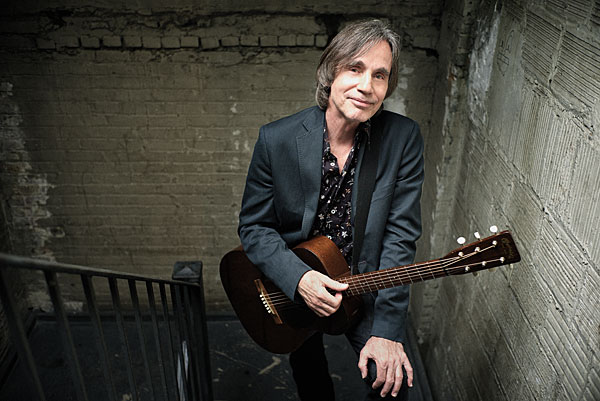
For famously civilized and jaded New York City, the crowd at the resplendent Beacon Theatre is uncommonly involved. Loud requests, many in tangled liquor dialects, boom from the balcony:
"'REDNECK FRIEND'!"
Onstage, Jackson Browne smiles and shakes his head.
"'COCAINE'!"
"I could do that, but it would have to be the rehab version." [crowd roars]
"'FOR A DANCER'!"
Oh, waitI'm yelling that.