

Jacques Mahul of JMlab: Inverted domes & otherwise...
Jacques Mahul is an interesting, thoughtful man. He's entirely Parisian: international, urbane, and sophisticated. During "HeeFee" '96 in Paris, Kathleen and I sat down with him and spoke about his early years as an audiophile. To accompany my">http://www.stereophile.com//loudspeakerreviews/273/">my review of the JMlab Utopia, We tried to find out what drives him—to make the drivers he makes today! I asked him when had it all started:
James Boyk: All-Tube Analog
It is a widely held belief that musicians do not assess hi-fi equipment in the same way as "audiophiles." I remember the British conductor Norman Del Mar—an underrated conductor if ever there was one—still being perfectly satisfied in 1981 with his 78 player, never having felt the need to go to LP, let alone to stereo. And some musicians do seem oblivious to the worst that modern technology can do. I was present at the infamous Salzburg CD conference in 1982, for example, where Herbert von Karajan, following one of the most unpleasant sound demonstrations in recorded history, announced that "All else is gaslight!" compared with what we had just heard. J. Gordon Holt proposed a couple of years back ("As">http://www.stereophile.com/asweseeit/348">As We See It," Vol.8 No.1) that sound is not one of the things in reproduced music to which musicians listen. I have also heard it said that even the highest fidelity is so far removed from live music that a musician, immersed in the real thing, regards the difference between the best and the worst reproduced sound as irrelevant to the musical message: both are off the scale of his or her personal quality meter.
James Farber: Capturing the Live Event...in the Studio
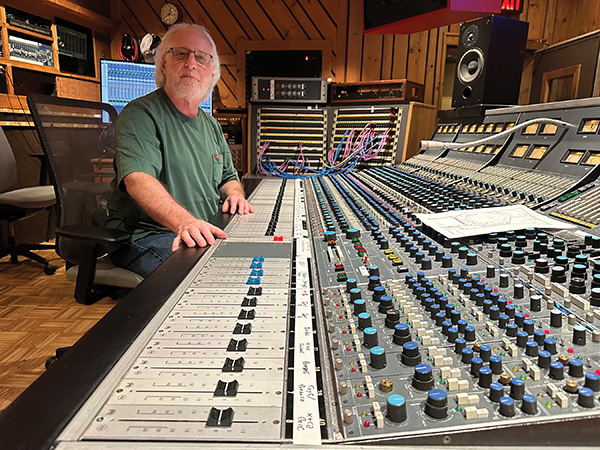
Photo by Ken Micallef
Ask the average jazz-loving audiophile to list his favorite recording engineers, and such icons as Rudy Van Gelder, Roy DuNann, and Fred Plaut would top their lists. but if you asked a handful of current and recent New York City jazz musicians to cite their favorites, one name would leap to the front of the pack: James Allen Farber.James Taylor: an American Standard
On iconic singer-songwriter James Taylor's 20th album, American Standard, the lanky crooner adapts the classic American songbook to his easy-rolling musical ways. The result is an American mixture of timeless songcraft.
Where some popular singers use the songbook canon to increase record and ticket sales, Taylor has no need to change himself or increase his audience. He's as comfortable as any man can be, having sold many millions of records the world over for almost 50 years.
Jared Sacks: DSD Present and Future

Some months back, SACD and DSD champion Jared Sacks, founder of Channel Classics, stopped by Casa Bellecci-Serinus in Oakland for an extended chat about the history of his label, recording in DSD, and his new NativeDSD.com download site. I started our conversation by asking Jared to share his history with music and the industry with Stereophile:
Jeff Tweedy: Wilco's Midwestern Yankee Embraces a Country Court
Jeff Tweedy is an artist who transcends time. Waitlet me clarify that. Tweedy, the multi-hyphenate singer, songwriter, guitarist, and co-producer for the midwestern-bred alt-rocking Americana band Wilco, has spent the bulk of his career creating music that crosses the divides between past, present, and future.
Jim Anderson: The Educated Ear
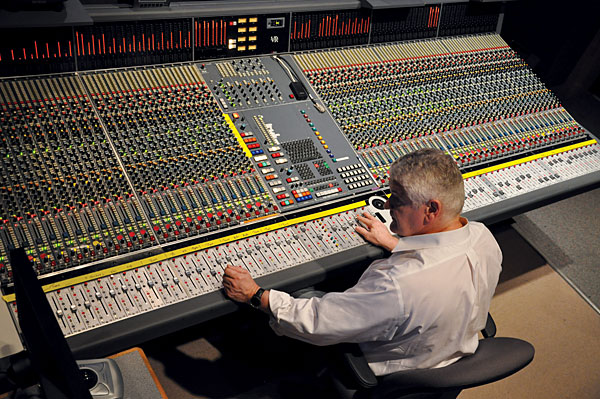
Tune those young ears, Mr. Anderson! After a 30-year career in audio engineering that's seen his name appear in the credits of over 1700 albums, Jim Anderson, who won the 2013 Grammy for Best Surround Sound Album, for his remastering of Patricia Barber's Modern Cool, thinks education is the key to stemming the tide of degraded sound that threatens to swallow the recorded-music industry. Anderson, who's taught for a decade in New York University's Clive Davis Department of Recorded Music, starts his students early.
Jim Fosgate: Of (Surround) Sound Mind
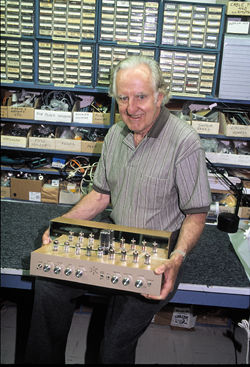
Jim Fosgate fits the category of Classic American Inventor to a T. This softspoken, quietly intense man has earned 18 patents and founded three successful electronics companies. In the late 1970s, he pulled out of the car audio business to follow his quadraphonic bliss, and designed the Fosgate Tate 101, arguably the finest quad decoder of the era. He also created the best-selling matrix surround processor of all time, Dolby's Pro Logic II, and in 2003 won an Emmy for the Development of Surround Sound for Television. He now serves as a senior executive consultant for Fosgate Audionics, a division of the Rockford Corporation.
Jim Thiel: A Coherent Source
There was something odd about the clock on Jim Thiel's office wall. I didn't get it at first, other than noting that instead of the minutes being marked off at 12 five-minute intervals, Jim's clock had 24 markings. That was it: as well as the number "12" in its usual place at the top of the face, there was another "12" at the bottom, where the "6" usually is. The clock that Jim built was typical of everything this laconic loudspeaker engineer is involved in: logical, functional, and different from what anyone else in the same field does. In his cigarette-strained drawl, Jim explained that the short hand of his clock always points toward the sun: directly up at noon, directly down at midnight. That's the way a clock should be, declared Jim, and when you're in his company, it's hard to see how he could be wrong.
Jim Winey: Maggies Man
The Pennsylvania Gazette documented an early connection between music and an American named Winey when, in 1759, it listed for sale as part of an estate "a middle sized organ, having eight stops." Interested parties were directed to one Jacob Winey, a Philadelphia merchant.