

Conrad-Johnson Premier 17LS line-stage preamplifier
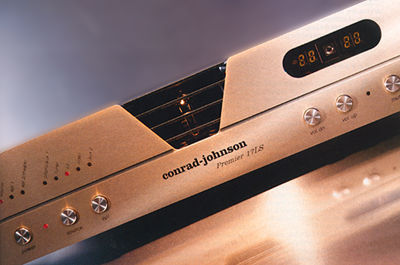
As part of my employer's never-ending attempts to transform me from an engineer into a manager, I am constantly being sent to seminars and courses, some of which are eminently practical—like "Managers and the Law," which taught us how to avoid getting ourselves and our company sued. Others are more esoteric, like a recent seminar on "paradigm shifts." A paradigm shift, we were told, is a fundamental change in the way we look at things, arising from a change in a belief so inherent that it's unconscious.
Conrad-Johnson Premier 3 preamplifier

It says something for the state of technology that, after a quarter of a century, there still is no authoritative explanation for why so many high-end audiophiles prefer tubes. Tubes not only refuse to die, they seem to be Coming back. The number of US and British firms making high-end tube equipment is growing steadily, and an increasing number of comparatively low-priced units are becoming available. There is a large market in renovated or used tube equipment—I must confess to owning a converted McIntosh MR-71 tuner—and there are even some indications that tube manufacturers are improving their reliability, although getting good tubes remains a problem.
Conrad-Johnson Premier 7A preamplifier
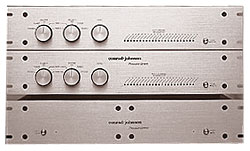
Conrad-Johnson launched the all-tube Premier 7 in 1988 as an all-out sonic assault on the state of the preamplifier art. A great deal has happened since then. For starters, C-J has gotten a great deal of feedback from customers, dealers, and reviewers. None other than J">http://www.stereophile.com/interviews/66">J. Gordon Holt (Stereophile, November 1988, Vol.11 No.11) concluded that: "It appears that nothing which could possibly have improved its sound had been omitted....It is, in fact, about as close as any tubed preamp has come to being perfectly neutral in sound—in nearly all respects." In the now-defunct Sounds Like... (issue 3), Sam Burstein concluded that "It is, with certain reservations, absolutely delightful to one's musical senses." And, speaking of absolutes, even Harry Pearson gave the Premier 7 a rave in the first round of his preamplifier survey (TAS, issue 58). As icing on the cake, John Atkinson (Stereophile, Vol.12 No.8) concluded that the 7 had "the requisite degree of sonic magic to make it a Class A recommended preamplifier."
Conrad-Johnson Premier Seven preamplifier
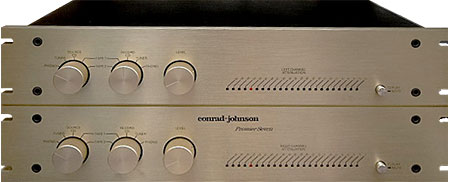
Whenever an audio high-ender thinks about tubes, he usually thinks about Audio Research. This is only natural, because Audio Research Corporation was almost single-handedly responsible for saving tubes from oblivion in the early '70s when everyone else switched to solid-state. But ARC was soon joined in its heroic endeavor by an upstart company called Conrad-Johnson, which entered the fray in 1977 with its PV-1 preamp, priced at an affordable (even then) $500.
Conrad-Johnson PV-4 preamplifier
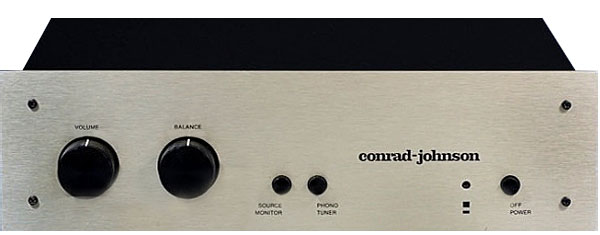
In appearance Conrad-Johnson's PV4 is distinctly plain: a basic black and silver box with a few simple knobs and buttons. The controls are logically laid out, clearly labeled, and work properly. The two channels track well through the volume control, maintaining balance; pushbuttons and control knobs have a smooth, solid feel (except for the noises audible through the system when switching inputs). Don't forget the turn-on and turn-off thumps mentioned above; the PV4 is the only one of the preamps I review in this issuethe others are the Audible Illusions Modulus ($450) and the Counterpoint SA-7 ($595)that lacks a mute switch.
Conrad-Johnson PV-5 preamplifier
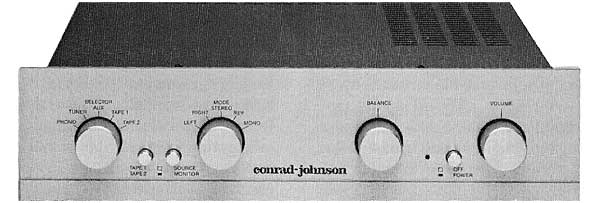
The $1485 PV-5 is a "budget" version of C-J's $2850 Premier Three preamplifier, but according to the manufacturer it embodies much the same kind of circuitry.
Tubed preamplifiers have a well-earned reputation as system busters. Many of them during warmup produce horrendous bangs or plops so severe that every speaker fuse in the system blows. If fuses are absent, or rated too high to protect things, the amplifier, speakers, or both are likely to blow up (not literally; they just twitch once and lie down dead). The PV-5 contains one of the most effective pop suppressors I've encountered, and produces no noise whatsoever during warmups and turnoffs.
Conrad-Johnson PV10 preamplifier
Last September, in Vol.15 No.9, I started my quest for the Ultimate Kilobuck Tube Amp with reviews of the $995 Panor/Dynaco ST70-II and the $1695 Nobis Cantabile. While neither really fit the bill—the Dynaco fell a bit short in terms of sonics, while the Nobis was priced a bit higher than a thou—they got me thinking of the Ultimate Kilobuck Tube Preamp. Because the greatest amp in the world can only sound as good as whatever drives it, and there's no sense looking for a kick-ass affordable tube amp if you're going to play Scrooge McDuck when it comes to the preamplifier.
Conrad-Johnson PV11 preamplifier
 I must admit that, for a long time, I found it difficult to accept the idea that a major portion of one's audio budget should be spent on the preamplifier. Speakers, yesthey produce the sound; amps drive the speakers, so they're important. And source components? Well, everyone knows it's garbage in/garbage out. But a preamp? Even the name suggests something that's not quite the real thing, like pre-school, pre-med, or premature. Unlike amplifiers, they don't have to contend with loads that sometimes approach a short circuit, and heat dissipation is not normally a problem. What's the big deal?
Conrad-Johnson PV9 preamplifier
As I write, it is garage-sale season here again in Santa Fe, and a recent sign near my home advertised "Over 3000 LPs, good condition, low prices." To my surprise, the seller wasn't a yuppie enamored of his new CD player but a true collector discarding the duplicates and dogs from his collection. 30 minutes later, many LPs heavier—including a mint Flanders & Swan At the Drop of a Hat (footnote 1)—and not too many dollars lighter, I returned to a great night's listening courtesy of the black vinyl disc.
Convergent Audio Technology SL-1 preamplifier

It takes more than passing courage to make another assault on building the world's best tube preamplifier. You face stiff competition from well-established firms like Audio Research, Conrad Johnson, and Counterpoint. Such units can't be made inexpensively, and you face the steadily growing problem of tube supply: it is getting harder and harder to get tubes that are stable, have predictable sound and performance characteristics, and are long-lived. And you have to show audiophiles who have been burned before that you will still be around when they need service.