

Digital Data Compression: Music's Procrustean Bed
Procrustean bed: a scheme or pattern into which something or someone is arbitrarily forced.
Procrustes: a villainous son of Poseidon in Greek myth who forces travelers to fit into his bed by stretching their bodies or cutting off their legs.—Webster's Ninth New Collegiate Dictionary
Procrustes: a villainous son of Poseidon in Greek myth who forces travelers to fit into his bed by stretching their bodies or cutting off their legs.—Webster's Ninth New Collegiate Dictionary
Digital Revenge
Many audiophiles will look back on the summer of 1982 as the year the creeping cruds invaded their hallowed halls of hi-fi. In the Conrad Hilton hotel, where most of the high-end contingent gathered at the June 1982 Consumer Electronics Show, one exhibitor was featuring a videodisc presentation with wide-range audio and insisting that this was the way of the future. And at least three others had managed to smuggle in digital tape recorders (all Sony PCM-F1s), and were giving many CES visitors their first taste of real, unadulterated, digital reproduction.
Digital Sound
Everybody, including myself, was astonished to find that it was impossible to distinguish between my own voice, and Mr. Edison's re-creation of it.—Anna Case, Metropolitan Opera Soprano, 1915
Directional Questions
As I write this, I am recuperating from four days of frenzy at the 1986 Winter CES in Las Vegas, Nevada. I am also pondering why I was so unexcited by most of what I saw and heard of the high-end exhibits; high-end audio may have reached a developmental plateau of sorts.
DisConcerted

On Sunday, March 22, at 8pm, the state of New York shut down, governor's orders. Here in the Big City, most stores are closedeven Starbucks, or at least the ones near me. In my neighborhood, up on Broadway, a grocery store is open, and a drugstore, a hardware store, and a couple of bodegas. Some bars and restaurants are open for takeout only, some advertising COCKTAILS TO GO in big black letters painted on bedsheetsNew Orleans comes to NYC. (Meanwhile, New Orleans itself, also a coronavirus hotspot, apparently is desolate, the bars closed, a hard thing to picture.)
Dispatches from the Other Portland
Portland, Maine, my hometown for the better part of two decades, is a pretty hip place. We are not, for the most part, innovators in fashion, but we are early adopters of the more interesting latest styles.
For years now, what I take to be a Brooklyn style has been prevalent among the local twentysomething crowd. The hipper restaurants are full of pretty young women and bearded men in plaid shirts who, on the one hand, seem ready for the woodlot but who, on the other hand, seem too skinny to lift a decent-size chainsaw. Likely as not, they arrived on single-speed racing bikes converted for commuter use. Nifty machines.
Dispelling a myth (?) about phono-cartridge loading
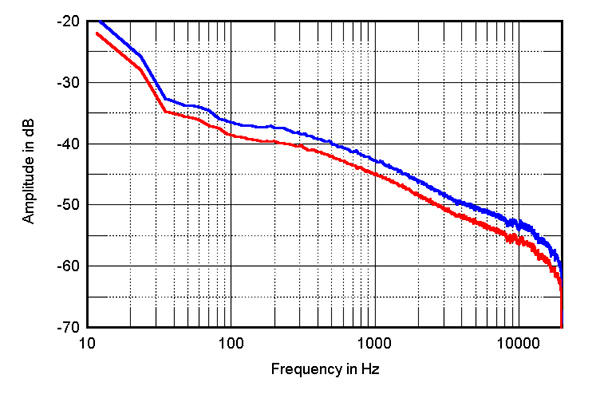
In the midst of his December 2023 Gramophone Dreams column, Herb Reichert presented the results of an experiment. He was listening to the most recent version of Zu Audio's Denon DL-103, installed on his new-old Lenco. He hooked it up to the moving coil input of his SunValley SV-EQ1616D phono preamp, which apparently is intended for use with low-output MC cartridges since it loads them down with a 50 ohm shunt resistora heavy load for all but the lowest-impedance MCs. The rough rule of thumb for loading an MC cartridge, as many readers are aware, is that the load resistance should exceed the cartridge's internal impedance by about a factor of 10.
Do It Yourself!
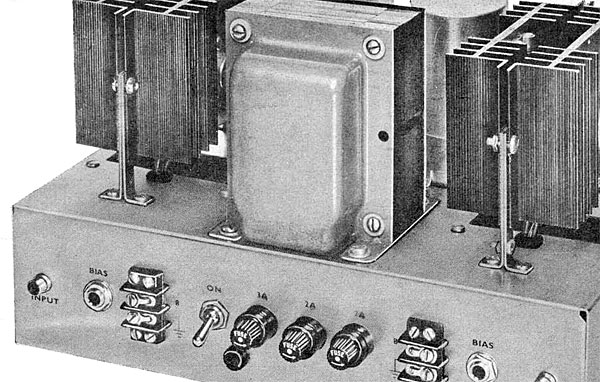
Editor's Note: in the main, Stereophile has steered clear of DIY audio projects, leaving them to magazines like The Audio Amateur, which was published by the late Edward T. Dell. But one of the exceptions was this 1967 article on the "Brute," a tube amplifier design by none other than Ed Dell. Note that the DIY competition mentioned by Gordon Holt is long closed to entries.John Atkinson
There's a platitude to the effect that the road to Hell is strewn with good intentions. Well, we don't see ourselves as headed for perdition, but we must admit that we are surveying a rather impressive-looking junk pile of good intentions at this point.
Do Musicophiles Enjoy Audio?
Paul Gowan's letter in the October 1989 Stereophile hinted that, whether or not audiophiles enjoy music, it should be true that the emotional experience we derive from music is what really matters. There, barefaced, lies the problem: who are "we"? A well-known Latin epigram affirms that in matters of taste there is no point in discussion. And a Greek epigram (coined in fact by Max Beerbohm in his Oxford novel Zuleika Dobson) suggests that "for people who like that kind of thing, that is the kind of thing they like."