

MQA: Some Claims Examined
"The fundamental problem of communication is that of reproducing at one point either exactly or approximately a message selected at another point."Claude Shannon
Since its announcement at the end of 2014, Master Quality Authenticated, the MQA encoding/decoding system, has spawned outspoken criticism. Some of the more thoughtful negative reactions have come from engineers such as Dan Lavry, Bruno Putzeys, and Daniel Weiss. Others have been expressed by manufacturers of digital products: the late Charley Hansen at Ayre Acoustics, for example, along with Jason Stoddard and Mike Moffat at Schiit Audio, John Siau at Benchmark Media Systems, and Jim Collinson at Linn Products. Some have been audio writers: Doug Schneider, at SoundStage!, and Paul Miller and Jim Lesurf, at Hi-Fi News. Most vociferous have been anonymous website posters. As Jim Austin remarks in his examination of MQA's decoding of impulse-response data elsewhere in this issue, "the nastiness online is unprecedented."
Munich!
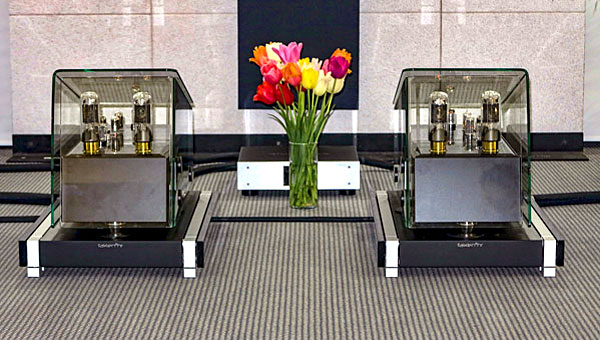
By the time you read this, Munich's High End 2019 will be a distant memory. Yet as I write this, having just returned from Munich, the experience is fresh in my mind. It's the most compelling audio topic I can think of, crying out for commentary.
Munich is to audiophilesto this one at leastwhat New York's 5th Avenue is to Black Friday shoppers. It's the audiophile version of flying through a canyon with a wing suit on. It's a giant rush, audio cocaine.
Music & Fractals
"Why do rhythms and melodies, which are composed of sound, resemble the feelings; while this is not the case for tastes, colors, or smells?"---Aristotle
Music Before Numbers?
This letter from Mike Pageau appeared in the April 2001 issue, and triggered the following "As We See It" essay:
Music Business—Show Business
Stereophile is devoted to getting the best sound from a home audio system. But as I have written">http://www.stereophile.com/asweseeit/533">written before, audiophiles don't have access to an absolute sound, only to what has been captured in the pits or grooves of their discs, which is itself the result of a creative process. The playing back and the making of recordings are therefore two sides of the same coin. This is why I get actively involved in recording projects and why I publish articles about those projects, the most recent of which appears on p.50. "Project">http://www.stereophile.com/musicrecordings/804k622">Project K622" describes the making of a new recording of Mozart's Clarinet Concerto (work number 622 in the Köchel catalog of Mozart's compositions, hence the article's title), which is being released both on hybrid SACD and on 180gm vinyl. (You can buy both from our secure "Recordings"">https://secure.stereophile.com/stereophile/recordings.shtml">Recordings…; page.)
Music Matters

I began writing these words on December 1, 2010, 13 years to the day that the magazine's website, www.stereophile.com, emerged from the digital darkness. That first, 1997 edition of our website was to a large extent the brainchild of one man, webmonkey Jon Iverson, who ever since has overseen its design and growth.
Music Served
I'm writing these words on the flight home from the 2008 Consumer Electronics Show, held January 7–10 in Las Vegas. I wasn't sure what to expect at this year's CES. Though the official stats show that the US economy has grown for the fourth straight year, audio retailers I spoke with before the Show feel that that economic growth has not resulted in any increase in consumers' disposable incomes. In fact, with the drying up of credit, retailers are concerned that 2008 may well be a step back from 2007 in overall sales, and that high-end audio—a niche category within a niche category—will be adversely affected by the relative impoverishment of the middle class.
Music? Or Sound?

The demo seemed simple enough. A distributor proposed a session for the Bay Area Audiophile Society (BAAS) that would pit his relatively low-cost speaker cable against an ultra-expensive competing model named for a Norse god. We would listen to the music first with the high-priced spread, then with his cable, then discuss the differences. As far as the distributor was concerned, everyone would hear that the Nordic Emperor had no clothes.
Must We Test? Yes, We Must!
"Test We Must," cried High Fidelity's erstwhile editor, Michael Riggs, in a January 1989 leader article condemning the growth of subjective testing. (See the sidebar for Peter Mitchell's obituary of HF magazine, now effectively merged with Stereo Review.) With the exception of loudspeakers, where it is still necessary to listen, he wrote, "laboratory testing (properly done) can tell us pretty much everything we need to know about the performance of a typical piece of electronics...We know what the important characteristics are, how to measure them, and how to interpret the results."
Mutton in Wolf's Clothing
I was visiting a high-end audio manufacturer several years back, and as the chief engineer and I talked about speaker design, the company's president popped her head around the door and told him that she was sending MacroVision their annual five-figure check.