

SACD & DVD-Audio: The Pre-Launch Mess
Audiophiles have a mess on their hands. In a somewhat surreal press conference in May, a half dozen audio luminaries—representing Sony, Philips, and several titans of the high-end recording business—stood on a HI-FI '99 stage looking awkwardly at the audience.
SACD, the Way Forward?
At the 2003 Consumer Electronics Show in January—see the report in this issue—Sony and Philips held an SACD Event at the Hard Rock Hotel in Las Vegas. There were trippy lights. There were the Grand Pooh-Bahs of Sony, Philips, and the record labels. There was loud multichannel Big Brother and the Holding Company. And there was Sony's main SACD man in the US, David Kawakami, supplying the pep talk.
Seeing Red
Although inclined to mood swings bordering on the manic-depressive, I am generally a very patient, tolerant person, willing to accept and overlook the foibles of those less perfect than myself. But even my incredible equanimity has its limits, beyond which the milk of my human kindness curdles, becoming as lumpy as last month's yogurt.
Selling the Benefits
"Ever wondered how the snowplow driver gets to work?"—Doyle Dane Bernbach TV ad for Volkswagen, 1963
Sellout!?
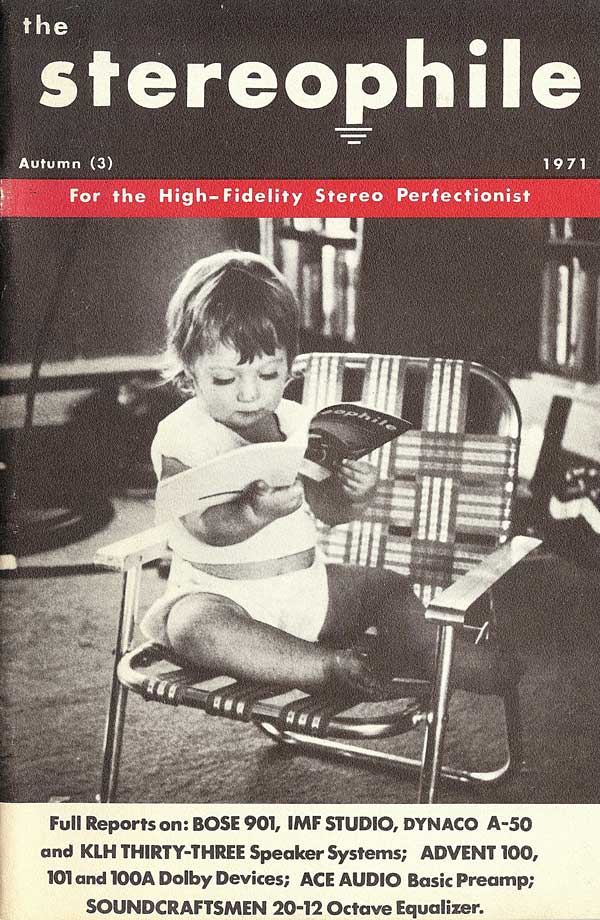
Alicia Holt, aged 18 months, devours her father's magazine
After much searching of soul and of bank account, we have reached an earth-shattering decision. The Stereophile is going to start taking ads. Servers, deconstructed
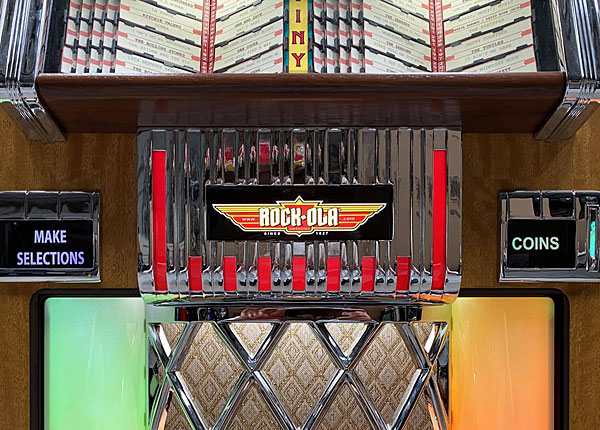
Jukeboxes were probably the first music servers to take a form we would recognize: a music-playing device that allows you to choose from several, or many, songs. The first commercial jukebox, Wikipedia says, was introduced in 1927 by the Automatic Musical Instrument Company, which came to be known as AMI.
Shaken, Not Stirred—and Welcome Back, Martin Colloms

Martin Colloms, pictured on HiFiCritic magazine's website.
A few months ago, the hi-fi world learned that Audio Research, perhaps the most storied hi-fi brand in US history (McIntosh would be the other choice), had a new owner. The company had overextended itself, then filed for "Assignment for the Benefit of Creditors"somewhat like Chapter 11 bankruptcy but different. The company was then acquired by a group led by a Canadian, Valerio Cora of Acora Acoustics. In the September issue's Industry Update, I wrote, "Audio Research, that great American hi-fi company, is now Canadian."
Not long after the issue came out, I received a note from Dave Gordon of Audio Research Corporation. With typical good humor, Dave suggested that my characterization was not correctthat ARC is not in fact Canadian. Why? Because Audio Research's parent company is based in ... Delaware?Should Music Be Free?

No one ever had to pay for recorded musicit was always "free" on the radioand the home taping of LPs, the copying of cassettes, and, later, burning CDs made buying music optional. Then Napster and other file-sharing sites kicked it up a notch and made it very easy to assemble a 10,000-song collection without spending a dime. Now, Spotify, BitTorrent, SoundCloud, MOG, and YouTube make music instantly accessible on demand. It raises the question: Will music lovers continue to buy music? Paying for recorded music is now, more than ever, a voluntary act.
Show Business
Perhaps it's the air in San Francisco, or more likely the fact that exhibitors and attendees were equally upbeat, but I came back from Home">http://www.stereophile.com/news/11672/">Home Entertainment 2003, held at the grand old Westin-St. Francis Hotel days before I write this month's column, jazzed. I was one of 15,123 consumer, international press, and trade attendees, according to the official stats, and we were treated to more than 100 exhibit rooms showing and demonstrating 225 brands of audio and home-theater gear. Stereophile's full report on what we saw and heard at the Show will appear in our September and October issues, while our web coverage can be found starting herehttp://www.stereophile.com/news/11662/">here;(footnote 1).
Show Time
"Rave on down through the corridors,
"Rave on words on printed page!"—Van Morrison, "Rave On John Donne"
"Rave on words on printed page!"—Van Morrison, "Rave On John Donne"