

Lindemann & Stello USB-S/PDIF converters

As someone who wrestled endlessly with the nine-pin serial ports and the RS-232 protocol with which early PCs came fitted (footnote 1), I welcomed the Universal Serial Bus (USB) interface when I first encountered it a decade ago, on the original Apple iMac. Plug it in. Don't worry. Be happy. The computer peripherals work as they should, which was often not the case with RS-232. It was a given, therefore, that the then-new USB port would be seen as a natural means of exporting audio data from a PC (footnote 2), but the first generation of USB-connected audio devices offered disappointing performance.
Linear Tube Audio Aero D/A processor
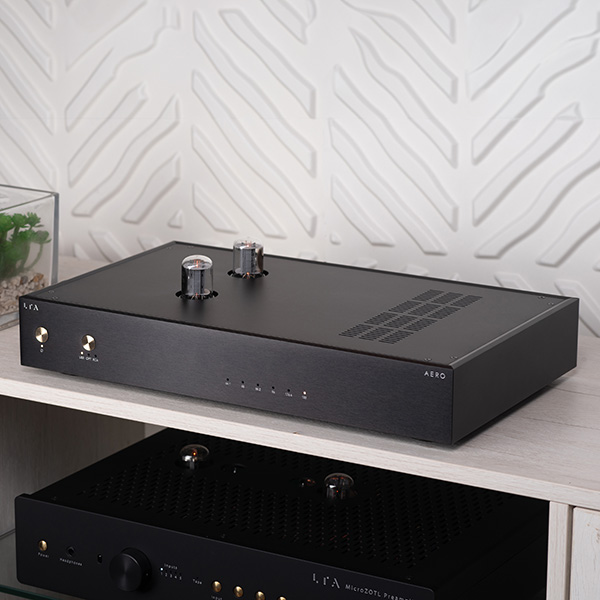
This paragraph from Linear Tube Audio's website description of their new Aero DAC sets the tone for the story I'm about to tell. "After trying various options, we chose the Analog Devices AD1865 R2R DAC chip, which is sometimes called the 'vinyl DAC,' for its organic sound. It is a non-oversampling DAC, with no digital filters. The AD1865 is much-loved by audiophiles and is used by at least one hi-fi company in a flagship DAC costing over $150,000."
Check the forums and you find that the AD1865 chip is also a heavy DIY favorite. Home brewers are attracted to this discontinued, "obsolete" 18-bit chip for its easy implementation and unprocessed, music-friendly sound.
Linn Klimax DS network D/A processor
Even the most savvy Stereophile reader might wonder what a "network music player" is. Linn rightly considers a music server to be a combination of 1) stored digital files, 2) music-management software, and 3) a device that uses #2 to transfer #1 to your hi-fi. What Linn's Klimax DS is is a high-quality digital-to-analog converter (DAC) that receives digital data through an Ethernet connection rather than optical or electrical S/PDIF or AES/EBU inputs.
Luxman DA-06 D/A processor
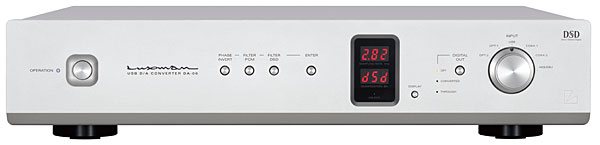
In the summer of 1999, Sony held a press event in New York City to mark the introduction of the Super Audio Compact Disc, then the sole domestic embodiment of the Direct Stream Digital (DSD) technology, jointly developed by Sony and Philips. The new format was hailed, in prepared remarks, by an impressive list of audio and music dignitaries: Nobuyuki Idei, then president of Sony Corporation; Steven Epstein, senior executive producer for Sony Classical; Yo-Yo Ma, appearing in a video created for the event; and Wynton Marsalis, appearing in person. All of the speechesevery single one of themflattered SACD by likening its sound to that of the analog LP.
Métronome Technologie AQWO SACD/CD transport and D/A processor

In an era when polar opposites compete as absolutes, it can be a challenge to acknowledge the different and equally valid ways in which audiophiles approach musical truth. But the reality is that our perceptions of how reproduced music should sound are determined, to a large extent, by how we approach the live experience.
M2Tech Young D/A processor & Palmer Power Station battery power supply

You know what's fascinating? As digital audio technology matures, DAC design is not converging on a single most popular or overall best approach. Multiple design paths continue to thrive, new ones are still appearing, and each variation on the DAC theme has its adherents and side trails: bitstream, non-oversampling, upsampling, various filters, DSD playback options, and on and on.
Mark Levinson No.30 Reference Digital Processor
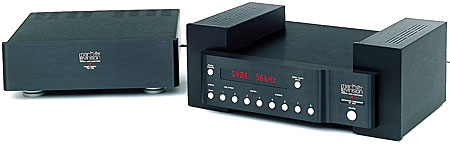
Over the past two and a half years, I've auditioned and reviewed a number of digital audio products. It has been a fascinating experience both to watch digital playback technology evolve and to listen to the results of various design philosophies. The road to more musical digital audio has been a slow and steady climb, with occasional jumps forward made possible by new techniques and technologies. Making this odyssey even more interesting (and confounding), digital processors seem to offer varying interpretations of the music rather than striving toward a common ideal of presenting what's on the disc without editorial interjection.
Mark Levinson No.30.5 Reference digital processor
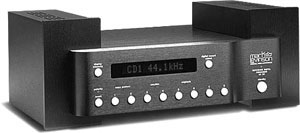
The arrival of the Mark">http://www.stereophile.com/digitalprocessors/mark_levinson_no30_referen… Levinson No.30 digital processor more than 2½ years ago marked a turning point in digital-audio reproduction. Although the No.30's $13,950 price tag put it out of reach of all but a few audiophiles, its stunning performance suggested that much more musical information was encoded on our CDs, waiting to be recovered by better digital processors. Further, it was inevitable that this level of performance would become less expensive over time. I was more excited by the No.30 than I've been over any other audio product. In fact, its musical performance was so spectacular that it alone occupied the Class A category in Stereophile's "Recommended Components."
Mark Levinson No.30.6 Reference D/A processor
The Mark Levinson No.30 has enjoyed a continuing residence in Class A of Stereophile's "Recommended Components" listing since it was reviewed in our February 1992 issue (Vol.15 No.2). Madrigal includes the No.30 in its "Reference" series, by which they mean that the unit will not become obsolete. Thus, when new technology became available, the No.30.5 update was introduced, consisting of a single digital-receiver printed circuit board to replace the original's three boards, and a new digital-filtering board. This revision was favorably reviewed by Stereophile in October 1994 (Vol.17 No.10).
Mark Levinson No.35 D/A processor
 When a manufacturer sets out to design and build a product, be it in high-end audio or any other field, the final retail price is usually a prime consideration. Parts and assembly are only part of the equation; there also must be enough buyers to amortize the design and development costs. If the product is to be a flagship modelsomething a company hopes will give a lift to its entire lineengineers will sometimes throw caution to the winds, designing a product without thought to its ultimate price, which is only set after the design is complete. When Madrigal Audio Laboratories set out to design their No.30 Reference Digital Processor, they appear to have chosen exactly this approach.