

TM Systems: New Name; Familiar Face
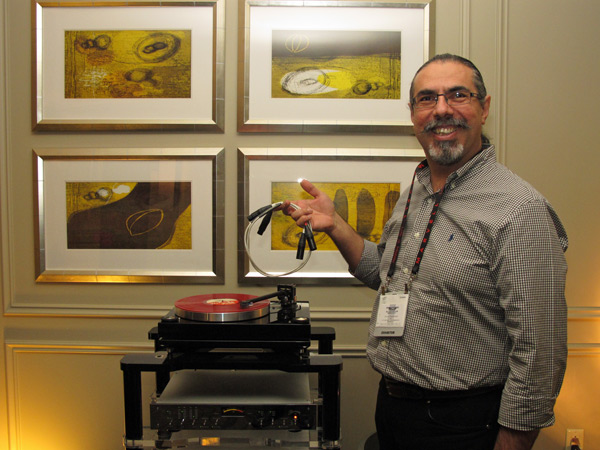
Touraj Moghaddam, based in Windsor, UK, near London, manufactures the relatively new TM Systems Pulse cables. The complete line includes tonearm wires and internal wiring for loudspeakers.
Not yet distributed in the US, Moghaddam’s handmade interconnects ($8000$9000/1.1m pair) will be followed in February or March by the machine-made Pulse R interconnects ($4000$5,000), which include special proprietary connectors made of copper alloy. Below them, Pulse B and Pulse C entry-level interconnects are in the works.
Veteran audiophiles will recognize Moghaddam as the 25-year veteran designer of Roksan turntables and loudspeakers. He began designing and manufacturing Pulse cables three years ago after he discovered that some Roksan ‘tables were being used with incompatible cables.
Gary Koh of Genesis, who had invited Moghaddam to exhibit his cables in the Genesis room, noted that they both attended the same college in England 25 years ago. “And now, 25 years later, we discover that we are both making our own cables because of similar concerns, such as their incorrect use by some people as tone controls,” he said.
Tone Imports’ Old-Fashioned Way & the DeVore Fidelity Orangutan O/96

In a show dominated by forward-racing technologies and innovative solutions to complement the ways in which we consume media, DeVore Fidelity and Tone Imports continue to find inspiration in old-fashioned pleasures...
Torus Power from Plitron
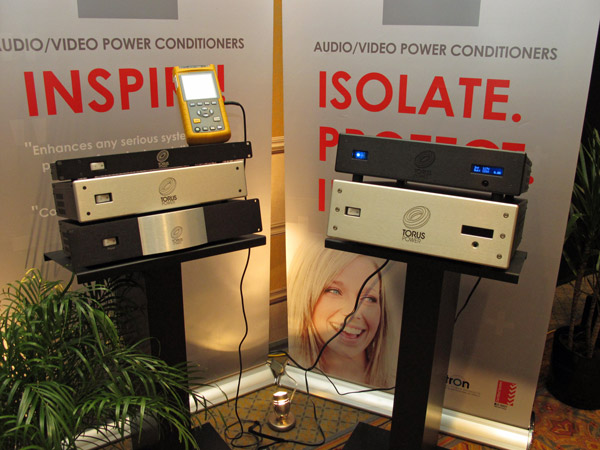
Joining WireWorld, Thiel, and Bryston in their impressive exhibit in the Sands/Venetian Convention Center was power specialist Plitron. Based in Canada, the company has spent 28 years in R&D and manufacture of toroidal transformers that are utilized by many of the leading companies in the audio industry. Five years ago, Plitron decided to introduce their own Torus Power line to demonstrate their full implementation of their work with toroidal isolation transformers and power conditioning.
Arthur Kelm, formerly chief engineer in a number of recording studios including Record One, the Record Plant, and Skywalker, designed the Torus Power Ground One power conditioner panel that uses Plitron transformers. “I have known that power is the foundation of every audio/video system,” he explained. “It’s also the most misunderstood application you have. People just don’t understand power and its importance.
“The major advantage of using an isolation transformer is that you now have a very low impedance to plug into, and you can rebond neutral and ground which is where 90% of your noise comes from in electrical systems.”
The complete Torus Power line includes units from 2.5 amps up to 300400 amps. The lowest priced unit, the RM 2.5 ($999), handles 2.5A. The company’s most popular units, ideal for dedicated audio systems, are the RM 15 ($2000) and RM 20 ($3000). There is also a custom installation series with 60A and 100A units, plus Ground One panels for use in all-home AV and theatres. Some models include automatic voltage regulation.
Totem's Elements
There’s a kind of hierarchy of prestige among speaker manufacturers (which may or may not have anything to do with the sound quality of their offerings). At the bottom you have manufacturers that use off-the-shelf drivers which are available to any hobbyist, and don’t do anything other than mount these speakers in an enclosure and connect the drivers to a crossover (which may also be an off-the-shelf unit). Then you have manufacturers that start off with an off-the-shelf unit but modify this unit to their purposes. (The modification can be as simple as adding a bit of mass to the cone or adding a foam ring around the tweeter cone.) The next higher level in the hierarchy are speaker manufacturers that have the drivers made to their specifications by a specialist manufacturer of speaker drivers. And at the very top of the hierarchy are the speaker manufacturers that make their own drivers. This allows them to not only control of every step of the manufacturing process but also the ability produce drivers that are proprietary.
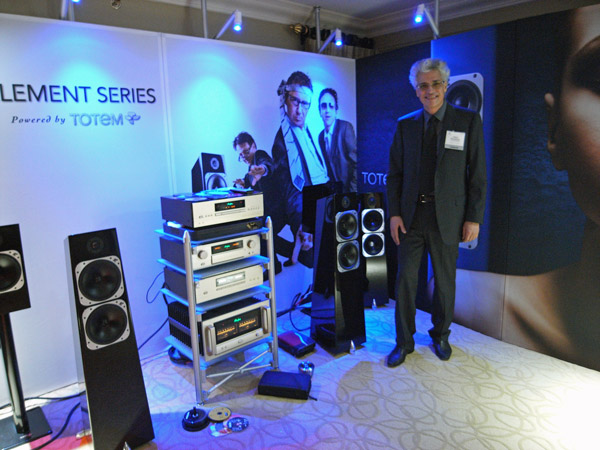
It is this top level of speaker manufacturer hierarchy that Totem has reached with the new Element series, shown in JA's photo with designer Vince Bruzzese. The 7” woofers used in the Element Series are of the Canadian’s company’s own design, manufactured in-house, which requires three hours of machining and more than four hours of assembly. I don’t know enough about loudspeaker driver design to talk with any authority about how the new Totem woofer differs from other woofer designs (the magnetic design was inspired by something called the Halbach array); suffice it to say that it has a free-air resonance of 1617Hz, and its mechanical top end frequency rolloff is such that it’s matched with the tweeter without any crossover components in the woofer path. The top-of-the-line Metal ($12,995/pair) sounded good in a brief listen. I look forward to having more of an opportunity to listen to these new Totems at the 2011 Montreal show.
Trenner & Friedl Duke

"$175,000/pair?" I gulped. I know my beat at the 2011 CES was expensive loudspeakers, but the price of the Trenner & Friedl Duke took my breath away. Yes, the sound in the large room the new Austrian company shared with Cardas, Profundo, and the Jeff Rowland Design Group was superb, but that's a lot of change, even if the manufacturer will fly anywhere in the world to set the speakers up in the customer's home. (The rest of the system comprised a dCS Puccini used as a transport to feed JRDG's new Aeris DAC (the Colorado company's first digital product), $9800; a JRDG Criterion line stage, $18,500; and two JRDG 625 stereo power amplifiers, $13,500; with Cardas Clear cabling.
Each 12" woofer uses a fiber-glassreinforced paper cone and is loaded by what is referred to as "a hybrid form of horn-resonator and bass reflex design." The mid/HF module is coupled to the woofer modules with spheres of varying hardness, to drain vibrations optimally, and can be adjusted to bring the drivers into proper time alignment at the listening position. The midrange unit features a papyrus cone with an elmwood phase plug and an alnico magnet, while the enclosure is filled with wool from "locally raised sheep" to reduce internal reflections being retransmitted through the drive-unit cone. The tweeter uses a titanium nitride dome loaded with a Tractrix-flare horn, while the supertweeter is a diamond-diaphragm type. The upper-range crossover is passive; the woofers are fed via a line-level crossover, and internal wiring is all Cardas Clear.
Trenner & Friedl's Crystal Power

The Trenner & Friedl Duke's diamond-diaphragm supertweeter fires upward at a Golden-Ratioproportioned Swarovsky crystal that acts to widen its dispersion.
Ultimate Wisdom

I have been following with interest the goings-on at Nevada-based Wisdom Audio, since the company was revitalized with members of the team that had led Madrigal to success in the 1990s. But their concentration on in-wall speakers, using planar technology developed by David Graebener, means that they fall within the bailiwick of our sister publication Home Theater. Going in their room at CES, however, I was confronted by the LS4 floor-to-ceiling on-wall ($80,000/pair), which sounded magnificent driven by Classé's superb new CT-M600 monoblocks and reinforced below 80Hz by a pair of Wisdom enormous STS 2x15" subwoofers ($10,000 each; STS stands for "Steamer Trunk-sized Subwoofer"). The system controller, which includes an active crossover and room correction, costs $6500.
The LS4 uses four identical push-pull modules, each comprising a central HF section operating above 750Hz flanked by midrange sections covering the 80–Hz range. The backwave is absorbed within the enclosure, but the enormous radiating area still gives a sensitvity of 100dB/2.83V/m. (Impedance is 4 ohms.) Though the LS4 is fastened to the wall behind it, the weight is supported by a single spiked foot.
The LS4 is where architectural audio becomes aspirational audio.
USB from JPS Labs
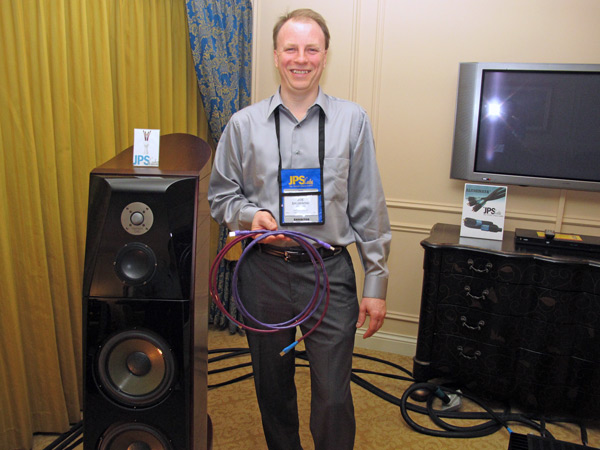
Joe Skubinski of JPS Labs introduced its first two USB cables, the Superconductor Q USB (approximately $399/1m) and Superconductor 3 USB (approximately $799/1m). The cables are so new that Skubinski had to guess at the prices. Both boast a precision twisted-quad design with dual shields and gold-plated connectors.
Skubinski’s design goals were to transfer the digital signal as flawlessly as possible without radiating noise into adjacent cables. As I left the room, he and the folks from Usher loudspeakers were about to conduct an experiment to see if the Superconductor 3 could successfully transmit music recorded at 352.8kHz.
Vandersteen's new Tréo
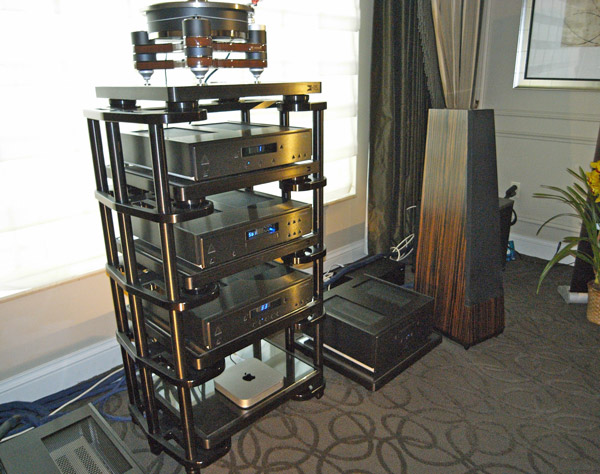
Richard Vandersteen doesn't rush to release new loudspeakers, so given that the top-of-the-line Vandersteen 7 was a hot product at the 2010 CES, I wasn't expecting anything new at the 2011 Show. Talking to Richard in the company's Venetian suite, where they were featuring the Model 7, he casually mentioned that the new Tréo ($5990/pair) was at the Show, just not in his room. So I hustled me along to the Musical Surroundings room, where the Tréos were being demmed with a Clearaudio turntable and Aesthetix electronics.
Basically, the Tréo is similar to the $10k/pair Quatro Wood that Wes Phillips reviewed in December 2007, but replaces that speaker's active, equalized bass unit, with a conventional passive 6.5" woofer and an 8" flat-cone "acoustic coupler." Good sound at an equally good price.
Vienna Acoustics The Kiss
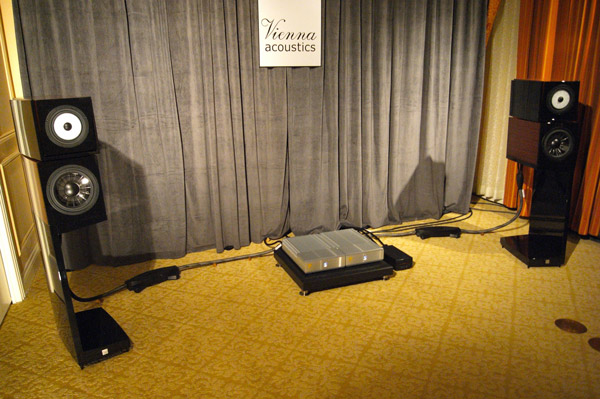
Austrian Vienna Acoustics set up its own distribution company in the US in 2010 and when I popped my head in the door of their suite at the Venetian, I saw they were demming the Kiss speaker ($16,000/pair) reviewed a year back by Wes Phillips. (The rest of the system comprised Ayre KX-R preamp, MX-R monoblocks, and DX-5 "universal audio engine, with Transparent cabling.)
The Kiss looks like a stand-mount but it is really a floorstander with an integral stand. The sound in this room really flattered piano, whether it was a 24/96 file of a jazz trio featuring a Fazioli instrument, or Glenn Gould's 1981 reading of the Bach Goldberg Variations, remastered from the analog backup tapes.