

Vivid G2Giya

My other joint best sound at CES was to the On a Higher Note room at the Mirage Hotel across the street from the Venetian. On dem was the G2Giya ($50,000/pair), which made its debut at the 2010 CES, driven by a Luxman stereo amplifier, and the Audio Aero La Source tube preamp/digital player, hooked up with Shunyata's new Anaconda line of cables.
The G2 has half the cabinet volume of the similar-looking G1Giya that Wes Phillips reviewed last July, and replaces the larger speaker's twin 11" woofers with 9" units. Whether it was the smaller speakers not exciting the penthouse room's acoustics as much as had the G1Giya the previous yearthe Mirage's glass-fronted rooms may give spectacular views of Las Vegas, but they also flap at low frequenciesor the new front-end and cables, but the sound on José Carreras singing the audiophile classic Misa Criolla, Peter Gabriel's idiosyncratic but convincing reading of Paul Simon's "The Boy in the Bubble," and the unexpected combination of John Lee Hooker dueting with Miles Davis, from the soundtrack to the movie Hot Spot was to die for, the system simply stepping out of the way of the music. As it should.
Volent Paragon VL-2
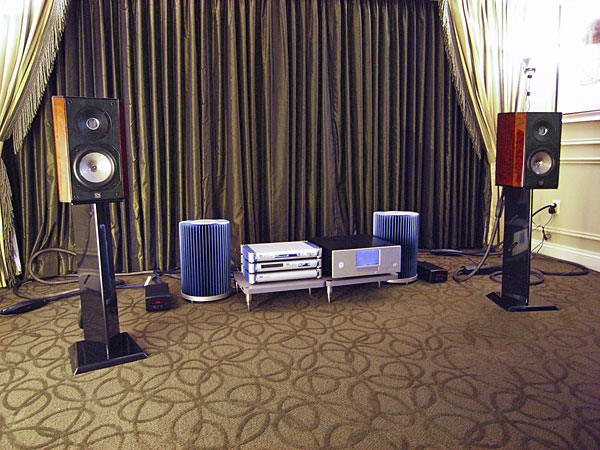
The Paragon VL-2 Signature ($8600/pair) from Hong Kong-based Volent Corp. combines a unique dual-ribbon tweeter with a titanium/graphite-sandwichconed woofer in an attractively curved enclosure filled with wool. Frequency range is specified as 30Hz60kHz, impedance as 4 ohms, and sensitivity as 88dB/2.83V/m. Driven by MSB's M202 tower amplifiers and MSB digital source, the sound was much larger than I was expecting from these stand-mounts.
VTL’s Mighty MB185 Monoblocks
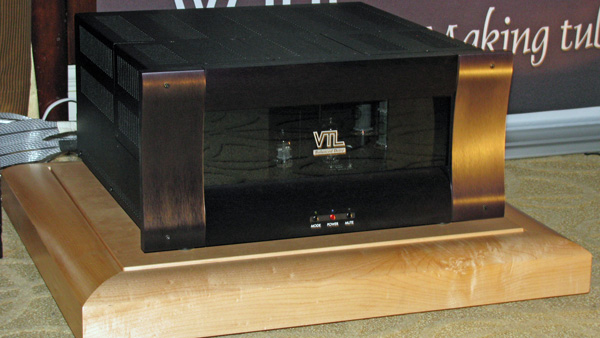
Hi-Fi shows can be notorious for playing the same audiophile approved dreck over and over again. Not so in the VTL room. Luke and Bea Manley played one great tune after the next and introduced me to a bunch of albums I need to go get. Helping me enjoy this great music was VTL’s MB185 monoblock amplifiers ($14,500/pair). Using EL34 output tubes giving 185W in tetrode and 90W in triode, the MB185 offers a unique three-way setting that allows the user to dial in the amount of global negative feedback used in the amplifier. According to Luke Manley, this will allow users to fine-tune the sound of the MB185’s to best match the accompanying speakers and listeners’ tastes.
This system, the smaller of the two in the VTL room, was certainly to my taste. I preferred the MB185 in tetrode mode, finding that it offered the best balance between dynamic bass punch and smooth midrange and extended treble with the Avalon Indra speakers being used. VTL has always struck me as a serious company making serious products, but I had serious fun in their room at this year’s CES.
Wadia's 171iTransport

Wadia’s new 171iTransport digital iPod dock ($599) is now also compatible with Apple’s iPad. Other changes include an improved circuit board, new clock chip, higher grade connectors, and a better internal power supply. The remote control has also been redesigned for better ease of use.
Wedding Dresses and Blue Hair

I have no idea what it has to do with an audio show either, not that Stephen Mejias seems to care.
Weiss MAN 202 Music Archive Network Player

We're still in that transition period where most folks who move to music servers and care about quality are going to source their tunes primarily from discs. As a result, most of the current server crop has a disc slot and the new Weiss MAN 202 is no exception.
The MAN 202 also includes AES/EBU, SPDIF, Ethernet and USB inputs on the back along with AES/EBU, SPDIF and Firewire outputs. Since there is a DAC inside, there are also a pair of balanced and a pair of unbalanced analog outputs. And there's more: Wordclock in and output via BNC connectors and a WiFi antenna is included for communicating with an Apple iPad through a free app which serves as the interface to run all of the music.
Weiss says that the MAN 202 will handle all digital formats up to 24bit/192kHz (with comparable quality to the Weiss DAC 202) and should be shipping in 4 or 5 months for a retail price of between $10,000 and $15,000. I love this kind of product, which is optimized for the modern audio enthusiast who doesn't have time to play around with computers.
Weizhi PRS6 AC Distribution
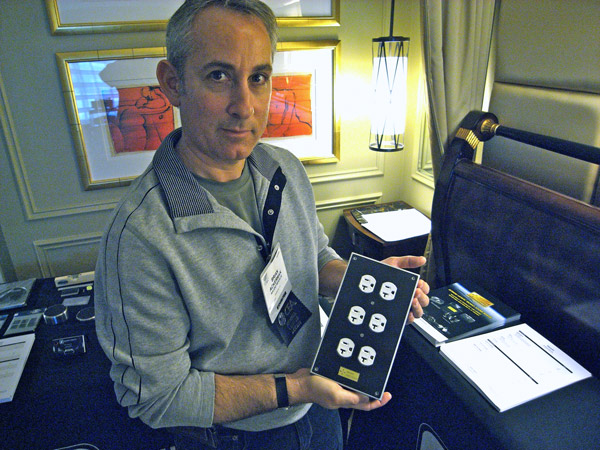
AAudio Imports' Brian Ackerman holds what must the world's most expensive AC strip, the Weizhi PRS6. Priced at $3200, the PRS6 is machined from a block of Super Duralumin alloy and features a graphite grounding module. There are no isolating transformers or conditioning circuits, the PRS6 is purely passive. The thinking behind the product, said Brian, is "to get the noise out of the line without changing the sound."
Yes, the Weizhi is a gorgeous piece of audio jewelry but do people really pay $3200 for peace of mind? Brian told me that he is currently shipping 10 units a week, so I guess they do.
Westlake Audio’s Cable Muffs
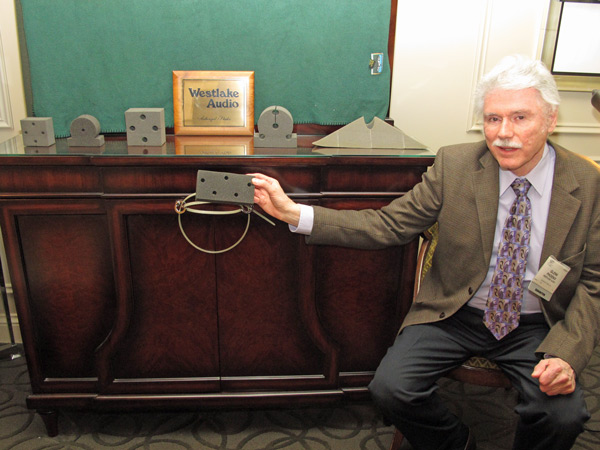
Glenn Phoenix, President of Westlake Audio, was touting the loudspeaker company’s cable muffs. Made of foam, the muffs are used to support and separate cables. They are also said to benefit cables that are under-damped.
“We have a rule in the company to keep cables between 2” and 4” apart,” he said. “Putting left and right channels too close together can increase crosstalk, while positioning them too far apart may lead them to generate and pick up interference.” I hope I got that right.
Westlake Audio manufactures cable muffs with a number of different size holes and slots to accommodate a wide assortment of cables other than the extremely thick variety. Prices range between $59.50 and $88/set.
Wharfedale's Diamond Series

A look inside the beautiful Wharfedale Diamond 10.1 ($350/pair), a bass-reflex design with a soft-dome tweeter and Kevlar mid-woofer.
Wireworld’s New USB Audio Cables

Wireworld’s David Salz released two new USB cables, the Platinum Starlight ($600/1m) and the Silver Starlight ($300/1m). The Platinum Starlight USB uses molded carbon-fiber connectors, while the Silver Starlight uses aluminum connectors.
Both cables use a new technology, called DNA Helix, that Salz originally developed for use in Wireworld’s premiere PS and SS HDMI cables. DNA Helix utilizes twice as many signal conductors as conventional USB cable designs.
When Salz was first developing the DNA Helix design, he began to measure the transmission speed of cables. By designing a more efficient cable, he found he was able to increase transmission speed by 20%.
“I always start with the direct connection as my reference,” he explains. “What I heard from cables at the start of my work was really disappointing. This new design allows me to get substantially closer to the purity of the direct connection.”