

Simaudio Moon 100 D DAC
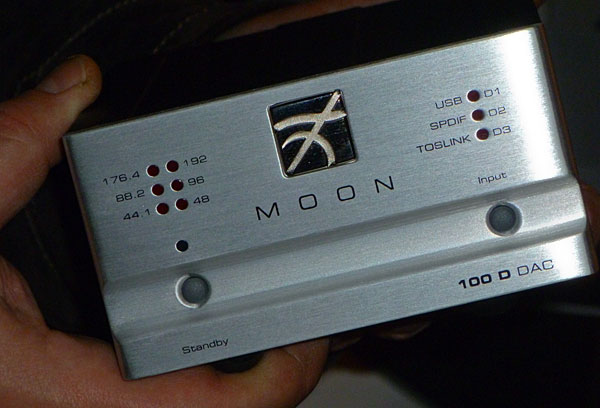
Introduced a couple months back, the Moon 100 D DAC includes coax and optical SPDIF as well as USB inputs. It also features an asynchronous sample rate converter and operates at 24bit/192 via SPDIF and 16/48 via USB.
All this for $699. "It's a killer" says Simaudio's Lionel Goodfield.
Simaudio Moon Amps
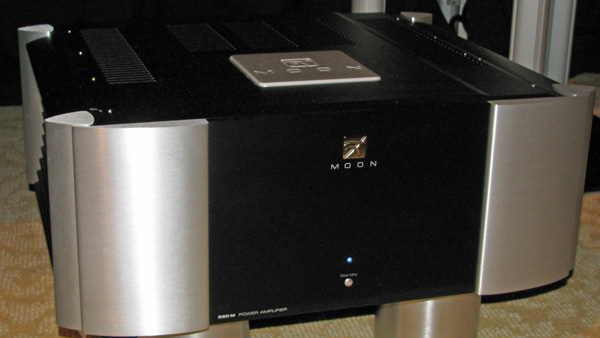
I chilled with Lionel Goodfield of Simaudio in the Canadian manufacturer’s room around noon on Friday. We were both hitting our midday energy slump, so we sat on their comfy couch and chatted about two new products in Simaudio’s Evolution Series. The Moon 880M monoblock amplifiers ($38,000/pair) offer 800W into 8 ohms, 1600W into 4 ohms, and a staggering 2400W into 2 ohms. The amp utilizes bipolar output devices biased into class-A/B and uses zero global feedback. The amps sounded as relaxed as the Bob Marley tunes Lionel played near the end of our discussion. It was a great break from the CES frenzy.
Sonneteer Server
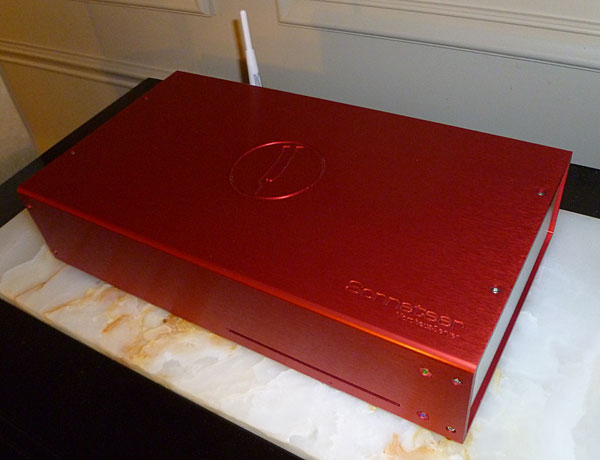
Sonneteer presented the production version of the $4,000 Server they were showing last year, this time with optional WiFi, and 3TB of storage.
Sonneteer's Morpheus Music Center
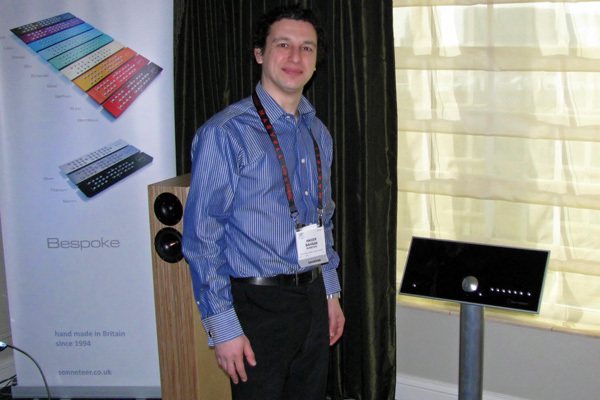
Sonneteer, a UK audio company, was showing off its new Morpheus Music Center ($4000), an integrated amplifier, DAC, and control center for streaming audio. The amplifier section is rated at 50Wpc and will stream music via WiFi or Ethernet, play Internet radio, and USB input. The Morpheus also has three analog inputs and one analog output so it can send signal to an external power amplifier or subwoofer. Standing by his creation is Sonneteer’s Haider Bahrani.
Sonus Faber Amati Futura

The first trickle-down from The Sonus Faber project is a revised Amati model, the Amati Futura ($34,000/pair). Beautifully finished in a mirror-gloss lacquer, as you can see, it was also almost unphotographable. It was also only on passive display in the Sumiko penthouse suite at the Venetian.
Sony reenters the high-end speaker market
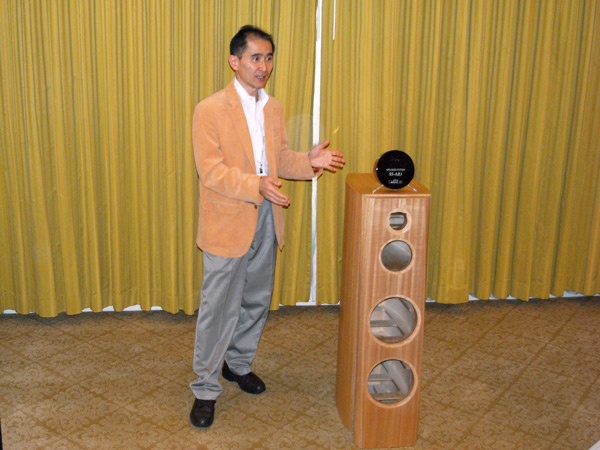
Sony has a track record of sporadically producing high-quality loudspeakers, like the SS-M9 that I reviewed in 1997. But as good as these speakers could be, their commercial success was limited. But at the last two Rocky Mountain Audio Fests, Ray Kimber had been getting great sound with a prototype Sony floorstander and the 2011 CES saw the official launch of the Sony SS-AR1 ($27,000/pair).
A three-way design, the SS-AR1 uses Scanspeak drive-units made to Sony's specification, housed in a unique, Japanese-made enclosure. Seen here standing next the basic enclosure, designer Yuki Sugiaro explained that the walls are made from Finnish birch ply and the front baffle from maple ply. The latter is sourced from trees grown in Hokkaido.) The woodworking is so precise that the cabinet shown here is holding itself together without any glue (thoigh glue, of course, is used on the production line).
Driven by Pass Labs amps and an EMM SACD player, the SS-AR1s were demmed in too small and crowded a room for me to pronounce on their sound quality, other than to note that the midrange seemed exceptionally clean and uncolored. But my prior experience at RMAF suggests that this will be a contender.
Availability is said to be "spring" and Sony announced that they have already signed up blue-chip US dealers like Goodwins, Definitive, David Lewis, and Music Lovers.
Stage III Concepts Cables

Stage III Concepts, a Pasadena-based company whose products are distributed by Brian Ackerman of AAudio Imports, has released four newly re-engineered, top-of-the-line cables. All are part of the A.S.P. Reference series (Absolute Signal Purity), and are entirely handmade (including connectors) by Luis de la Fuente. Connectors are made of ceramic with a mixture of special resins to minimize crosstalk between pins, and the entire housing composed of carbon-fiber and epoxy resin. The wire itself is silver-palladium alloy. The A.S.P. Reference interconnect and speaker cable also sport a vacuum dielectric.
On display were the Zyklop power cord ($6000/1.5m), Gryphon interconnect ($5800/1m pair RCA, $6300/1m pair XLR), and Mantikor speaker cable ($13,200/2m pair). Besides digital and phono cables and speaker jumpers, the company sells hook-up wire for components in a variety of gauges. The least expensive, 22 AWG ($66/1.5m) is followed by 17 and 15 AWG ($280/1.5m).
Asked about the cable’s sonic properties, Ackerman replied, “It has no sound at all. It’s probably the closest thing I’ve heard to having no wire. It’s virtually invisible, like a direct connection.”
Stein Music’s Intriguing Accessories
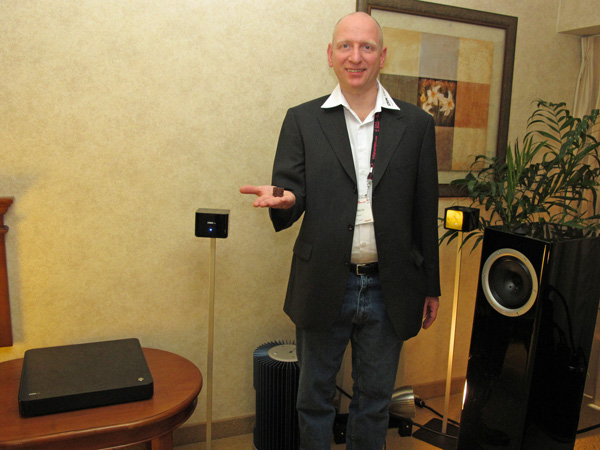
The Stein Music Harmonizers (approx. $1100 each; distributor Walter Swanborn of Fidelis AV is putting together package deals that include Stein’s Harmonizer accessories) are one of those mysterious sound-improving devices that are hard to explain to those who have not heard them. They certainly impressed Sam Tellig, who recently discussed them in his monthly Stereophile column.
They’ve also impressed me greatly. A set of four Stein Harmonizers has been residing in my reference system in Oakland for several months, bringing me much pleasure. To these ears, when set up correctly, they have a far from subtle effect on three-dimensionality, transparency, and realism. They take me one step closer to the real thing, making what comes out of my speakers sound less like hi-fi and more like music.
I was delighted to spend some time at T.H.E. Show with the Harmonizers’ designer, Holger Stein of Germany. Stein was showing the newest version of the Harmonizers, which were five years in the making.
The latest Harmonizers have a three-position switch on the rear. Those positions are (1) on with light, (2) on without light to preserve battery life for up to two years, and (3) off, to save energy when the system is not playing. Besides that, they function identically to their predecessor (which I have).
So how does the Stein Harmonizer work? Best to quote directly from Stein. Since, for him, English is a second language, I’ve given him an assist in the editing department:
Stello Ai500 integrated amplifier
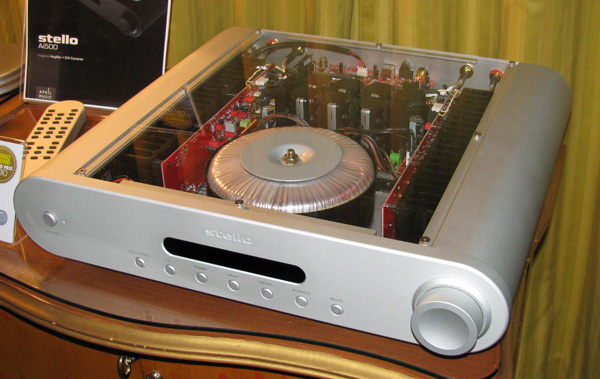
The Stello Ai500 integrated amplifier was shown in the April Music room. A 150Wpc integrated with a built-in high resolution DAC, the Ai500 sells for $3500 and ably drove power-hungry Magnepan speakers.
Stereophile Room at the Venetian

The show will open in a few minutes and 5-year CES veteran Rosemarie Torcivia is ready to hand out free magazines and answer questions in room 29216.