

His Master's Voice
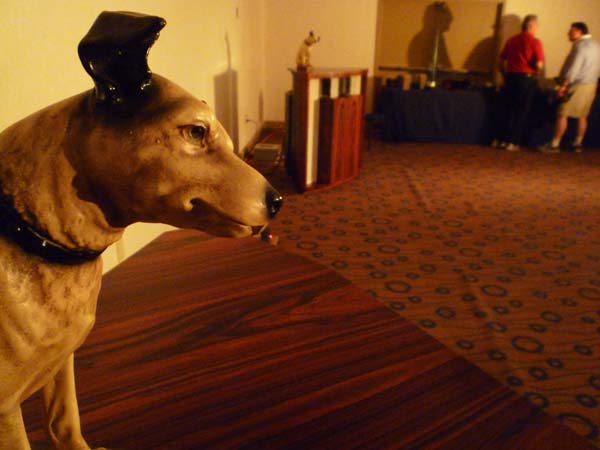
Aww. Nipper sits patiently atop one of John Wolff’s gorgeous Hartsfield loudspeakers.
Hot Stuff from Rosso Fiorentini & AMR
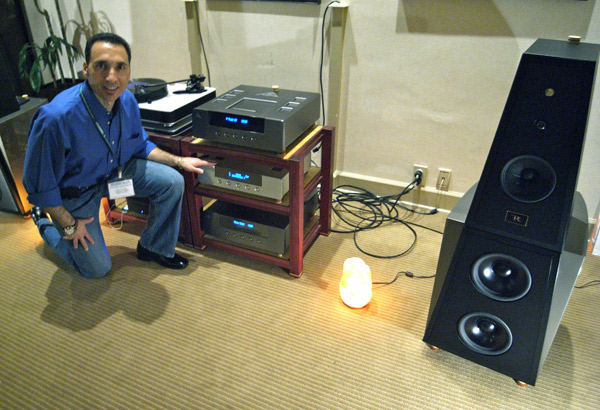
The Avatar Acoustics room featured the Rosso Fiorentini Siena speakers ($24,995/pair) that made their North American debut at last January's CES, seen here with Avatar's Darren Censullo. A four-way sealed-box design, the Siena features two 8" aluminum-cone woofers, a 6.5" paper-cone midrange unit, a 1" silk-dome tweeter, and a Murata ultrasonic generator and produced a big sweep of sound on what appeared to be the Show's ubiquitous dem track, Nils Lofgren's live acoustic number "Keith Don't Go," driven by an AMR AM-77.1 integrated amplifier. But converting Nils' bits from an AMR CD-77.1 CD player used as a transport was AMR's new DP-77 D/A converter ($4995). Uniquely, this offers a choice of two DAC chips, one a non-oversampling 16-bit type which is recommended for CD playback, the other a 32-bit type optimized for playback of high sample-rate data, which offers minimum-phase, apodizing, and "organic" reconstruction filters.The DP-77 has an asynchronous USB input that can accept data with sample rates up to 192kHz and jitter is reduced by using a high-precision clock and rather than adjusting its frequency in continuous steps to match the average rate of the incoming data, which can allow jitter to bleed through to the DAC chip, the DP-77's clock switches between 28 million discrete frequencies.
Immedia Rocks Gently
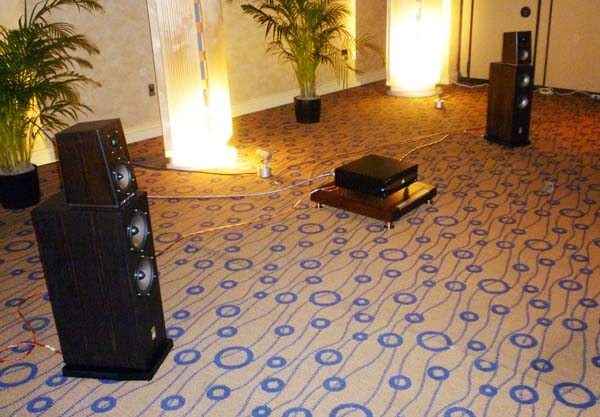
In the Immedia room, a sweet, relaxed sound was coming from a system made of Spiral Groove Allegra 2.0 loudspeakers, a Spiral Groove E60A power amplifier on a Finite Elemente Pagode platform, Audio Research CD8 CD player, Qualia & Co. Indigo Blue Reference preamp, and Spiral Groove cables.
At the time I walked into the room, Immedia’s Allen Perkins was in the nearby Analog Ballroom, tending to a disassembled sample of his Spiral Groove turntable, discussing its technology and design, while Michael Fremer used a fully assembled SG ‘table to give a turntable setup seminar.
So, though I didn’t get to hear vinyl, I nevertheless enjoyed the music. The system filled the rather large room with a lovely, easy sound, with solid stereo images and strong, compelling center fill. I don’t recall what we were listening to, but my notes quote the song’s lyrics—“I will rock you gently...”—which seems appropriate for this room and system.
Inside the BMC AMP M1 monoblock

Wow. Here’s a look inside the 200W BMC AMP M1 monoblock ($15,580/pair), with its massive 2-kilowatt toroidal transformer.
BMC stands for Balanced Music Concept. The company was founded by Bernd Hugo and Carlos Candeias, two audio designers based in Germany. BMC’s products are designed in Europe, but manufactured in China to keep prices down. While $15,580 is a lot of money for most anyone, BMC products contain a number of interesting design quirks, including modular construction for easy upgrades, Superlink signal transmission mode which “skips any coding process” and is said to create a wider soundstage with increased detail resolution, and Digital Intelligence Gain Management which eliminates the need for a preamplifier and allows a DAC to connect directly to an amplifier.
Whatever. Just look at the amp’s innards. The level of construction and detail look heroic! I wouldn’t want to make one of these things, but listening to it sure was fun.
JA on Voltage Sensitivity
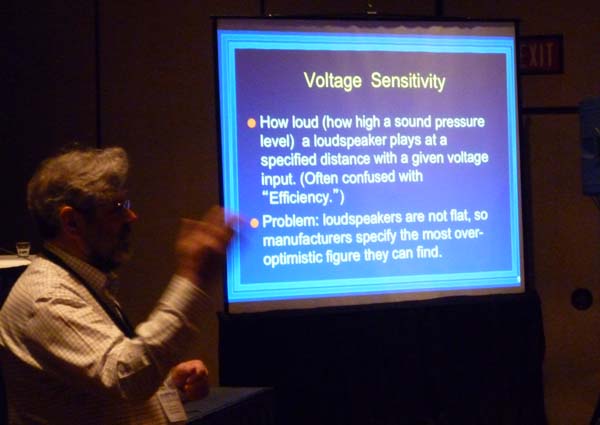
Here we see John Atkinson giving a karate chop to the problem of inaccurately stated voltage sensitivities. Hi-ya!
Problem: Loudspeakers are not flat, so manufacturers specify the most-overoptimistic figure they can find.
Jessi Monroe: She's Got Legs

But who cares about speakers and turntables? Say hello to Miss Jessi Monroe!
When I visited his room, WS Distributing’s Tom Myers had mentioned that Jessi was supposed to be performing a few of her songs, but she “ran out to buy some records and never came back.” My kinda girl.
Just as I was about to leave the room, Jessi walked in…and I sat back down.
Jessi’s been traveling between Los Angeles, Atlanta, and Nashville, working on her recording career. She played a few riffs for us and the sound was somewhat tentative and perhaps touched by sadness, but long-legged and lovely, with blue-green eyes, long eyelashes, and exceptionally red lips.
John Atkinson on Speaker Measurements
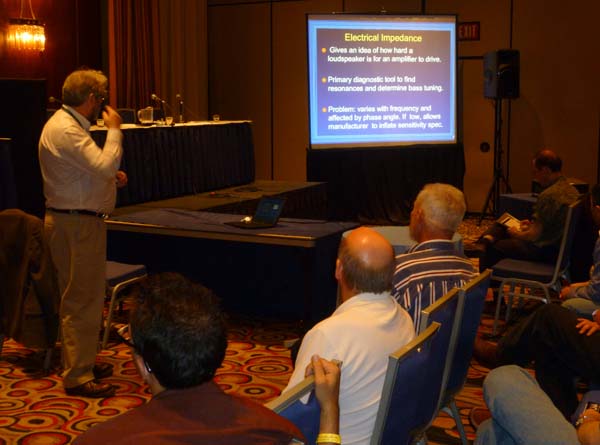
In just a couple of weeks, my boss, John “Ice Cool” Atkinson, will celebrate 25 years as editor of Stereophile, the greatest hi-fi magazine on the planet (and don’t you forget it). As editor, JA has refined the hi-fi industry in many ways, and has taught us all so much, but it’s perhaps his loudspeaker measurements which have been most influential and fascinating.
In these 25 years, JA has performed extensive technical analyses of well over 700 different loudspeakers, an accomplishment that, in my opinion, cannot be overestimated. On several occasions, I’ve had the privilege of watching John go through the process—a slow, long, often tedious, often thankless process, and one which often involves some very heavy lifting. The dude is tireless.
So, it was cool for me to see a large group of audiophiles and music lovers on hand to listen as JA discussed that process in detail, illuminating how and why he does what he does. “I’ll describe what I do,” he said, “what the measurements mean, what they don’t mean, and how we can use them to understand what we hear….”
That’s my boss!
Kingsound's King II Electrostat

The Kingsound full-range electrostatics have been hits of recent Shows. At Axpona, Roger DuNaier was demming the latest version of the King II ($11,500/pair), which was driven by VAC's Statement tube amplification via Cardas Clear cable to great effect on Jane Monheit's "Somewhere Over the Rainbow." Her voice had that palpable presence that you only seem to get with panel speakers. I photographed Roger with the rear of the speaker, so you can see the King II's field-serviceable modular construction. There are seven full-range modules and three narrower tweeter modules and the corssover and HT supply is now housed in a separate enclosure, connected with industrial-quality, secure connectors.
Krell Cries Mary
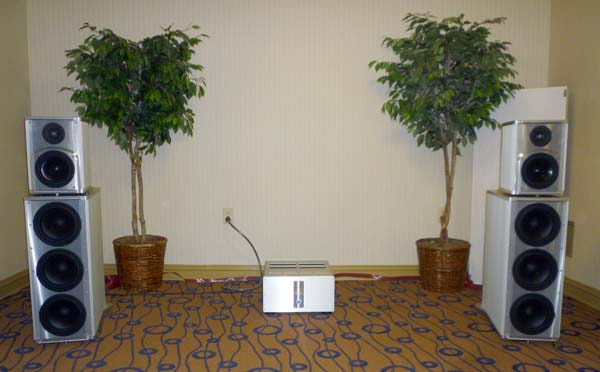
John Atkinson mentioned some of the trouble faced by MBL’s Jeremy Bryan in getting the best possible sound from his demo room. Bryan went to heroic lengths to tame his unruly room. One of the most obviously sonically challenged rooms I visited at Axpona was that held by Krell, who were showing their new Phantom preamp, scheduled to be available later this summer ($17,500), along with their Primo/Duo modular speaker system ($65,000/pair; designed specifically to be mated with Krell electronics), and the big Evolution 402e power amplifier ($18,500).
We listened to Sting doing a version of Jimi Hendrix’s “The Wind Cries Mary.” (Man, I once knew a girl named Mary; she could make the wind cry....) Although Krell’s Bill McKiegan had strategically placed a few RealTraps panels around the room, some sonic problems were still readily audible. The bass was boomy, largely due to the acoustic of the small, L-shaped room, but guitars and voices were attractive, and the soundstage was wide and deep. Afterward, we listened to a bluegrass track and I was impressed by the system’s speed and clarity.
Krell Phantom preamplifier
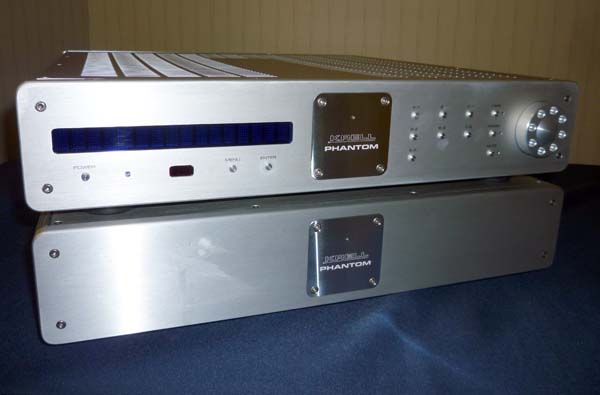
The Krell Phanton preamp made its debut at Axpona. It shares the steely, solid, no-nonsense look and feel of other Krell components, and is meant to partner with any of the company’s Evolution e-Series amplifiers. The Phantom is the first Krell preamp to include an optional crossover, so that the user can employ a satellite/subwoofer arrangement, without compromising sound quality.
The Phantom uses a dual-monaural circuit design, and receives power from a Krell current mode analog power supply housed in its own chassis. No negative feedback is used. The Phantom should be available later this summer; price estimated at $17,500. The crossover option adds $2500.