

Listening and Reading
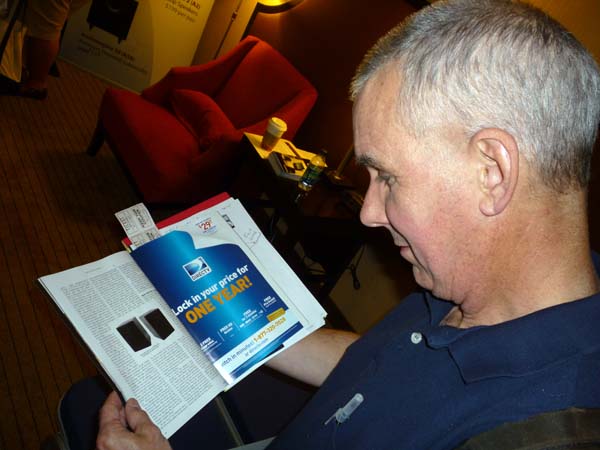
And I couldn’t resist snapping a shot of one guest in the Audioengine room, who was listening to the company’s A5 ($349) while reading my review of the speaker.
LSA Makes a Statement
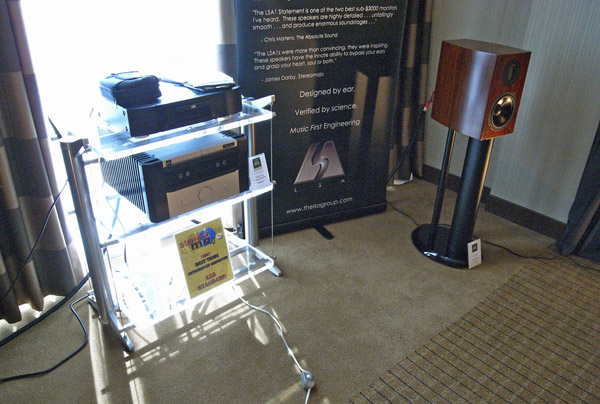
"Designed by Ear. Verified by Science." So says the promotional material from Nashville-based LSA, who were demming the pretty LSA1 Statement speaker ($2600/pair) at Axpona, driven by their 150Wpc Statement hybrid integrated amplifier ($5000). This amplifier uses a pair of Electroharmonix 6922 tubes in its preamp section but a solid-state output stage. The speaker combines a treated paper-cone woofer with an Aurum Cantus folded-ribbon tweeter and uses Alphacore air-cored inductors in its crossover. Listening to a laidback blues from George Faber, "It Beats Working," I was impressed by the smoothness of the highs and the low-frequency extension of this nicely finished two-way.
Make it Yourself with Madisound and Meniscus

Responses to my first “Entry Level” column have been wonderful—far more detailed, thoughtful, and encouraging than I could have imagined or hoped. Many of the letters I’ve received tell stories about first experiences with hi-fi, and, within those, many readers fondly recall building their own loudspeakers.
To many of today’s teens and young adults, the thought of building a loudspeaker would be completely foreign and unrealistic, if not plain irrational and silly: Why build a loudspeaker? But, decades ago, doing things yourself, with tools and instructions, was not only the easiest way of accomplishing a goal, but often also the best, cheapest, and most enjoyable and satisfying way—a way of life we’ve sadly forgotten.
Companies like Madisound and the Meniscus Audio Group try to preserve that tradition, offering all the parts and knowledge required to those who are interested in doing things themselves. Here we see an array of Madisound speakers, all built from kits. I spoke with Mark Sayer, speaker guy of Meniscus Audio Group, who has been building his own speakers since he was a child. For him, the experience is more about the process than the product, a way of slowing things down.
MBL Conquers Room Acoustics
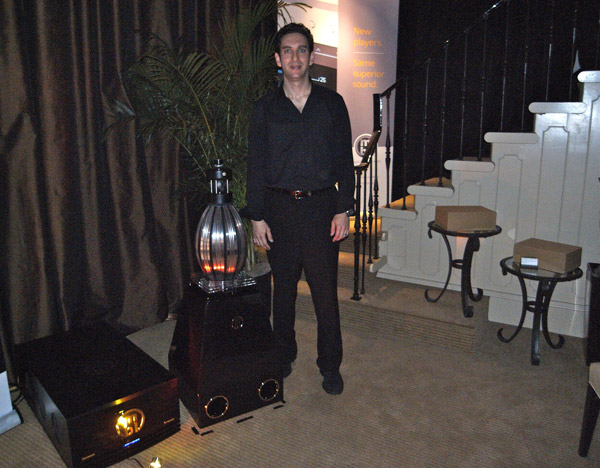
MBL's Jeremy Bryan had an interesting problem when set up his system at Axpona, in that while the hotel room was large, it was also double-story, with a 16' ceiling and an acoustic nightmare of a mezzanine level at the rear. Jeremy, shown in the photo next to the unanticipated in-room stairway, solved it by packing the mezzanine floor with queen-size mattresses that had been emptied from other hotel rooms. The system was the same used at SSI in Montreal two weeks ago101E Mk.2 omnidirectional speakers driven by gigantic 9011 monoblock amplifiers, a 6010D preamp, a 1621A CD transport, and a 1611F D/A converterand I listened to the same hi-rez solo piano recording made by MBL's long-time chief engineer Jürgen Reis, "Walchensee, Mondnacht," performed by Martin Vatter, from the album Klangbilder. Once again, the piano sound was disturbingly lifelike, with full-range dynamics.
Michael Fremer Explains Turntable Set-Up
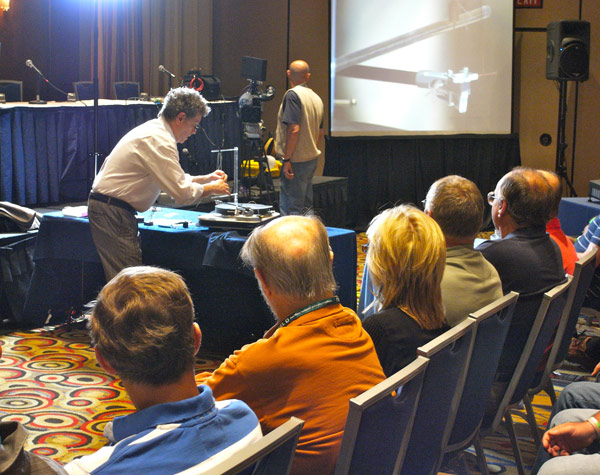
An enthusiastic crowd turned up on the first morning of the Show to catch Michael Fremer's workshop on how to optimally set-up a turntable. With the help of close-up video, Michael used a Spiral Groove turntable and arm, and Lyra cartridge to show how to optimize headshell offset, overhang, antiskating, VTA, azimuth, and other analog mysteries. The session is being repeated Saturday at 11:30am in the Goldmine seminar room.
Miles and Miles of Tweaks
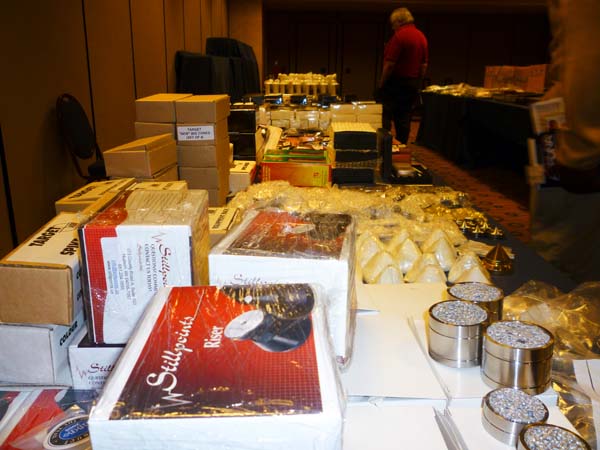
Well, not really miles, but definitely a lot. Feet and cones and spikes and pucks and all sorts of fun stuff. I kinda just wanted to run as fast as I could and fling myself right up onto this table to swim with all of these little goodies. But I managed to restrain myself.
Musical Fidelity V-Series
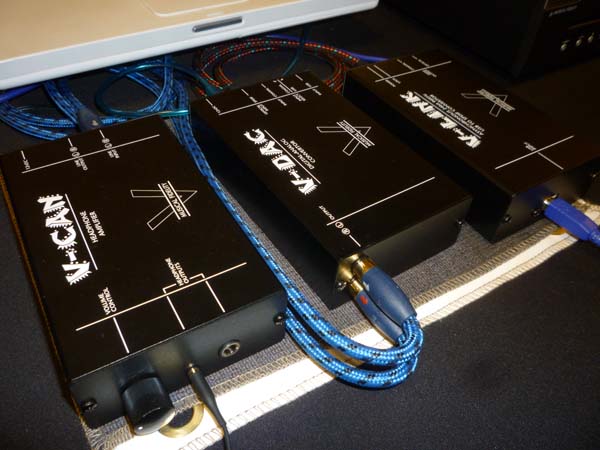
A trio of Musical Fidelity V-Series products: V-CAN headphone amplifier ($199), V-DAC D/A converter ($299), and the asynchronous V-Link 24/96 USB to S/PDIF converter ($169), all tied together by budget-priced AudioQuest cables. These products may be affordable, but they offer true high-end sound quality.
Napa Acoustic: Big Sound, Small Packages
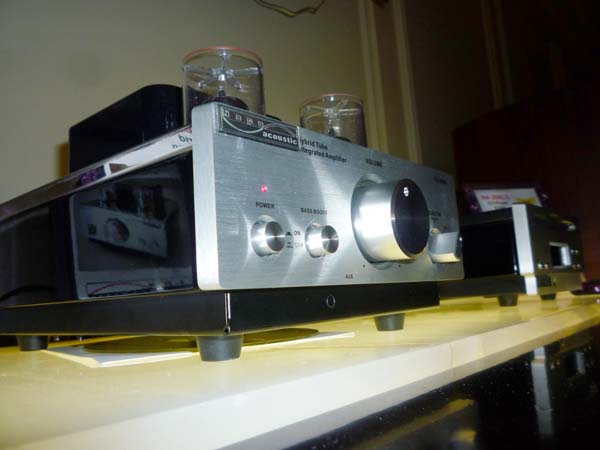
Upon walking into the Napa Acoustic room, I heard many expressions of awe and disbelief as attendees searched for subwoofers and asked, again and again, if the products’ stated prices were correct. Indeed, the system here—Napa NA208 A amplifier ($399), NA208S speakers ($199), and DT-307C CD player ($399)—filled the room with solid, believable sound and music.
The brand made its debut at last year’s Jacksonville Axpona. While all of Napa’s current manufacturing takes place in China, the company’s Joseph Kwong told me he hopes to produce an affordable vacuum tube amp right at home, in Fremont, CA, in the not too distant future.
NSMT's Mastering Series Speakers
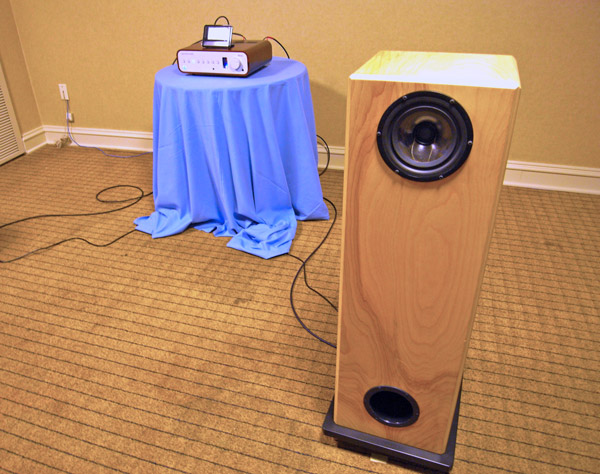
The larger speakers in the Role Audio room were the Model 100M from NSMT's Mastering Series ($5500/pair). An active two-way speaker, the 100M uses a coaxial drive-unit from SEAS in a well-finished enclosure made in the USA from formaldehyde-free materials. The sound, using a Squeezbox Touch and a Peachtree iDecco used as a DAC was rich, with good dynamics.
Oracle Paris

Check out the sexy Oracle Paris ($3150), available in four high-gloss finishes. This one is in red, and ladies love red.
It uses a carbon fiber Paris tonearm ($950), which begins as a Pro-Ject 9cc, but gets dressed up with Oracle’s Micro Vibration Stabiliser System, developed for the more expensive Delphi Mk.VI, and which uses a silicone damping bath and precision plunger fitted to the tonearm tube. The Paris phono cartridge ($1150), a high-output moving-magnet design, is machined from a magnesium-aluminum alloy. Fully assembled and pre-calibrated for a nearly plug-and-play installation, the Paris package costs $5000. The ‘table uses a semi-floating suspension system with Sorbothane decoupling, has a two-piece acrylic/aluminum platter system, includes adjustable Delrin feet and a Delrin record clamp, and uses the same motor and drive electronics found in the Delphi Mk.VI.
“We have a hard time compromising,” confessed Oracle’s Jacques Riendeau. “With the Paris, we pushed the limits of performance while hitting a lower price point.”