

Command—Carnegie—Da Vinci—Manley
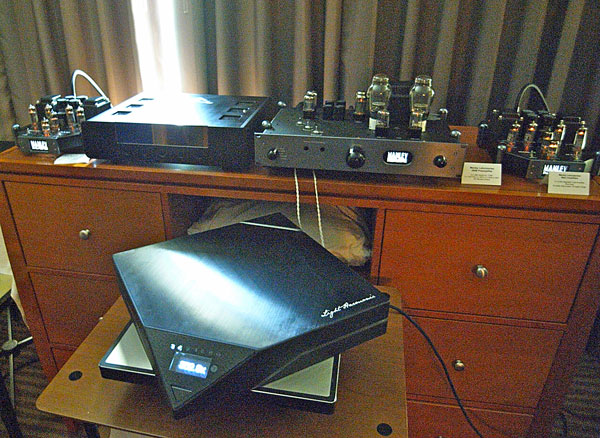
One of the Command Performance AV rooms at Capital AudioFest featured Carnegie speakers, the CST-2 ($5999/pair), which combines a Mylar-film planar tweeter with eight 5.25" composite-cone woofers in a slim tower supported on a marble base. The speakers were driven by Manley Mahi EL84 monoblocks and a Manley 300B preamp, with the source a silent CommandPC server feeding 352.8kHz USB data to the Light Harmonic Da Vinci DAC that had impressed at the Atlanta Axpona. The DAC has been upgraded since Axpona: when handling 16-bit data, it would pad out bits 1724 with 0s to give 24-bit data, which is standard practice. But in 2s-complement digital arithmetic, which is how audio data are encoded on a CD, there are actually two zero levels: 16 0s but also 16 1s, which represents a magnitude one LSB lower. Light Harmonic's engineers found that if they padded 16-bit data with 8 1s rather than 8 0s, the sound improved.
Command—Manley—Joseph
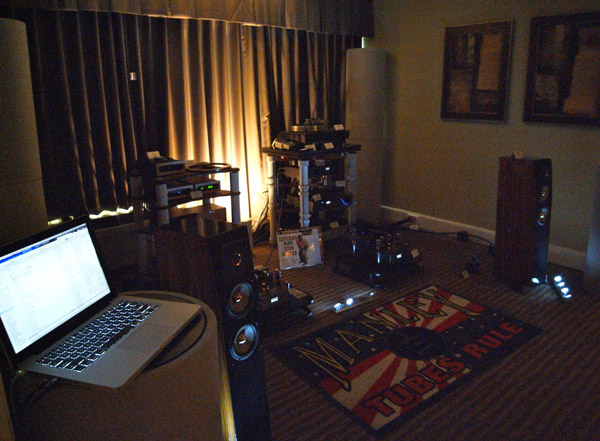
As you can see from my photo, it was pretty dark in the room hosted by Command Performance A/V, so I couldn't see who was discussing the state of high-end audio in the US. It turned out to be Joseph Audio's Jeff Joseph, Manley Labs' Eveanna Manley, and The Signal Collection's Chris Sommovigo. I write about the migration of audio manufacturing overseas in my forthcoming "As We See it" in the September issue, and both Joseph and Manley are proud that they still manufacture their products in the US"We're based on Chino, not China," said Eveanna, though she admits that this does add a premium to the retail price that is an unwelcome downside given, as I wrote about in the April issue's "As We See It," the reduced spending power of the middle class these days.
But if the premium is accompanied by performance, it can be justified, and the system in the darkened room was providing much music, courtesy of Pure Music running on Jeff's MacBook Pro. As it had two weeks ago at the NYC Axpona, the laptop was sending USB data to a Bel Canto LightLink converter, which in turn fed the audio data via a low-jitter ST optical link to the Bel Canto DAC3.5VB. This was connected to a Manley Jumbo Shrimp tubed line stage and a pair of Manley Snapper 100W tube monoblocks ($7250/pair) via Cardas Clear interconnects and speaker cables. Speakers were the Joseph Perspective ($11,800/pair), which marries two magnesium-cone woofers to a Sonatex-dome tweeter. AC power was provided by Shunyata's new Talos ($3500, and also made in the US), which replaces the company's well-regarded V-Ray unit.
Daedalus Audio / Linear Tube Audio / WyWires

My first night here at the Hilton, loud music pumped from the room next to mine. At 11:45pm and it was still blasting, interrupting my much-needed beauty sleep. Several calls later, the volume from the adjacent Daedalus Audio room went down, and I was down for the count.
Gary Gill
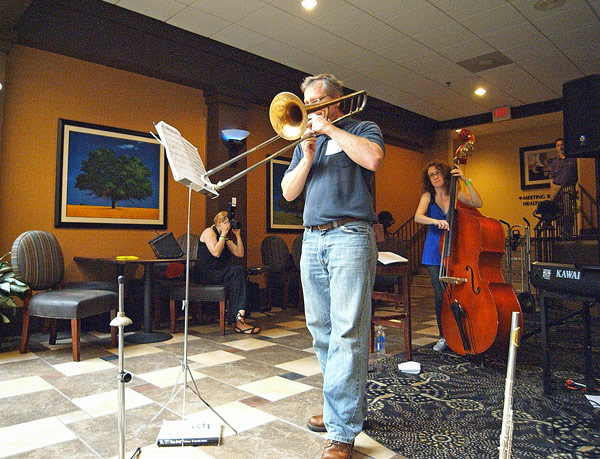
Capital AudioFest organizer Gary Gill is a fine jazz trombonist, as I found out when we both sat in with Steve Davis's band at the Atlanta Axpona in April. To remind Showgoers what the real thing sounds like, Gary's quintet performed Saturday evening in the hotel's bar. This is Gary in full song, but not shown in my photo are the, not one but two Theremin players who sat in on some songs.
GOTO Horns

These $150k/pair monsters weren't playing either time I went into this room. But they win the prize for most "Awesome-Looking Speaker at the Show." And there's my favorite hotel carpet again!
Highwater Sound
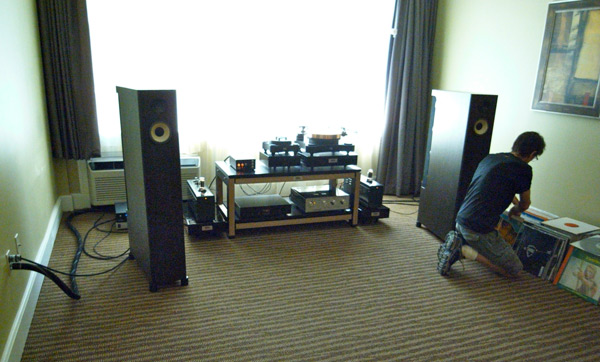
The Highwater Sound room at the Atlanta Axpona had been one of Stephen Mejias's favorites: "I felt as though I were in a concert hall, gripped by the music, by the space around me, by the physical motions of musicians striking, plucking, and bowing their gorgeous instruments. There was a certain sacredness to the scene, a sense that what was taking place should not and could not be disturbed," he wrote. Unfortunately, by the time I got to that room on Sunday, Highwater's Jeffrey Catalano was already striking the system, so I made sure I had plenty of time to visit the Highwater room at Capital AudioFest.
Inside the Polk LSiM 707
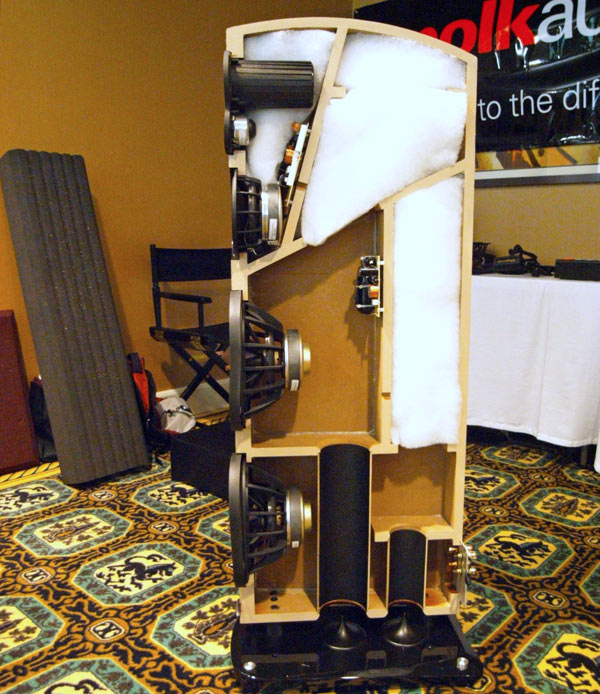
You can see that each woofer is mounted in its own internal chamber, the ports firing down. And there's that horrible carpet again!
JS Audio—Wilson—Dan D'Agostino—HRS—Nordost
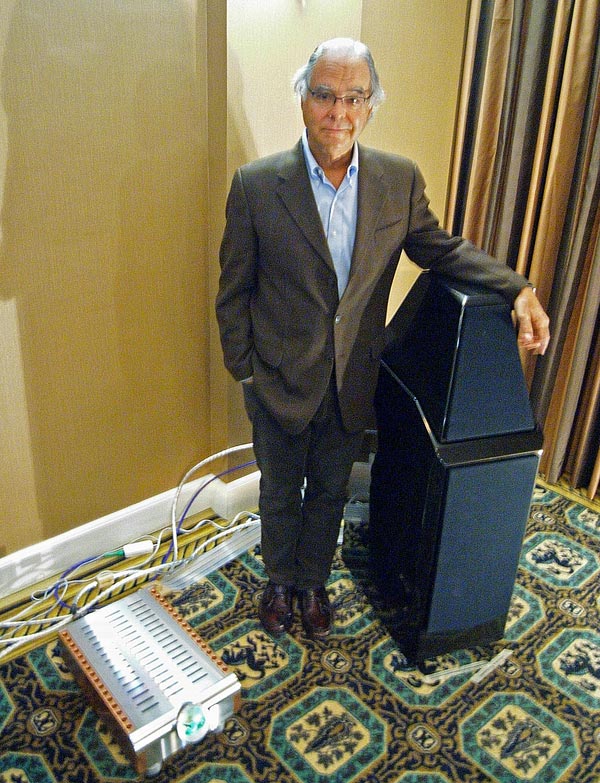
The larger of the two JS Audio rooms featured Wilson Sasha W/P speakers driven by Dan D'Agostino's new Momentum monoblock amplifiers. Source was either a Sooloos system or the Sound Devices digital recorder belonging to Wilson's Peter McGrath (pictured standing on that hotel carpet), both feeding data to Meridian's 808 Mk.3 CD player/digital processor, which also controlled playback volume. My hurriedly scrawled notes say that the Sooloos feed was via Ethernet, but don't hold me to that; the Sound Devices was definitely S/PDIF. The cabling was all Nordost Odin, which may well have cost more than everything else in the system, and the source components sat on a Harmonic Recovery Systems rack, which all involved said was a major contributor to the quality of the sound in this room.
And OMG, the sound! Whether it was Peter McGrath's hi-rez recordings or commercial material like Yello's "Stay," you were mainlining the music. Peter asked if he could play some of my hi-rez recordings, and played first the Cantus performance of Eric Whitacre's Lux Aurumque in 24/88.2k fidelity. I was transported to the Sauder Auditorium at Goshen College in Indiana, with the acoustic wrapped around me. The system did subtlety. Peter then played the 24/88.2k master of Attention Screen's "Blizzard Limbs," from Live at Merkin Hall. Again, the acoustic wrapped round me but the drum transients were more startling than I have ever heard before. And I mastered the recording!
I have heard Wilson Sashas in a number of systems, and yes, they are "fast," in that the bass doesn't boom or blur. Yes, the Nordost Odin is extraordinarily transparent cable (at a price) and that Meridian player's D/A is top-rank. And that HRS rack is a black hole for vibrations. But driven by the Dan D'Agostino ampswow, did the Sashas kick some awesome booty! Without ever sounding crass or lacking in subtlety.
Mapleshade's Wife Acceptance Factor...

. . .has to be zero, to judge by how Pierre Sprey dresses his speaker wires!
Mapleshade—Sonist
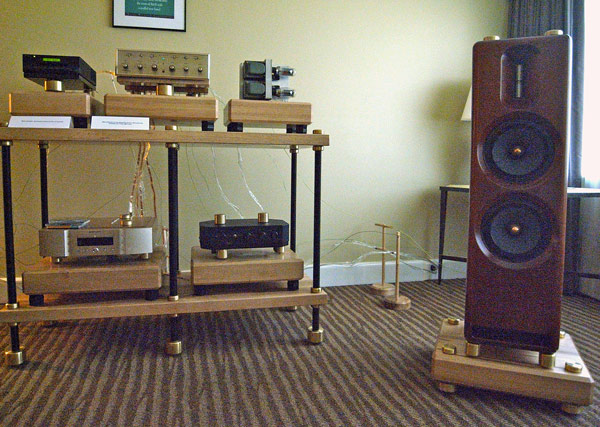
"Concrete is toxic to the sound of speakers!" explained Mapleshade's Pierre Sprey, when I asked about the maple platforms and brass footers on which everything was standing in his room at Capital AudioFest. Pierre makes superbly natural-sounding recordings, but also lives in a world where everything matters when it comes to optimizing sound quality. The system comprised Sonist Concerto 4 speakers ($5895/pair), these a 97dB-sensitive design with a solid poplar front baffle, driven by a heavily modified vintage tubed Scott integrated amplifier. (Pierre has been buying up used examples of this amp since 1989 and offers the modded amps for salesee his website.) Source was a modded Cyrus CD-8SE CD player (the bottom panel was now maple) and preamp was a Kora Triode.
Whether it was Pierre's fanatic attention to detail that no-one else considers important, or maybe he is just an expert at setting up systems. But the Sonist speakers sounded very much better than the Concerto 4s and smaller versions that I heard at the Atlanta and Jacksonville Axpona Shows: clean, transparent, and uncolored.