

TAD C600 Preamplifier
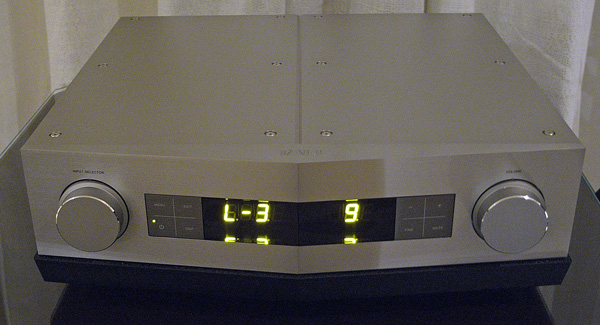
It costs $42,000 but TAD's new C600 solid-state line preamplifier features dual-mono construction, an all-discrete signal path, a separate power supply, and fastidious attention paid to detail in both its design and construction. The amber LED display for example, is DC-powered rather than from the usual multiplexed supply, to eliminate EMI interference. And the sound, in conjunction with the D600 SACD player, M600 monoblocks, Reference One floor-standing speakers, and HRS rack to give a system price of $214,500? I'll leave it to Stephen Mejias to describe in his show wrap. Personally, it was a highlight of the 2012 CES.
TAD E1 Speaker

All-new from TAD at the 2012 CES was a more affordable line of components than the 600 series and electronics and Reference loudspeakers. The Evolution Series E1 speaker ($29,800/pair, right) still uses a concentric tweeter and midrange unit, like its more expensive Reference One sibling (left), but while the tweeter dome is still beryllium, the midrange diaphragm is now magnesium rather than beryllium and the unit is built on a 5" rather than a 6" chassis. Twin 7" woofers are used, but still with the highly linear corrugated surrounds and with a 2.5: voice-coil. Bass extension is specified into the low 30s, anechoic. I auditioned so much music on this system, I thought I was outstaying my welcome, but the sound of the E1 system, at $76,800 including the new M2500 500Wpc power amplification and the C2000 D/A preamp driven by asynchronous USB from a MacBook Air and all sitting on a Finite Elemente rack was open, natural, and uncolored, with superb low-frequency definition and weight. I couldn't imagine how the sound of a a 176.4kHz/24-bit transfer of Rebecca Pidgeon singing "Spanish Harlem" could be bettereduntil TAD's Andrew Jones switched to the TAD Reference system (see next story).
TEAC America’s Reference 01 Series
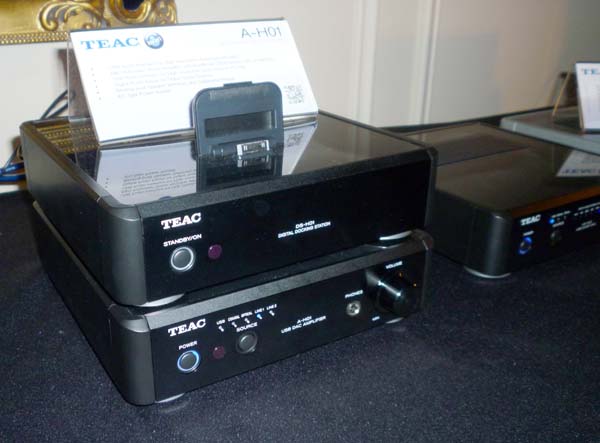
While we’re on the topic of small things, TEAC America introduced their Reference 01 Series of budget-priced, room-friendly components, including the UD-H01 DAC, A-H01 stereo amplifier, and DS-H01 iPod docking station. (I’m waiting to hear back on the prices, but I’m fairly sure these products retail for hundreds, rather than thousands, of dollars.)
The 2012 CES Unveiled
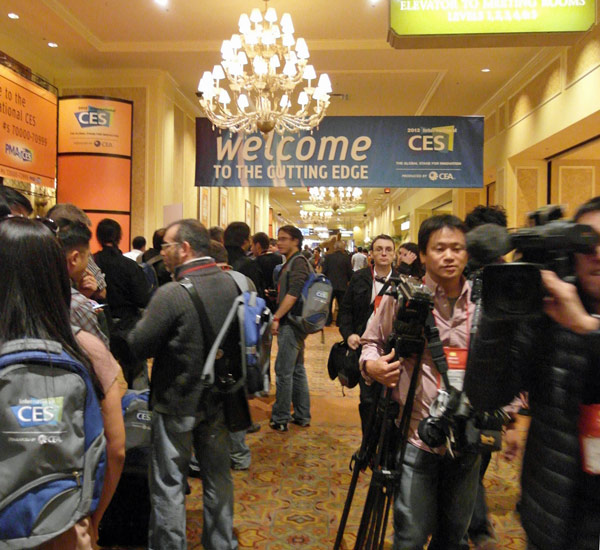
The first major press event at CES, scheduled to start at 4 pm on the day before the Press Day, is something called CES Unveiled, described as "a pre-show look at who will be making news headlines before the show officially opens...catch all the latest products in one room." This description is a bit...well...exaggerated. The exhibitors are mostly small companies, with no representation from heavy hitters like Sony, Panasonic, Sharp, etc. The high-performance audio companies also pass on it.
The 2012 Consumer Electronics Show: A Better Way?

Photo: John Atkinson
It looks sort of pretty, doesn't it?
Imagine how much prettier it would be if it were real. Imagine again how much prettier it would be if those bridges and roads and towers weren't there at all.
Every time I stepped from the slow elevator and onto the casino floor at Harrah's, where Stereophile's editors spent their sleepless nights, my hatred for Las Vegas was revitalized. This was like some kind of bad joke, some kind of post-modern torture. Oh, god, I am still here. I would turn right and see the same flashing lights, the same low ceilings, the same people who had been there the night before, still sitting, still smoking, still hoping, still staring blank-faced into spinning screens of cherries, spades, and jokers, and I would wonder why.
Why? Most people who visit Las Vegas seem to be looking for money, sex, drugs, or simple escape. Why are we here?
The Advanced Genesis Tweeter
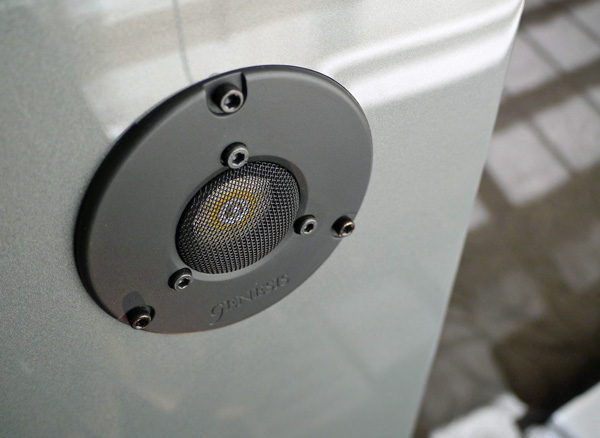
The Genesis Advanced Technologies 7.2f claims to be the "new affordable reference for bringing true-to-life music into your home." And they have a formidable amount to technology in the speaker to support this claim. At the top, there is the latest version of the circular flat-ribbon tweeter that apparently has been steadily improved since it was first introduced in 1992 (and which, for once, owes nothing to Dr. Oskar Heil). A solid titanium-cone mid/woofer claims to deliver exceptional clarity and low distortion within its range (and the "oil-can" resonance is far outside the range where the driver is utilized), and a servo-controlled powered bass from an 8" side-firing aluminum-cone driver, is claimed to extend the response down to 22Hz. There is also a rear-firing tweeter, which can be turned off if desired. There is control over tweeter as well as woofer level. The price of all this technology is a very reasonable $9000/pair.
The Atlantic Technology AT-2
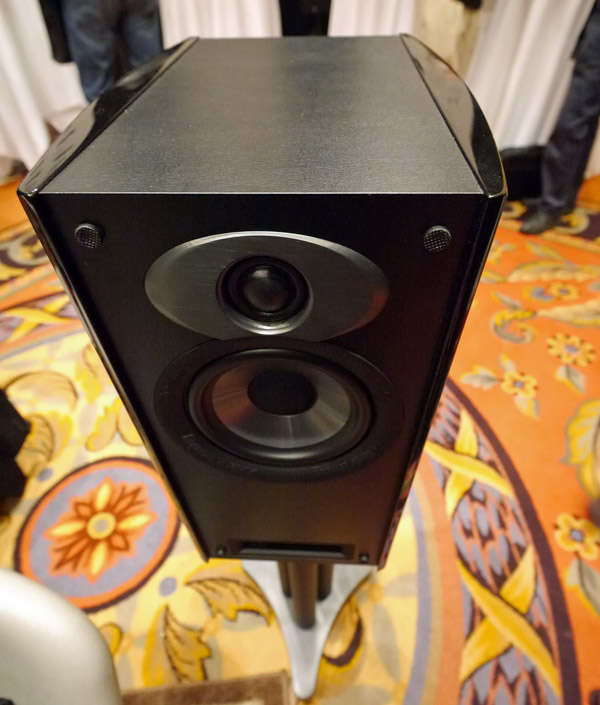
Atlantic Technology's AT-1, which uses their patented H-PAS venting technology, was one of the hits of last year's CES, and the positive impression was confirmed in Erick Lichte's review (September 2011). The H-PAS approach has now been applied to the new AT-2 ($1800/pair). The 3dB point is specified as 41Hz, which I'm told is an anechoic figure. This normally translates to in-room response to the low 30s, and the sound of the AT-2 in the Venetian's less-than-ideal space seemed to confirm this.
The Boys from Wharfedale
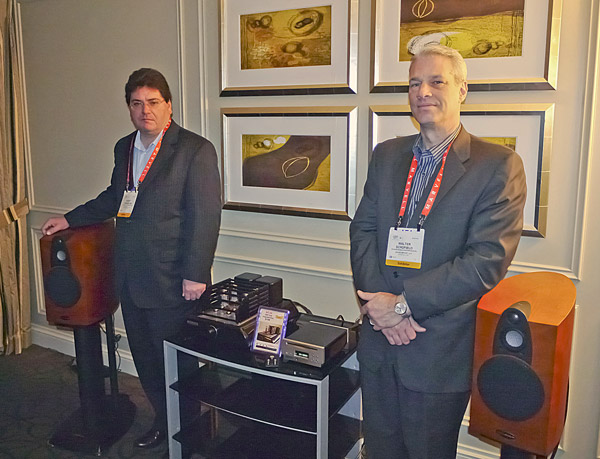
Wharfedale is one of those venerated British names in audio. And while its image is perhaps on the old-fashioned side, there's absolutely nothing old-fashioned about the latest Jade series of loudspeakersunless you're thinking of old-fashioned craftsmanship. The price of speakers in the Jade series ranges from $1200/pair (stand-mounted Jade-1) to $4200/pair (floorstanding Jade-7), and the manufacturing is vertically integrated: they make every component of each speaker!
The Con Brio Music Server Up Close
The Extreme MBL X-Treme

At the previous Shows where I had auditioned it, MBL's extravagantly excessive (or should that be excessively extravagant) X-Treme system had been set-up in inappropriate rooms, Finally, at the 2012 CES, this 4-enclosure system, which basically comprises two of the true omnidirectional upper-frequency modules of the Berlin-based company's 101E Mk.2 speaker (to be reviewed by Mikey Fremer in the April 2012 issue) with two man-sized powered subwoofers, each using six 12" drivers mounted three on each side to cancel mechanically induced vibrations, was set up in a room worthy of it. (The Venetian room was 31' by 22' with a 10' ceiling.) Bi-amped with four file-cabinetsized MBL 9011 monoblocksthe total system cost was $565,000!the X-Treme produced a big-bottomed sound that was indeed extreme when required but also delicate when appropriate. Oh my!