Solid State Power Amp Reviews

Sort By: Post DateTitle Publish Date

Bryston 3B-ST power amplifier
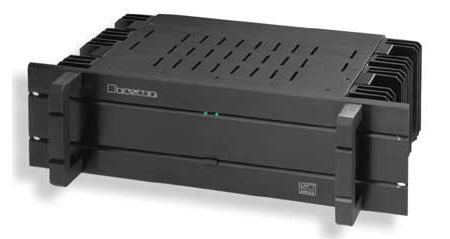
Canadian electronics manufacturer Bryston Limited has been producing consumer and professional amplifiers since 1974 [see Robert Deutsch's interview elsewhere in this issue—Ed.]. Bryston amps are engineered to be physically and electrically rugged, to meet the stringent demands of professionals, many of whom leave their studio amplifiers turned on for years. While chassis had to be light instead of the audiophile massiveness found in some high-end consumer amplifiers, studio engineers and concert pros continued to favor Bryston amps, which easily passed the "steel toe" test. The 4B, for example, became a standard amplifier for recording engineers and touring musicians.
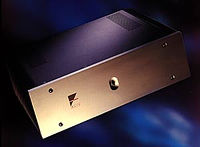
Ayre Acoustics V-3 power amplifier

"Why no review of the Ayre V-3?" queried Stephen Slaughter in July's "Letters" column, echoing several urgent posts to my e-mail address. Word of mouth on this remarkable 100Wpc amplifier was reaching fever pitch. Show reports over the last several years had sounded a consistent note—rooms that demoed with V-3s kept getting mentioned in "Best of Show" overviews. Naturally, this also meant that the pendulum had started its backward swing. "It's not really as good as people are saying," one WCES attendee confided in me. "That's why they won't give it to critics."

YBA 1 Alpha HC power amplifier

The auteur theory of the cinema, first described in the 1950s by François Truffaut, states that a great movie represents the artistic vision of one person, usually the director. Moviemaking may involve collaboration, but it cannot be done successfully by a committee. There has to be a single individual in charge, one whose sensitivity and world view is reflected in the movie. In the same sense that the author of a novel is telling a story through the medium of print, the director of a movie is telling a story through the medium of film.


Mark Levinson No.331 power amplifier

The No.331 is the latest iteration in a series of Mark Levinson 100Wpc, solid-state, stereo power amplifiers. Extensive cosmetic alterations, internal structural changes, and new circuit designs make it quite different from the No.27 and No.27.5 models that preceded it. These design refinements emanate from Madrigal Audio Laboratories' latest flagship amplifier, the $32,000/pair, 300W RMS Mark Levinson No.33 Reference.


Symphonic Line Kraft 400 monoblock power amplifier

Things didn't start off auspiciously. I'd been after Symphonic Line's Klaus Bunge for more than a year to send me the Kraft 400 Reference monoblocks. Finally he called. He said he was going to be in town for a few days, and he had with him a pair of what he described as his "traveling" Kraft 400s, which he proposed to leave with me.

Jeff Rowland Design Group Model 2 power amplifier

I remember having a conversation with an audiophile some time ago about the thorny subject of choosing an amplifier. He was convinced, on the basis of an article he had read in Stereo Review, that all amplifiers of a given power rating sound pretty much the same. Although he was sufficiently well off to buy just about anything on the market, he didn't want to waste his money. He chose the amplifier for his system by going through the Audio Annual Directory Issue, calculating the price:watt ratio for each amplifier that was listed, and then bought the amplifier with the lowest price/watt figure that had enough power to drive his speakers. He didn't do any comparative listening and didn't consider buying anything that cost more for the same power, because he knew already that it wouldn't sound any different.


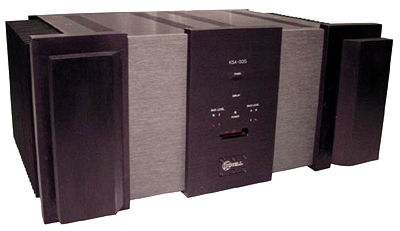
Krell KSA-50S power amplifier

In the fall of 1982, I had just become the Editor of the English magazine Hi-Fi News & Record Review. Hi-fi was in a state of flux. The Compact Disc had just made its debut in Japan, but the British and American launches were six months and a year away, respectively. The Linn orthodoxy prevailed about the role of the source in system performance, but there was no agreement about what was and was not important when it came to enhancing the musical experience. "Objectivists" insisted that amplifiers and even loudspeakers had pretty much reached a design plateau where no further improvement was necessary or even desirable, while "subjectivists" were fragmented. All I was aware of was that my system, based on Celestion SL6 loudspeakers, needed more of an undefinable something.

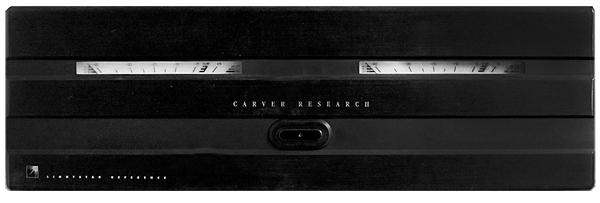
Carver Research Lightstar Reference power amplifier

When it comes to amplifiers, ya gotcher tubes, yer solid-states, and yer hybrids. Although amplifier manufacturers would have you believe otherwise, the majority of designs within each category are variations on a few fairly-well-known themes. Everyone agrees that the power supply is extremely important. Most designers try to obtain the amplifier's desired frequency response and distortion characteristics with a minimum of negative feedback. It's also agreed—at least among designers of solid-state amps—that the ability to drive a variety of speakers, including those that present a low-impedance and/or reactive load, is an important priority.

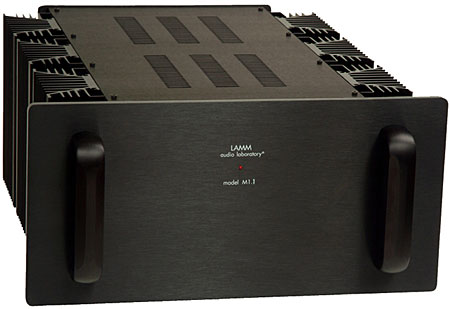
Lamm Industries M1.1 monoblock power amplifier

What is it about a component that makes the blasé High Ender sit up and say, "Hey, this is special!"? What elements of its reproduction reach out to you and won't let go? How does the intrepid audio reviewer find a way to describe these hopefully recurring moments of musical discovery which define the high-end experience? How many times, after all, can you say, "Ooooo, ahhhhh, that's the best [insert some part of the frequency range here]," ad nauseam? How much difference is there, anyway? Therein lies the tale...


Advertisement
Advertisement
Advertisement