Solid State Power Amp Reviews

Sort By: Post DateTitle Publish Date

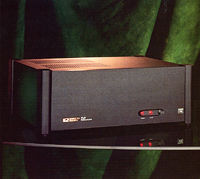
Kinergetics KBA-280 power amplifier

Kinergetics Research was a name to be reckoned with in the early days of CD, when they produced some of the earliest well-received, audiophile-grade CD players. They've branched out since then, producing amplifiers, preamps, subwoofers, and surround-sound processors. In fact, they're so busy with such products that they no longer build CD players! The last Stereophile review of a Kinergetics CD player appeared way back in 1993.


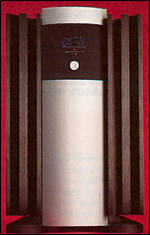
Mark Levinson No.33H monoblock power amplifier

Chances are you've never seen an amplifier quite like the Mark Levinson No.33H. That's because there's only one other amp that's anything like it: the Mark Levinson No.33, upon which it's based. Both amps are more tall than broad, looking almost as though they're resting on their ends; heatsinks cluster around their side-panels. In the city of the High End, the No.33 and No.33H are skyscrapers standing tall above the warehouses.


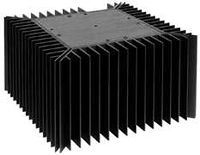
Pass Aleph 1.2 monoblock power amplifier

We all have biases. The trick is knowing your biases so they don't get in your way. Mine are pretty obvious. I don't like "fussy" gear that demands special care and feeding. I'm lazy—I want to just turn stuff on and begin listening. Perhaps that's why I have a positive bias toward Nelson">http://www.stereophile.com/interviews/1191pass">Nelson Pass's designs. They're reliable, untweaky, and usually sound good.


VTL MB 175 Signature monoblock power amplifier

Prejudice is bad—whether it's directed at people, places, or things. You know how it goes: digital is "bright," analog is "warm," solid-state is "brittle and etched," tubes are "smooth and soft" dynamic drivers are "low-resolution," electrostats and planars are "high-resolution" copper wire is "smooth," silver is "bright," etc. While putting everything that crosses your path into one box or another makes life simpler and seemingly more organized, the truth, musical or otherwise, usually gets mutilated in the process. Not that we all don't have preferences—but those are not the same as prejudices.


Pass Labs Aleph 3 power amplifier

Everyone's going crazy for single-ended power amplifiers. What's the big deal? What is it about these relatively low-powered contraptions that could make everybody so nutso? And has Pass Labs' Nelson Pass completely lost his marbles, selling a 30Wpc amplifier for a price that can buy a high-quality 200Wpc amp? Isn't that 200W amp seven times as loud—and seven times as good—as a 30W amp?


Krell Full Power Balanced 600 power amplifier

Latest and largest in Krell's current range of power amplifiers, the 600Wpc, $12,500 Full Power Balanced 600 joins the 300Wpc FPB 300 ($9000) and the 200Wpc (originally 150Wpc) FPB 200 ($5900). All are single-box stereo chassis and are specified as "Full Power Balanced"—I think to distinguish the essence of these designs from ordinary stereo amplifiers operated in balanced-bridged mode, usually with impaired performance. The FPB 600's speaker output is balanced; ie, neither "positive" or negative" terminals are connected to ground or the amplifier chassis. (Note that no speaker switches or headphone adaptors, which often have joined channel grounds, may be used, as they will short the outputs.) The output terminals are electrically at 0V, but float above the chassis ground.
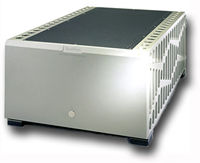

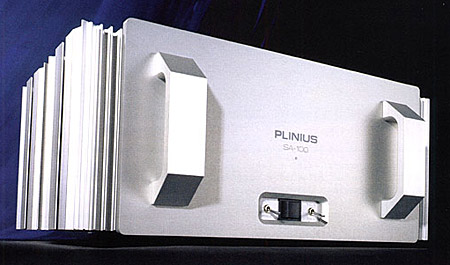
Plinius SA-100 Mk.II power amplifier

Man, you've got to watch out for those preconceived notions—they'll kill you every time. For the last several years I've seen Plinius amplifiers at hi-fi shows and—even though I didn't know the first thing about the company or its products—figured that I knew what they were all about. Spotting their brawny façades festooned with feathery heatsinks, I smugly assured myself that they were some kind of antipodean pretender to the muscle-amp throne—Krell or Threshold wannabes.


Mark Levinson No.333 power amplifier

If I've read it once in mainstream audio magazines, I've read it a hundred times: "The most important component in a system is the loudspeaker, because it is the loudspeaker that makes the sound." Putting aside the obvious illogic of this statement—that without other components in the playback chain, even the perfect loudspeaker can't make a sound—my experience is that it just is not so. Yes, it is true that changing from one loudspeaker to another makes the greatest overt changes in a system's sound.
Advertisement
Advertisement
Advertisement