Solid State Power Amp Reviews

Sort By: Post DateTitle Publish Date

Musical Fidelity Nu-Vista 300 power amplifier

Nothing like scarcity to create demand, right? Well, there's been a scarcity of Nuvistors out there for decades, and hardly any demand. Do you know about the Nuvistor, aka the 6CW4? It was a tiny triode tube smaller than your average phono cartridge. Enclosing its vacuum in metal rather than glass, the Nuvistor was designed as a long-lived, highly linear device with low heat, low microphony, and low noise---all of which it needed to have any hope of competing in the brave new solid-state world emerging when RCA introduced it in the 1960s.
Conrad-Johnson MF2500 power amplifier

Rumor had it that if the MF2500 amplifier had gotten any better in development, Conrad-Johnson would have had to include it in their "Premier" series. However, C-J's intention was to hold to the lower price of their established MF series, and so they have. Rated at 240Wpc and retailing for $3495, the '2500 is the core model of Conrad-Johnson's current range of "MF" power amplifiers. Its companion MF2250 offers 120Wpc, while the MF5600 delivers 120Wx5 for multichannel home-theater applications.

Linn Klimax 500 Solo monoblock power amplifier

Recently I found myself on the phone with Linn's chief design engineer, Bill Miller, talking about switch-mode power supplies. Affable Mr. Miller was ensconced in Linn HQ in Glasgow, Scotland. After a bit I inquired if Head Man Ivor Tiefenbrun was about the manse, and was quickly handed over. "You're such a cheeky guy. Why'd you call it the Klimax?"


Mark Levinson No.334 power amplifier

My father could not resist buying electronic and photographic gear. As soon as he heard about a new Polaroid camera, or a new weather radio, tape recorder, or color television, he'd go shopping. He'd be even more eager to buy an updated version of what he already had, particularly if this meant there was a story to tell. He'd buy one for himself, and sometimes he'd give me and my three brothers one of our own for a birthday or Christmas gift. (I often thought he took more pleasure from giving to us than he did from getting his own.)


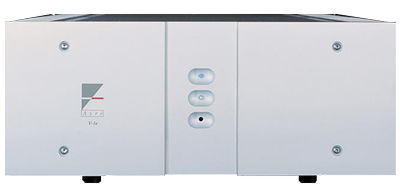
Ayre V-1 power amplifier

I've heard my share of Krells, Levinsons, Rowlands, and the like in other people's systems—expensive solid-state amplifiers are not my usual beat. With the exception of an inexpensive Adcom a few years back, for more than a decade I've owned and reviewed only tube amps. In fact, until the $7500 Ayre Acoustics V-1 showed up, I'd not had one in my system. Similarly, I'd had only tube preamps until I reviewed the Ayre K-3, which so impressed me that I asked to hear the more">http://www.stereophile.com//amplificationreviews/609/">more expensive K-1—and ended up buying it.


Rotel RB-991 power amplifier

As a reviewer who has focused on seeking out high-quality audiophile gear for cost-constrained readers, I'm embarrassed to say that the flagship RB-991 stereo amplifier is the first Rotel product I've had in my house. (To be fair to myself, this 38-year-old family-owned company did not develop a large US market presence until this last decade.)


NAD 218 THX power amplifier

The story of New Acoustic Dimensions, aka NAD, begins in the late 1970s. The company was founded as a dealer distribution collective to design and market reasonably priced serious high-end gear to cost-constrained audiophiles. By eliminating needless features and focusing manufacturing in low-cost production facilities, NAD has successfully delivered audiophile-quality gear for 20 years at prices little more expensive than mass-market department-store schlock.


Pass Labs X1000 monoblock power amplifier

Pass Laboratories' X amplifier series represents the efforts of designer Nelson Pass to prove that simple linear amplifier topologies can be scaled to provide high-quality audio performance at very high power levels. The handsome X1000 monoblock under scrutiny here, the largest and most powerful amp in the Pass stable, makes 1000W into 8 ohms and a mighty 2000W into 4 ohms. The amplifier has no global negative feedback, and only two gain stages: the front-end provides all the voltage gain and feeds a high-current follower stage.


Advertisement
Advertisement
Advertisement