Recording of the Month

Sort By: Post DateTitle Publish Date

Recording of June 1987: Copland: Appalachian Spring, etc.
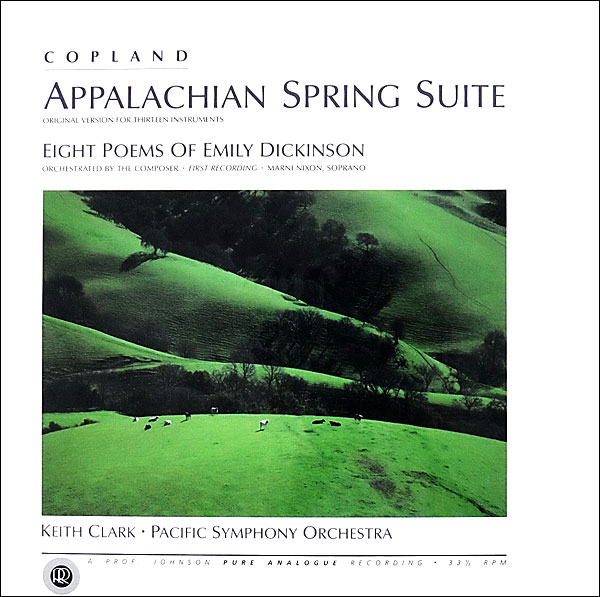

Copland: Appalachian Spring (Suite), Eight Poems of Emily Dickinson, An Outdoor Overture (CD only)

Pacific Symphony Orchestra/Clark/Marni Nixon (soprano)

Reference Recordings LP RR-2 and CD RR-22CD. Tam Henderson, prod.; Keith Johnson, eng.


This is unquestionably one of the best recordings Reference Recordings has done. The sound of the LP is up-front and quite bright, giving the orchestra that peculiarly nasal quality I usually associate with small French orchestras. There is truly remarkable detail and naturalness here; I was about to write that the recording makes the orchestra sound very small and pinched in Appalachian Spring when I noticed on the record jacket that this is the "Original version for 13 instruments." Okay, so I know what it costs to hire musicians in the US, but I still prefer the version of this work scored for full, bombastic, overblown 108-piece symphony orchestra. The 13 instruments are superbly balanced, though—even the piano, which is usually (and wrongfully) relegated to behind the orchestra. About a half a block behind it.

Recordings of December 1986: Two Out-of-Character Recordings

REFLECTIONS

666rotm.reflections.jpgJim Walker, flute, Mike Garson, piano

Reference Recordings CD RR-18CD.


DEBUSSY: Quartet in g

RAVEL: Quartet in F


The Cleveland Quartet

Telarc CD-80111.


What do you listen to when you've heard Reference Recordings' Symphonie Fantastique, Telarc's 1812 Overture, and Sheffield's Firebird, the last of your audiophile guests have gone home, and tomorrow's a workday but you're too hyped up to go to bed?


These.


Both are from record companies whose reputations were built on sonic blockbusters, but the subjects of this review are about as true to expectation as Mr. T flouncing about with a limp wrist.


Reflections is a program of short works for flute and piano. It's quiet, restful, and, in an age when it seems that nothing is worth listening to unless it's high-powered or "significant," this laidback program is a delightful change of pace.

Recordings of November 1986: Chesky's First Releases

666rotm.earl.jpgBERLIOZ: Symphonie Fantastique

Royal Philharmonic Orchestra, Massimo Fraccia

Chesky CR-1.


RACHMANINOV: Piano Concerto No.2 in c

Earl Wild, Royal Philharmonic Orchestra, Jascha Horenstein

Chesky CR-2.


Chesky? Massimo Fraccia? Is this a put-on?


No, it's not. Chesky is a new record company which, at a time when everyone is predicting the imminent demise of the LP, has just launched its first two LPs and is threatening to follow them with more.


David Chesky is a young composer/musician who, despite some impressive credentials in the classical music world, remains singularly unrenowned. But he is also a musical reactionary after my own heart, who feels that all the best performances of the so-called Romantic repertoire were done years ago and will probably never be equalled. But rather than just bitch about this in record reviews, he is doing something about it, by releasing some of those early, possibly definitive performances on the best-sounding recordings he knows how to produce.

Recording of August 1986: Sheffield Lab's Orchestral Direct-to-Disc LP

886rotmjgh.1.jpgStravinsky: The Firebird (1910 Suite)

Debussy: Prelude to the Afternoon of a Faun

Los Angeles Philharmonic, conducted by Erich Leinsdorf

Sheffield Lab Direct-to-Disc Lab 24 (LP). Lincoln Mayorga, prod.; Doug Sax, James Boyk, engs.


For some reason, Stereophile didn't receive an early pressing of Sheffield's latest orchestral recording, their first since the Wagner and Prokofiev discs back in 1977. So, guess where my review copy of this finally came from? From Harry Pearson, that's who. How did this come about? Well, I had seen a passing comment in The Absolute Sound to the effect that HP didn't like the recording, and since I was favorably impressed with what I'd heard of it at the last two Consumer Electronics Shows, I phoned HP to ask what he didn't like about it. "Dull high end, closed-in sound, not enough spaciousness" was the reply. Thank you, I said. Several days later, a copy of the disc arrived, postmarked Sea Cliff, NY.


Thank you Harry, but I must disagree with you about this recording.

Recordings of June 1986: The First Private Music Releases

The four works in Private Music's initial release represent such a consistently high level of creation that it is remarkable to see them released all at once. The label's owner, Peter Bauman, was one of the founders of Tangerine Dream, the pioneering electronic music group from Germany (footnote 1). His influence infuses all the releases.

Recording of December 1985: Respighi: Church Windows

rotm1285.p.pngRespighi: Church Windows

The Pacific Symphony Orchestra, Keith Clark conducting.

Reference Recordings RR-15 (LP). Tam Henderson, prod.; Keith Johnson, eng. AAA


Some years ago, Harry Pearson, editor and publisher of That Other Magazine, announced his intention to help finance production of a no-holds-barred symphonic recording. The only question was, who would produce it?


Reference Recordings' Tam Henderson assures me he did not have HP's grant in mind when he conspired with the Pacific Symphony's conductor to record "something" in the Crystal Cathedral, a huge barn of a place in Santa Ana, CA. When that hall, graced by a large, romantic-sounding pipe organ and superb acoustics, proved to be unavailable because of some legal wrangle, the idea of recording something big and romantic for orchestra and pipe organ refused to go away.

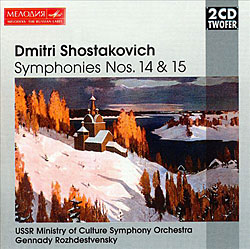
Recording of September 1985: Shostakovich: Symphony 15

985rotm.shost250.jpgShostakovich: Symphony 15

USSR Ministry of Culture State Symphony Orchestra, Gennady Rozhdestvensky conducting.

JVC/Melodiya CD VDC-528 (CD). Igor Veprintsev, eng. AAD.


I have been wondering recently if we aren't seeing the beginning of the end of rotten recordings. I'm now not too surprised when yet another superlative-sounding Telarc or Reference Recordings disc arrives for review, but when a Soviet-made Melodiya blows me away with its sound, not to say a stupendous performance, I must conclude that something earthshaking is going on.

Recording of August 1985: Mozart: Eine Kleine Nachtmusik


885rotm.250.jpgMozart: Eine Kleine Nachtmusik, Posthorn Serenade
Prague Chamber Orchestra, Charles Mackerras conducting.

Telarc CD 80108 (CD). Robert Woods, prod., Jack Renner, eng. DDD.


Holt's First Law of Recording states: "The better the performance, the worse the recording—and vice versa." It's true; really fine recordings of superb musical performances are so rare that the discovery of one such gem is cause for rejoicing. Well, you can rejoice: this is one of them.

Recording of January 1985: Works for Piano

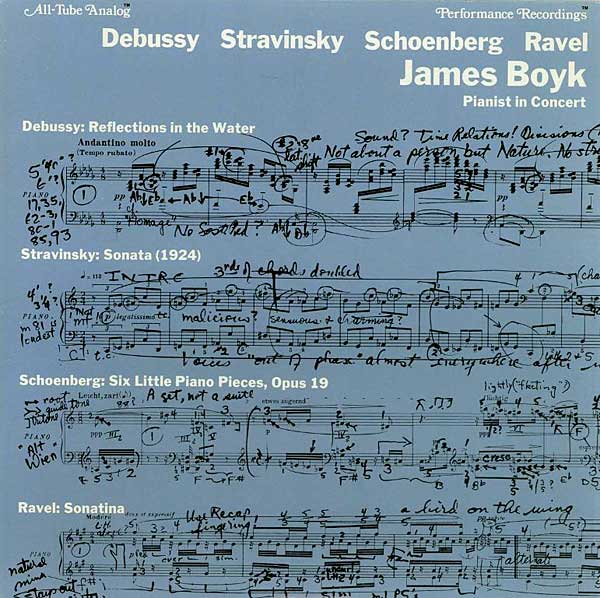
Performance Recordings is the closest thing to a one-man label. James Boyk is president, A&R director, musical director, recording engineer, production manager, jacket notes author, and the star performer. He is also Artist in Residence and lecturer in music and engineering (specifically sound recording and reproduction) at Cal Tech. And he happens to be one of digital's most ardent detractors, having conducted, and widely publicized, several controlled listening tests that proved to his satisfaction that digital recordings are destructive to musical sound. (I will not question his methodology or conclusions here; suffice it to say that James is as stalwartly pro-analog and anti-digital as it is possible to be.)
Advertisement
Advertisement
Advertisement