Music in the Round

Sort By: Post DateTitle Publish Date

Music in the Round #59

Growing up as an audiophile in the 1950s, I always aspired to owning Marantz equipment, and finally attained that status when, late one night in 1974 in Greenwich Village, a friend found a Model 8 amp sitting on a pile of discards on a curb. He quickly ran for his car, and scarfed up the amp and a pair of Acoustic Research AR1 speakers. All turned out to be in perfect working order, though their appearance reflected their history of ill-use. The speakers went into his machine shop—but I got the Model 8! Few products have ever given me so much pleasure and pride; Marantz will always occupy a warm spot in my heart.
Music in the Round #58

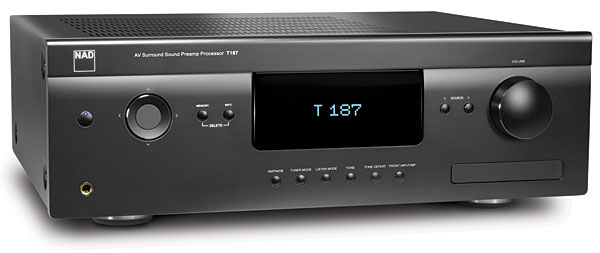
NAD's T 187. Another pre-pro? And not inexpensive at $3000! Why do I care?


First of all, NAD has come to the forefront of established full-range manufacturers as innovators in digital audio. From their original digital preamp, the 118, which I reviewed in the July 1998 issue; to the M2 Direct Digital amp, reviewed by JA in March 2010; to the Masters M51 high-resolution DAC, reviewed last July by Jon Iverson; and their Masters M50 and M52 music-streaming devices, NAD has never simply repackaged available chips and modules, but has always gone their own way.

Music in the Round #55

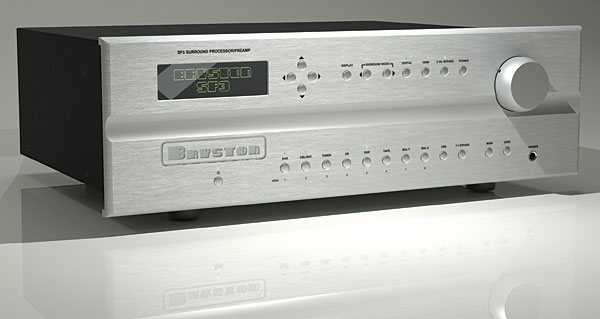
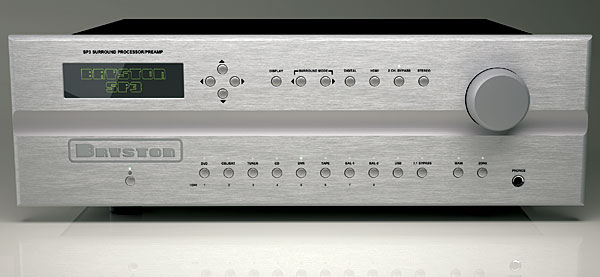
In my review of Bryston Ltd.'s SP-3 preamplifier-processor ($9500) in my May 2012 column, I found that it sounded outstandingly open and dynamic when used as an analog stereo or multichannel preamp. This was evident regardless of the rest of the system, which began with a McIntosh Labs MC303 three-channel power amplifier driving B&W 800 Diamond speakers, but eventually included Bel Canto REF1000M and Anthem Statement M-1 amps, as well as Adam Audio's Classic Column Mk.3 speakers. Didn't matter. The Bryston's transparency allowed each component to perform as well as I'd ever heard it. After that, I disconnected the SP-3 from my Manhattan system, tossed it (figuratively!) in the car, and took it out for a weekend in the country.

Music in the Round #54


Bryston describes its SP-3 ($9500) as comprising a true analog preamp plus a full-featured multichannel digital audio processor, and claims that none of those functions compromises any of the others. That statement is a slight modification of the sentence that began my September 2006 review of the SP-3's predecessor, the SP2. It is indicative of the enduring philosophy of the manufacturer that, in the more than five years since, Bryston has worked to create a new pre-pro that fully reflects new developments in audio and video but without compromising analogquality. Audio is extracted from an input HDMI signal for processing while the video signal is routed, unprocessed, to the two HDMI outputs. Digital audio of all formats, including high-definition audio codecs, are supported, and stereo and multichannel analog inputs are handled by discrete class-A circuitry. Completely separate power supplies support the analog and digital functions, and the internal construction is highly modular, to ease future updating of the SP-3 to keep pace with evolving technology.

Music in the Round #53

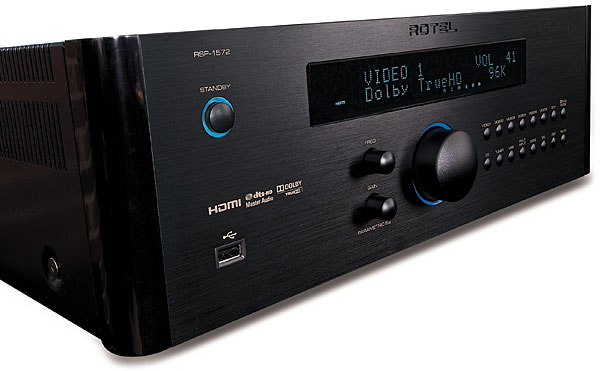
When I attended the 2011 CEDIA Expo last September, one thing I was looking for was a rumored top-of-the-line preamplifier-processor from Rotel with all the bells and whistles and a large TFT display. It was nowhere to be seen or even rumored, but the Rotel folks did introduce me to a less exalted pre-pro, their RSP-1572 ($2199). I've always liked Rotel's styling; I guess you could say that the pretty RSP-1572 caught me on the rebound (footnote 1).

Music in the Round #52

In my last column, in November 2011, I mentioned that preamplifier-processors are generally at a price disadvantage in comparison to the same manufacturer's A/V receivers. The economies of scale almost ensure this. Typically, to design a pre-pro, a manufacturer uses one of its AVR models as a platform; the result is most distinguished from its parent AVR by its lack of power amplifiers.

Music in the Round #51

As I write this, in early August, the global economy is in flux and the stock market gyrates, seeming in stark contrast with the gleaming, luxurious audio components that surround me. Perhaps there is some prescience in my rising interest in reasonably priced, high-performance products, as exemplified by the Oppo Digital BDP-95 universal Blu-ray player, which I reviewed in this column in September. Surely there must be other products that provide truly excellent sound at prices strikingly lower than expected.

Music in the Round #50

I began my July column by talking about how quickly things are changing these days in multichannel audio. What I didn't pay enough attention to is that some things can change quickly enough to create inefficiency. Given that most multichannel digital products are based on digital signal processing (DSP), and many are network-enabled, they can be updated with relative ease. Almost every preamplifier-processor or A/V receiver I've reviewed has needed a firmware update during the reviewing process, and such updates are de rigueur for Blu-ray players, as more and more features (!) are added to new releases. And in addition to providing new performance features, firmware updates often also include corrections for operational glitches that have slipped by the designers and their alpha and beta testers, no matter how assiduously they've done their work.
Advertisement
Advertisement
Advertisement