Digital Processor Reviews

Sort By: Post DateTitle Publish Date

Sutherland Engineering 12dAX7 USB DAC/preamplifier
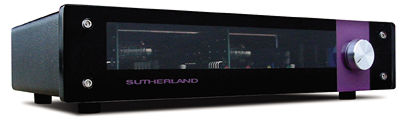
Computers and vacuum tubes go together like Trent Lott and flyaway hair, right? The last time filaments glowed in computers was during the 1960s, when a computer was a building. I remember laughing at the ponytailed computer-science dweebs back then, who spent their college days playing nursemaid to a football field's worth of electronics capable of little more than adding two plus two. Chained to a computer half the day, as most of us now are, guess who had the last laugh?
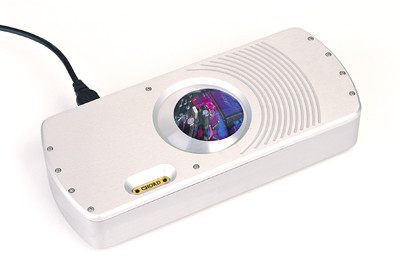
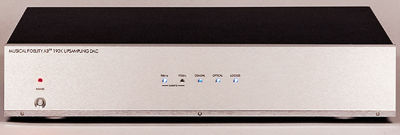
Chord Electronics DAC64 D/A processor

Such is the pace of development in digital technology these days that it is hard not to become convinced that digital playback is a solved problem. The measured performance aberrations are so low in absolute level—and, more important, so low compared with the typical threshold of human hearing—that it is difficult to see why digital components should sound different from one another.

Boulder 1012 D/A preamplifier

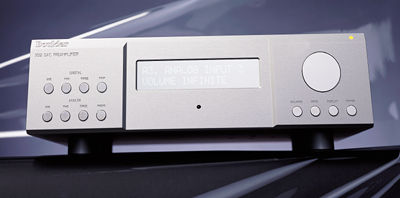
The Boulder 1012's is a line-level preamplifier and DAC in one box. Its design and build qualities are icons to elegant engineering know-how. No screws show on the rectangular box of large but not massive proportions, for example, which is all done up in matte aluminum and set off with a few highly polished stainless-steel buttons. The chassis construction uses tongue-and-groove techniques. The sides of the 1012 benefit from styling cues found on Boulder's newer amplifiers. As you can see from the photograph, the look is both elegant and hi-tech in a way very few other manufacturers manage.


Perpetual Technologies P-1A D/D & P-3A D/A processors

At the Consumer Electronics show in Las Vegas in January 1999, Mark Schifter, erstwhile president of Audio Alchemy, was handing out a press release announcing what seemed like a groundbreaking product from his new company, Perpetual Technologies. The product was the P-1A, a digital-to-digital processor that would do resolution enhancement, loudspeaker correction (amplitude and phase), and room correction—all for less than $1k. It sounded too good to be true.

dCS Purcell D/D converter

The dCS Purcell is named after Henry Purcell, the English composer, organist, bass, countertenor who was born in 1659 and died in, alas, 1695. It's a digital/digital converter intended for consumer use, as opposed to the less elegantly packaged pro-audio version, the dCS 972, that I reviewedhttp://www.stereophile.com//digitalsourcereviews/260/">reviewed; in February 1999. Both devices increase the sample rate and/or word length of the output from linear PCM digital audio sources like CD or DVD up to a maximum sample rate of 192kHz and a word length of 24 bits. According to the extensive documentation, this is achieved by "using extremely powerful and accurate digital interpolation filters, which yield an output signal having negligible levels of distortion."


Bel Canto Design DAC 1 D/A processor

It's hard to know what the best strategy is for digital upgrades. Maybe you bought your first CD player when you became convinced that the format was going to succeed, and it seemed that players were about as good as they were going to get. Some time later, you tried one of the new outboard digital processors, and the sonic improvement was such that you just had to have it. Then you replaced the player itself with a CD transport, so you could benefit from improvements in servo control and digital output circuitry. At this point you were generally happy with your digital front-end—until you read about how 16-bit DACs (which is what your processor had) were old hat now that 20-bit DACs were available. But alas, your processor couldn't be upgraded, and was worth maybe 30% of what you'd paid for it. So you took a loss and bought a new-generation digital processor, and things were fine and dandy...for a while.


MSB Link DAC III D/A converter

Prelude
I fell in love with the original Link DAC, as was obvious from my">http://www.stereophile.com//digitalsourcereviews/234/">my review in the January 1999 Stereophile. I said that "the Link redefines entry into high-quality digital sound," as it provided excellent sound and 24-bit/96kHz conversion for the remarkably low price of $349. It is as firmly ensconced in Class C of "Recommended Components" as it is in my weekend system, where it tames the digital signals from my DMX receiver and my trusty old Pioneer PD-7100 CD player.


California Audio Labs Sigma II D/A converter

HistoriCAL Introduction


California Audio Labs is a child of the digital age. Originally, they made a noise by offering modified">http://stereophile.com/digitalsourcereviews/654">modified CD players with tube output stages, a practice for which I found no intellectual justification. On the other hand, the results were successful, even if (probably) due to the CAL units' softening of the harshness of early digital sound.


Advertisement
Advertisement
Advertisement