
Cable Reviews

Sort By: Post DateTitle Publish Date

An AudioQuest Cable Loom: Vodka network, Pegasus interconnects, Robin Hood speaker cables, Blizzard power cables
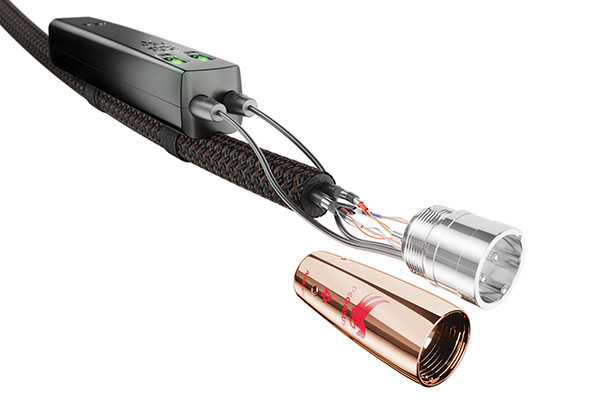
I began the test series I discussed in Colloms on Cables with the first company to respond to our request for review samples: AudioQuest. Their loom comprised a pair of Robin Hood Zero loudspeaker cables; Pegasus I/C interconnects, both unbalanced RCA and balanced XLR; Blizzard AC power cables; and Vodka Ethernet cables. AudioQuest has decades of experience with audio cables, supplying a huge range from high-quality "industrial" cables—some available in bulk for custom-install applications and manufacturing—to more familiar audiophile constructions. Their designs are highly finessed and exquisitely terminated, some executed in exotic materials, particularly solid silver. An established bedrock of engineering underlies AudioQuest's cables. They're based on high-quality, nontwisted conductors, low-loss insulation materials, well-known construction geometries, and a nuanced approach to subtler aspects including conductor purity and cable-draw finish.

Nordost QKore system grounding accessories

As a longtime user of Nordost's cable and AC-power products, my ears opened wide when they released their three QKore Ground Units and QKore Wire at High End 2017, in Munich. While I've never questioned the importance of proper electrical grounding, to prevent problems with safety and noise—the latter including measurable noise generated by transformers, appliances, LED lighting, power supplies, and Bluetooth, WiFi, and cellular devices—I couldn't fathom what difference a passive grounding device might make in a high-end system that, in my case, is fed by an 8-gauge dedicated line with its own copper ground rod driven into the terra infirma of the fault-ridden Pacific Northwest.

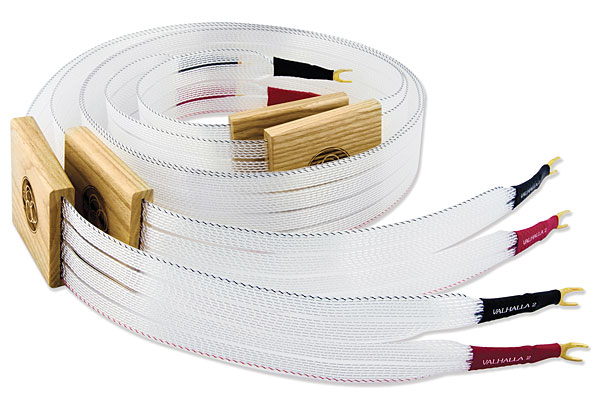
Nordost Valhalla 2 Reference cables

It would be an understatement to say that in 2001, when Nordost introduced their original Valhalla cables, they were a revelation for me. Their focus and resolution of detail were like nothing I'd ever heard, and revealed in recorded performances a startling energy and realism. Throw in their seemingly absolute transparency, and similarly unique levels of spatial and temporal precision, and the Valhallas established a new standard of sound quality in audio cables. Although their tonal balance was cool, as I reported in my first review of them in the November 2001 issue, they were the only game in town in terms of reproducing the feel of a live performance. I immediately adopted them as a reference cable, and they remain a reference for me today.

Audience Au24 SE interconnect

A reader once noted that I tend to stick with the same reference gear longer than most reviewers. In addition to Audience's Au24e interconnect, I've been using Nordost's Valhalla, Nirvana's S-X, and Stereovox's SEI-600II for many years. They're ancient in audiophile terms, and, other than the Audience cables, have long since been discontinued or replaced. However, they are still excellent, and conveniently define a continuum of qualities that I use to assess cables. At one end, the Nordost Valhalla is sharply focused and excels at reproducing transients. At the other end, the Nirvana S-X strips away electronic grunge, and beautifully conveys the continuity of the space and musical flow. The Au24e and Stereovox are near the middle and share many—but not all—of the others' strengths.

Audience Au24e cables

Call me shallow, but what first attracted me to Audience's Au24 cables when I reviewed">http://www.stereophile.com/cables/802audience">reviewed them in August 2002 was their looks. In contrast to superstiff cables as thick as garden hoses, the Au24s were slender and elegant. They were wonderfully flexible, too, and even their custom-made RCA plugs were slim and easy to handle. Instead of having to fiddle with a system of locking collet and barrel, merely slipping them on resulted in a tight, solid connection. Compared to the Au24s, a sizable number of audiophile cables seemed excessive, even a little foolish.


Stereovox SEI-600II & LSP-600 interconnect & speaker cable

Stereophile editor John Atkinson said one evening in 1995, "What I find fascinating is that, in an industry as mature as audio cables, a new company can appear out of the blue and upset everything." He was gently poking fun at my admission that I found cable design fascinating, in particular the practice of combining different conductor materials.


Nordost Heimdall interconnect & speaker cable

The good news: Domestic audio has survived its first half century and continues to live above ground. The bad news: At an age when most hobbies can enjoy the luxury of splintering into smaller factions that hate each other with impunity, ours isn't big enough. There are too few audiophiles on Earth to indulge that kind of specialization, let alone support the very different magazines that would ensue—so we'll never get to enjoy such promising titles as Liberal Tube Lover (not that I didn't try), The Elderly Skeptic, or, of particular interest, Cable Hating for People Who are Barely Audiophiles in the First Place.


Advertisement
Advertisement
Advertisement