Cable Reviews

Sort By: Post DateTitle Publish Date

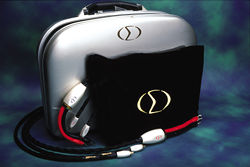
Nirvana Audio S-X Ltd. loudspeaker cable

Nirvana Audio's cables have long been fixtures in my audio system: first the SL interconnects and speaker cables, and, after their debut in 1998, the S-X Ltd. interconnect. In 2002, after a long development process, designer Stephen Creamer introduced the companion S-X Ltd. speaker cable ($2780/2.5m pair, add $50/pair for biwire configuration). He explored a wide range of options, including dramatically different structures and materials, but always returned to the elements he'd used before—and ended up with a design that combined elements of his two existing speaker cables, the SL and the entry-level Royale. At its core, the S-X Ltd. has the Royale's two conductors, each a symmetrical Litz element consisting of 285 isolated strands of high-purity copper of several different gauges. In the S-X Ltd., the conductors are spaced slightly apart to minimize capacitance, wound into a twisted pair, and wrapped in FEP insulation.



Harmonic Technology CyberLight Wave & P2A interconnects

When no one's watching, it's easy to express your opinion. When tens of thousands of people are reading over your shoulder, it becomes more difficult. In fact, it can be downright creepy—especially when what you're thinking sounds like one of those grand, all-encompassing (over)statements you yourself tend to distrust. You don't want to be wrong; on the other hand, if you're too much of a wuss to express what you reallythink just because someone might take it as grandiose, then it's time to give up.


Silversmith Audio Silver interconnect & speaker cables

The possible approaches to any technical problem range from trial and error to first-principles physics. Then there's the "purist" approach—the simplest, most direct way to meet the challenge. Often, the purist approach doesn't pan out because of such phrases as "we need 60 tons of molten gold" or "can we cool the entire building to absolute zero?" But in the world of high-end cables, the purist approach is viable, and is exactly where you find Jeffrey Smith.


Empirical Audio Holophonic-PC & Holophonic-XPC interconnects, Clarity-7 loudspeaker cable

It's not unusual for a high-end audio company to originate in another segment of the high-tech electronics world, but it is a bit unusual when the spin-off is a cable company. That's the case with Empirical Audio, whose founder, Steve Nugent, spent 25 years as a digital hardware designer for Unisys and Intel. The key is that, in addition to standard design work, he chased "the more esoteric sides of design, namely grounding, shielding, ESD (electrostatic discharge), EMI (electromagnetic interference), transmission-line effects, and power delivery." Voilà—cable design.


Siltech G5 Classic Cables

Introduced in 2003, Siltech's G5 Classic series of cables evolved from their highly regarded Generation 3. The G3 series introduced a new metallurgy in which small amounts of gold were incorporated into the silver used as conductors. The G5 Classics use a proprietary geometry called X-balanced Micro Technology, which, according to Siltech, makes the G5s the quietest cables, with the lowest distortion, to be found. Kapton, Peek, and Teflon insulation is used, and the cables are designed to minimize the pickup of RF and EM interference, with low inductance, low capacitance, and low resistance as design goals.


Monster Cable Sigma Retro Gold speaker cables & interconnects

I've been in a nostalgic funk of late. What started it was visiting Golden, Colorado, where I spent my graduate-school days, and seeing all of the changes, not to mention the lecture halls full of kids who couldn't be a day over 12. When I commented on how young the freshmen looked, our host—a colleague of mine from grad school, now a professor—responded, "Those are seniors, Brian." I felt a little old.


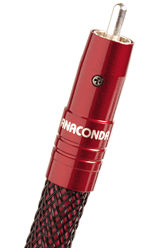
AudioQuest Gibraltar speaker cables & Anaconda interconnects

Being a metallurgical engineer, I've always been intrigued by audio cables—their construction, the materials they're made of, how they're produced, and, of course, how all of that relates to their sound. Over the years, I've auditioned a wide range of cables, from Nordost's round conductors in a flat cable, to Alpha-Core's flat cables in a round conductor, to MIT's complex termination systems. I've even got a closet full of cables—some quite good—from companies that no longer exist.


Harmonic Technology & Analysis Plus interconnects & speaker cables

The dCS Verdi/Purcell/Elgar system's ultra-high resolution and superb focus, and its ability to drive an amplifier directly, provided a good opportunity to compare my current reference cables, Harmonic Technology's Magic Woofer ($2000/8' set) and Pro-Silway II interconnects ($399/m pair, $240/add'l. meter) with Analysis Plus's far less expensive Solo Crystal Oval 8 speaker cable ($969/8' set) and Solo Crystal Oval 8 interconnect ($399/m, longer lengths available).

Acoustic Zen interconnects, AC, and speaker cables

If the devil is in the details, then Beelzebub has taken up residence in the collections of cables we use to connect our components. Reviewing the stuff is tough enough, but things are even more difficult for the average audiophile: Inevitably, the wire that sounds fabulous in the store or in your friend's system doesn't work worth a hoot in your own system, and you're left where you began. Equally inevitably, the wire that does work best carries a price more often seen in Tiffany's or Harry Winston. It's enough to drive a hi-fi nut to drink. So relax, pour yourself a nice glass of wine, and sit right back to hear the tale of Robert Lee and his amazing wires...


Advertisement
Advertisement
Advertisement