Phono Cartridge Reviews

Sort By: Post DateTitle Publish Date

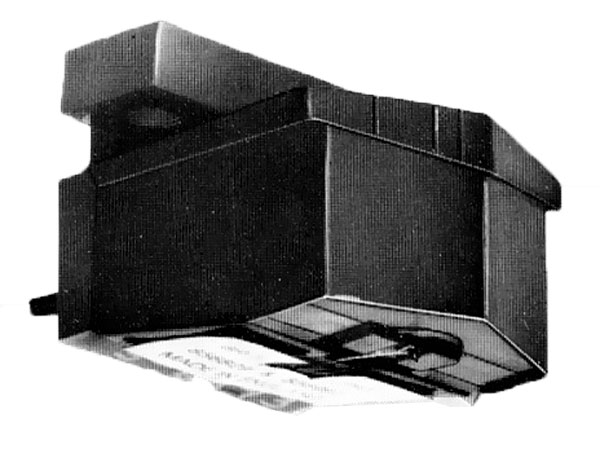
Denon DL-103 phono cartridge

This low-output moving-coil cartridge can be fitted with different styli. The basic DL-103 has a 0.5-mil spherical tip, the DL-103S a Shibata tip. As of the spring of 1975, the '103S is being imported by American Audioport, Inc., in Columbia, MO. the '103 is being brought in directly from Japan by a few dealers. Our '103 was loaned by Music & Sound of California, the '103S came from Audioport.


They are not too similar in sound. The DL-103S is incredibly clean-tracking, with a light, airy high end, a subtle zizz on string tone, and a very slightly withdrawn quality similar to the sound of the Supex 900E, but not as overly rich-sounding as the Supex.

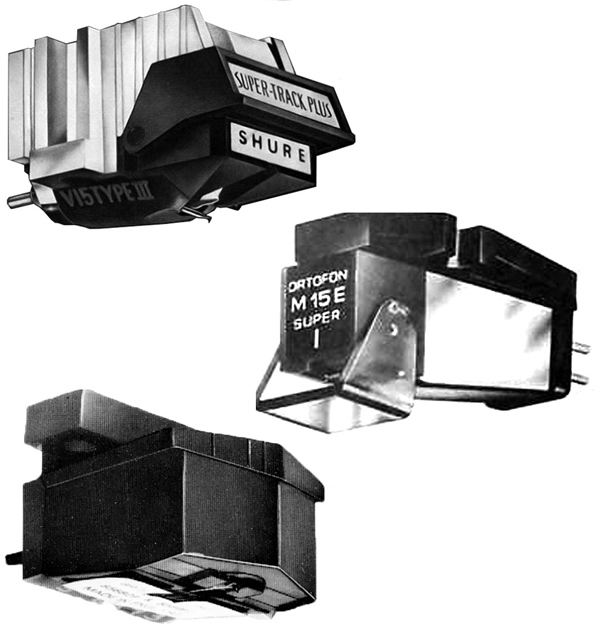
Shure V15-III phono cartridge

The Shure V15-III is the latest of Shure's top-of-the-line "Super-track" pickups, earlier versions of which we scorned because of their dished-down response in the 6kHz range and their consequent "dead" sound. (We were unimpressed with Shure's suggestion that the pickup cable capacitance be increased to a total of around 300pF, since few audiophiles are equipped to measure either cable capacitance or frequency response).

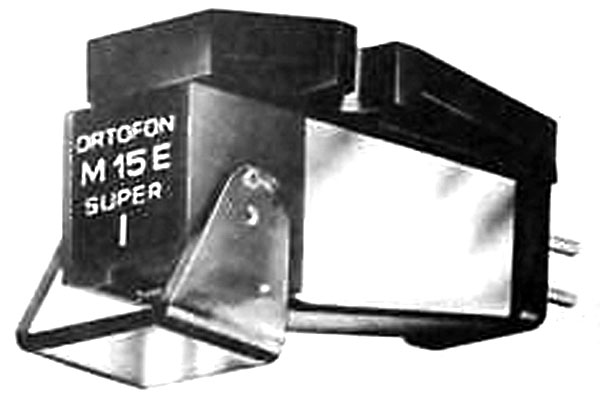
Ortofon M15 Super phono cartridge

The M15 Super is the first high-output pickup to come from Ortofon. Previous ones required either step-up transformers or a booster preamp, and it is only fairly recently that either kind of step-up device was available with high-enough quality to avoid a noticeable degradation of the sound. Early step-up transformers muddied the bass, and previously-available booster preamps added noise or hardness or both to the sound. Now that there are excellent transformers available from Ortofon and other sources, and at least one extraordinarily good booster preamp (the Mark Levinson, at an extraordinarily high price—$170), Ortofon's latest and best pickup doesn't require the use of either.

Decca Mark V phono cartridge

The Decca Mark V is the latest version of that English firm's unique "tip-sensing" stereo-matrix-ing pickups. The "matrixing" apellation refers to the fact that the Decca pickups do not use 45°–45° sensing coils, but use instead a combination of vertical and lateral-sensing coils. There is a single coil for lateral sensing, with its pole pieces brought down next to the tip. This is the tip-sensing feature, whose major attribute is that the stylus motions don't have to be conveyed along the length of an armature before reaching the transducing pole pieces. Thus there is virtually no possibility of the stylus vibrations being modified through flexing of the armature prior to their transduction into audio signals.

Three Pickups: Which is the Best?

If you have read my reviews of the Ortofon M-15, the Shure V15-III, and the Decca Mark V, you have probably formed a pretty firm impression of which of the three contenders for the title "Best Pickup" is the winner. In case you haven't, though, here's a capsule wrap-up of our reactions to the three phono cartridges reviewed in May 1974.

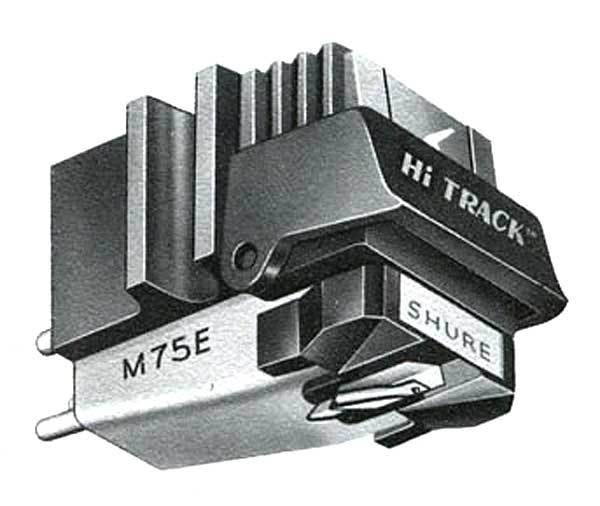
Shure M75E phono cartridge

This is one of Shure's new generation of pickups with "trackability" that grew out of research on the Type II V-15 pickup.


At first glance, the V-15-II and the M75E are physically identical. They're the same size, the same shape, and almost the same weight (the M75E weighs 0.8 grams less); and both of them have the same neat little hinged cover that flips down to protect the stylus when the pickup's not in use.

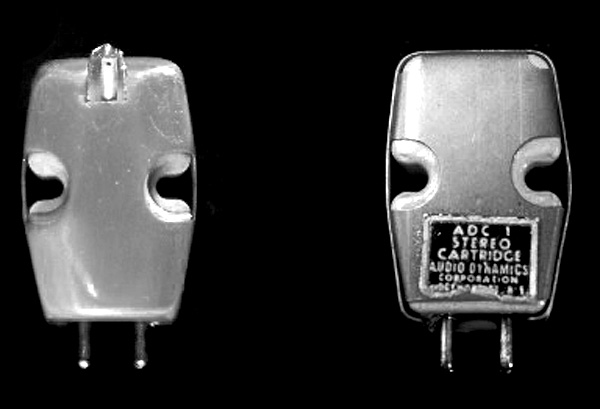
Audio Dynamics ADC-1 phono cartridge

We tested two samples of the ADC-1 phono cartridge, both of which were taken from a dealer's stock. One was a demonstrator that had been in use for some months. The other was brand new, right off the shelf. Both were tested in an Empire 98 tonearm and in a Gray 108-C tonearm with its damping lightly adjusted, but results with both cartridges were for all intents and purposes identical in both arms.

Empire 880P phono cartridge

The 880P is a moving-magnet stereo cartridge for use in transcription arms and the few high-quality record changers now available, such as the Garrard Model A and the Lesa units. It has standard ½" mounting centers, and the pickup requires the 47k ohm termination provided by most preamplifiers. The 8mV output, too, is about ideal for nearly all preamps.
Advertisement
Advertisement
Advertisement