CES 2011

Sort By: Post DateTitle Publish Date

Sonus Faber Amati Futura

The first trickle-down from The Sonus Faber project is a revised Amati model, the Amati Futura ($34,000/pair). Beautifully finished in a mirror-gloss lacquer, as you can see, it was also almost unphotographable. It was also only on passive display in the Sumiko penthouse suite at the Venetian.

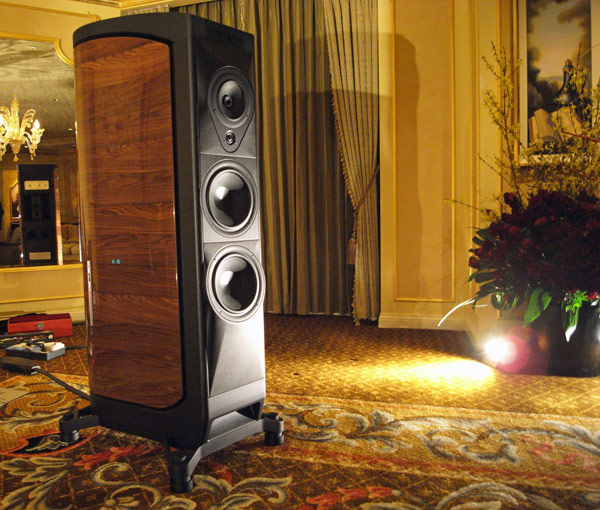
The Sonus Faber

Previewed by Michael Fremer in the October 2010 issue of Stereophile (pp.13–16), where he goes in depth into its technology, Sonus Faber's flagship loudspeaker, The Sonus Faber, will only be produced in a limited edition of 30 pairs. Apparently, all 30 pairs have been spoken for by distributors and dealers.


This is a big speaker—it stands 67" tall and weighs 672 lbs—and was being demmed in an appropriately large room with the large Audio Research Reference 610T tubed monoblocks. Or it would have been demmed, as on both my visits to the room, the electricity supply to the room had failed. (If you look closely, you can see the electrician's red toolbox to the left of my photo.)

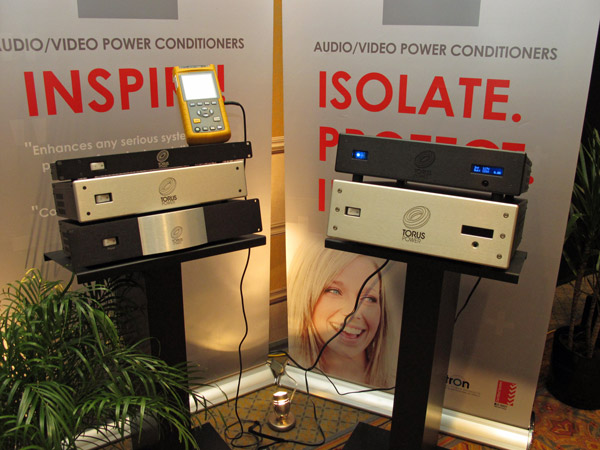
Torus Power from Plitron

Joining WireWorld, Thiel, and Bryston in their impressive exhibit in the Sands/Venetian Convention Center was power specialist Plitron. Based in Canada, the company has spent 28 years in R&D and manufacture of toroidal transformers that are utilized by many of the leading companies in the audio industry. Five years ago, Plitron decided to introduce their own Torus Power line to demonstrate their full implementation of their work with toroidal isolation transformers and power conditioning.


Arthur Kelm, formerly chief engineer in a number of recording studios including Record One, the Record Plant, and Skywalker, designed the Torus Power Ground One power conditioner panel that uses Plitron transformers. “I have known that power is the foundation of every audio/video system,” he explained. “It’s also the most misunderstood application you have. People just don’t understand power and its importance.


“The major advantage of using an isolation transformer is that you now have a very low impedance to plug into, and you can rebond neutral and ground which is where 90% of your noise comes from in electrical systems.”


The complete Torus Power line includes units from 2.5 amps up to 300–400 amps. The lowest priced unit, the RM 2.5 ($999), handles 2.5A. The company’s most popular units, ideal for dedicated audio systems, are the RM 15 ($2000) and RM 20 ($3000). There is also a custom installation series with 60A and 100A units, plus Ground One panels for use in all-home AV and theatres. Some models include automatic voltage regulation.

Major Changes for YG Acoustics

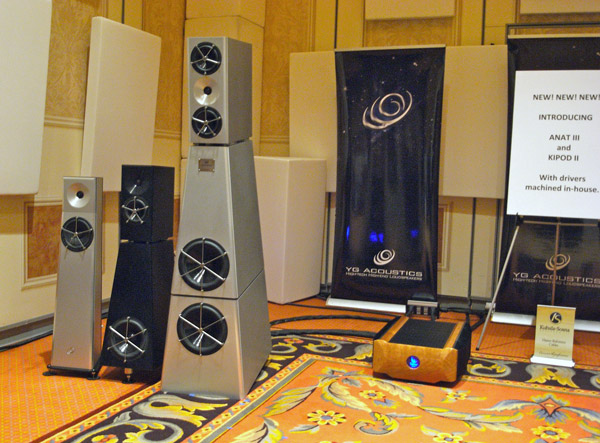
If you look closely at the easel to the right of the photo of the YG room at the Sands/Venetian Convention Center, you can see the text "with drivers machined in-house." Usually, this means that the manufacturer has machined the baskets and polepieces, but in the case of YG, they are also talking about the cones!


Called "BilletCore" by the Colorado company, the aluminum cone for the midrange and low-frequency drive-units used in the top-of-the-line Anat III Reference ($111,000/system) and the smaller three-way Kipod is milled from a solid block of aluminum. In the case of the Anat subwoofer, the starting point is a billet of aluminum 2.5" thick weighing 16 lbs, compared with the finished cone after a day of work, which is 0.008" thick and weighs less than 1 ounce. Stiffening ribs are left on the rear of the cone and the final step is to black-anodize the aluminum. The benefit of machining the cone is said to be improved unit-unit consistency and rigidity compared with a conventional spun, cast, or pressed metal diaphragm, which pushes break-up modes even farther out-of-band.


Though YG was in the same room as in previous CESes, they had taken heroic measures this year to tame its acoustics, as can be seen from the photo. The result was worth the effort. In a system that included dCS Scarlatti digital front-end, a Veloce battery-powered preamp, Tenor 350M monoblocks, and Kubala-Sosna Master Reference cables, the Anat II Reference produced a warm, detailed, full-range sound. Particularly impressive was a version of Sting's "Roxanne" from Italian singer Petra Magoni of Musica Nuda. Both the voice and the solo double bass accompaniment had a palpable presence but without sounding forced or exaggerated.

Trenner & Friedl Duke

"$175,000/pair?" I gulped. I know my beat at the 2011 CES was expensive loudspeakers, but the price of the Trenner & Friedl Duke took my breath away. Yes, the sound in the large room the new Austrian company shared with Cardas, Profundo, and the Jeff Rowland Design Group was superb, but that's a lot of change, even if the manufacturer will fly anywhere in the world to set the speakers up in the customer's home. (The rest of the system comprised a dCS Puccini used as a transport to feed JRDG's new Aeris DAC (the Colorado company's first digital product), $9800; a JRDG Criterion line stage, $18,500; and two JRDG 625 stereo power amplifiers, $13,500; with Cardas Clear cabling.


Each 12" woofer uses a fiber-glass–reinforced paper cone and is loaded by what is referred to as "a hybrid form of horn-resonator and bass reflex design." The mid/HF module is coupled to the woofer modules with spheres of varying hardness, to drain vibrations optimally, and can be adjusted to bring the drivers into proper time alignment at the listening position. The midrange unit features a papyrus cone with an elmwood phase plug and an alnico magnet, while the enclosure is filled with wool from "locally raised sheep" to reduce internal reflections being retransmitted through the drive-unit cone. The tweeter uses a titanium nitride dome loaded with a Tractrix-flare horn, while the supertweeter is a diamond-diaphragm type. The upper-range crossover is passive; the woofers are fed via a line-level crossover, and internal wiring is all Cardas Clear.

Everything But The Box

Do you hate box speakers, and can’t abide planars, either? Well, a company called Everything But The Box (EBTB), based in Bulgaria, has some products that might be just what you want. Their speaker cabinets are all rounded, made of aluminum and polyester resin. (The drivers look conventional, though.) Some, like the $3000/pair Venus in the photo, are designed to hang from the ceiling via steel cables. The speakers are finished in high gloss lacquer, available in 16,000 (!) custom colors.

Monitor Audio's New Gold GX speakers

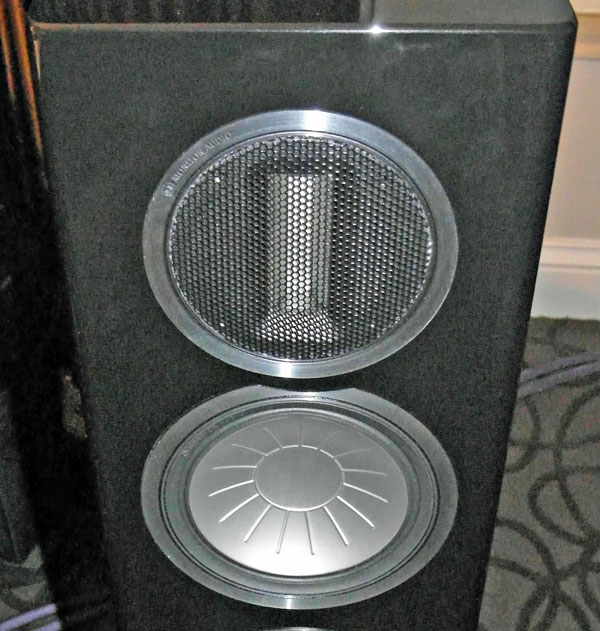
I was very impressed with the Monitor Audio PL200 that I reviewed last April; apparently, so were a lot of other audiophiles, but many were put off purchasing the speakers by the $8000/pair price. The new Monitor Audio Gold GX series is intended to appeal to these folks. The GX series offers most of the technology and aesthetic appeal of the Platinum, but at substantially lower prices. The GX300 is broadly similar in appearance and driver complement to the PL200, but costs an easier-on-the-wallet $5500/pair. It was making fine sounds at CES with Simaudio electronics and Simaudio digital source.

Norbert Lindemann and Dixie!

Made in Germany, available in 12 color combinations, the Lindemann Birdland series of loudspeakers is intended to appeal to the consumer who appreciates not only great sound but also stylish industrial design and German craftsmanship. Components include German-made ceramic drivers, German copper-foil inductors, cryogenically treated Swiss-made copper terminals, and various other audiophile goodies. The demo system featured the Dixie!, the smallest speaker in the series, with Lindemann digital source and electronics. The speakers had a sound that was notably free of cabinet resonances, and had much greater dynamic freedom than I would expect from a speaker of such relatively modest size. The speakers were not fazed even by Copland’s Fanfare for the Common Man: the lowest octave was missing, but the sound did not otherwise lack in body or dynamic punch. At $9900/pair, the Birdland Dixie! cannot be considered a bargain, but it’s one of the best-sounding small speakers that I’ve heard.

Totem's Elements

There’s a kind of hierarchy of prestige among speaker manufacturers (which may or may not have anything to do with the sound quality of their offerings). At the bottom you have manufacturers that use off-the-shelf drivers which are available to any hobbyist, and don’t do anything other than mount these speakers in an enclosure and connect the drivers to a crossover (which may also be an off-the-shelf unit). Then you have manufacturers that start off with an off-the-shelf unit but modify this unit to their purposes. (The modification can be as simple as adding a bit of mass to the cone or adding a foam ring around the tweeter cone.) The next higher level in the hierarchy are speaker manufacturers that have the drivers made to their specifications by a specialist manufacturer of speaker drivers. And at the very top of the hierarchy are the speaker manufacturers that make their own drivers. This allows them to not only control of every step of the manufacturing process but also the ability produce drivers that are proprietary.


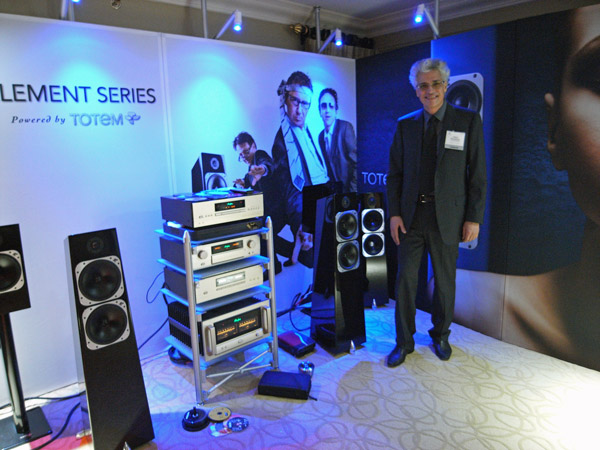
It is this top level of speaker manufacturer hierarchy that Totem has reached with the new Element series, shown in JA's photo with designer Vince Bruzzese. The 7” woofers used in the Element Series are of the Canadian’s company’s own design, manufactured in-house, which requires three hours of machining and more than four hours of assembly. I don’t know enough about loudspeaker driver design to talk with any authority about how the new Totem woofer differs from other woofer designs (the magnetic design was inspired by something called the Halbach array); suffice it to say that it has a free-air resonance of 16–17Hz, and its mechanical top end frequency rolloff is such that it’s matched with the tweeter without any crossover components in the woofer path. The top-of-the-line Metal ($12,995/pair) sounded good in a brief listen. I look forward to having more of an opportunity to listen to these new Totems at the 2011 Montreal show.

Advertisement
Advertisement
Advertisement