CES 2012

Sort By: Post DateTitle Publish Date

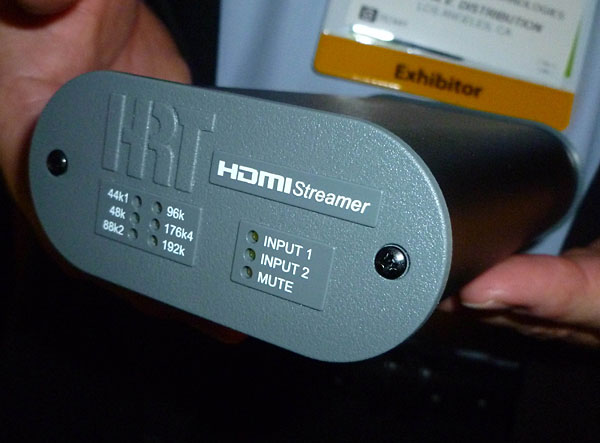
HRT HDMI Streamer

Branching away from strictly audio products, the HDMI Streamer has two HDMI inputs and one HDMI output and a stereo audio output. The idea is to peel the audio off of an HDMI signal and send it to your analog stereo preamp while leaving the video intact for your TV. All perfectly legal says HRT. Available sometime around April for $229.95

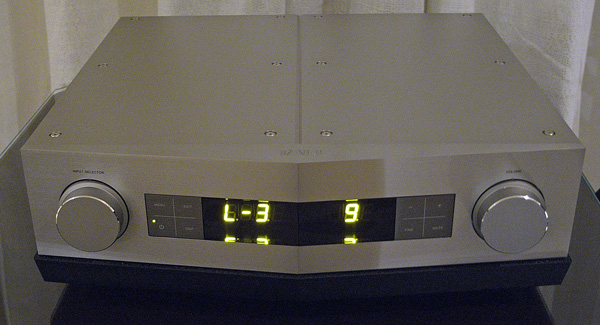
TAD C600 Preamplifier

It costs $42,000 but TAD's new C600 solid-state line preamplifier features dual-mono construction, an all-discrete signal path, a separate power supply, and fastidious attention paid to detail in both its design and construction. The amber LED display for example, is DC-powered rather than from the usual multiplexed supply, to eliminate EMI interference. And the sound, in conjunction with the D600 SACD player, M600 monoblocks, Reference One floor-standing speakers, and HRS rack to give a system price of $214,500? I'll leave it to Stephen Mejias to describe in his show wrap. Personally, it was a highlight of the 2012 CES.

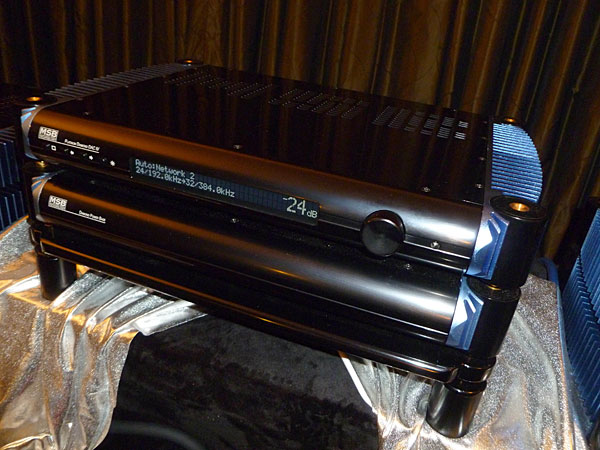
MSB Diamond DAC IV, Diamond Power Base, WiFi System Interface and Galaxy Clock

The Diamond DAC shown here has now been upgraded with MSB's Pro I2S Network capability which the company claims is a faster, lower jitter version of MSB’s original network and retails between approximately $20-35k depending on included options. The entire line is also now available in this luscious, but hard to photograph, black finish and it's likely I'll be reviewing an MSB system for Stereophile in the next few months.


Below the DAC is the MSB Diamond Power Base power supply running at $4,495 and below that is the very thin WiFi System Interface which brings iPad app control to the entire MSB line for $1,950 and should be available shortly.


Perhaps the most interesting MSB announcement is the $9,950 FemtoSecond Galaxy Clock that the company is making available as a plug in module for all DAC IVs. The claim for the clock upgrade is less than .077 picoseconds of jitter (77 femtoseconds)--let's see if JA can measure that.

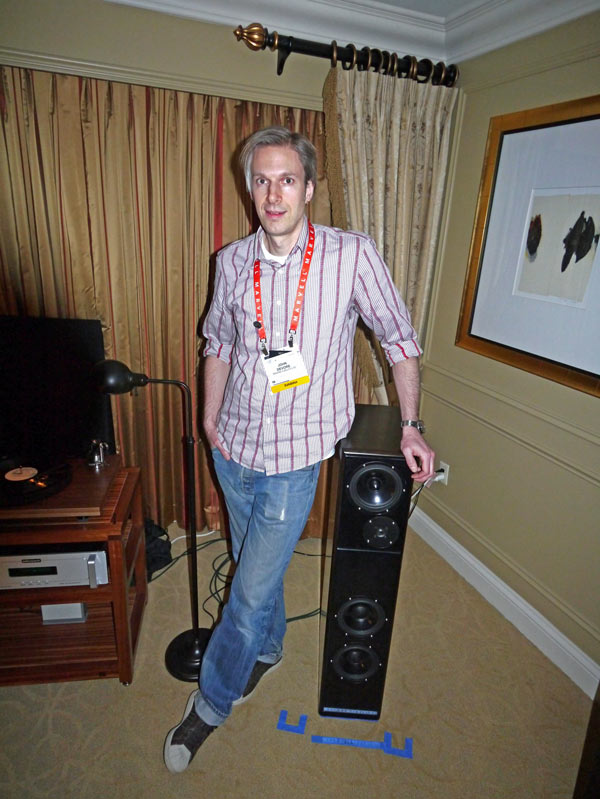
John DeVore & the Gibbon X

DeVore is a name that's no stranger to Stereophile readers, two DeVore Fidelity models being listed in "Recommended Components," and designer John DeVore often mentioned in Stephen Mejias' blog. The Gibbon X ($11,000/pair) is a new three-way floorstanders, featuring all NewGen drivers, including a woofer that is 50% larger than the woofer of the original Gibbon and has double the linear voice-coil travel. The new midrange driver has a phase plug for improved transient performance, and has its own chamber. With the LP of Louis Armstrong and Duke Ellington playing on the system that included the Gibbon Xs (Well Tempered Lab turntable and arm, Audio Research electronics), I was sorry that I had to leave to continue on my rounds.

HRT HeadStreamer

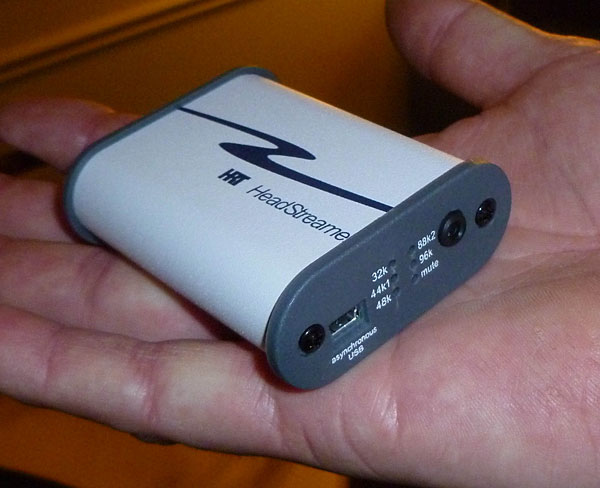
I'm guessing this will be a hot product: asynch USB to stereo out for either headphone or audio feed. Handles up to 24/96 (sample rate indicated by LED), powered by your USB bus and is priced at $139.95. Designed and manufactured in California and available now. I'm really curious to hear how this one sounds.

The Sonus Faber Aida

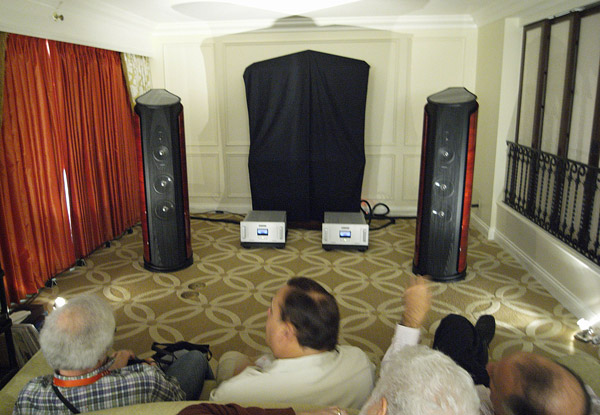
The New York debut of Sonus Faber's stunning-looking Aida ($120,000/pair) was compromised by sub-optimal room acoustics and too much noise from outside the dem area. But the speaker, powered by Audio Research's new Reference 250 monoblocks ($25,900/pair) lived up to the promise in Las Vegas. But as I had found in New York, the true magic of the Aida was only to be found if you sat exactly in the sweet spot, when the speakers disappeared and the end of the room dissolved into the recorded acoustic. Certainly the team from WhatsBestForum.com sitting in front of my camera—Hi, Steve!—were enjoying what the Aidas' were doing.


The rest of the system comprised an SME Model 20/3 turntable/tonearm ($17,000) with a Palos Presentation cartridge ($3995), an Audio Research CD8 ($9995) and DAC8 ($4995), Reference Phono 2SE ($12,995) and Reference 5SE linestage ($12,995), all connected with Shunyata cables. Racks were the ubiquitous Harmonic Resolution Systems SXRs and power conditioning was also by Shunyata.

High-Efficiency Non-Switching Amp from THX

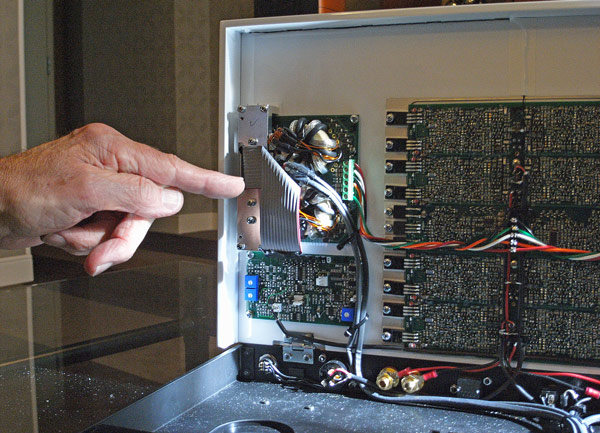
When I gave my Richard Heyser Memorial Lecture at last October's AES Convention, THX's Laurie Fincham was sitting in the audience. Afterwards, Laurie whetted my appetite for what the company would be presenting at CES: a patented non-switching power amplifier topology that would be as efficient as a class-D amplifier but without the side-effects that afflict such designs, high levels of radiated RF, for example. In the photo, Laurie is pointing to the power supply of the amplifier. DC is fed to two oscillators running at 25kHz, one generating a sinewave, the other a cosinewave, ie 90° out of phase with the sinewave. Each wave feeds a transconductance amplifier in the primary of a small transformer; the output of each secondary is rectified and summed to produce a high DC voltage which is then used to power the amplifier circuit. There are no storage capacitors in the circuit—it looks as if almost all the energy entering the supply is available as the final DC voltage! The new topology was developed by Fincham, Owen Jones (the twin brother of TAD's Andrew Jones) and Andrew Mason.

The 2012 Consumer Electronics Show: A Better Way?

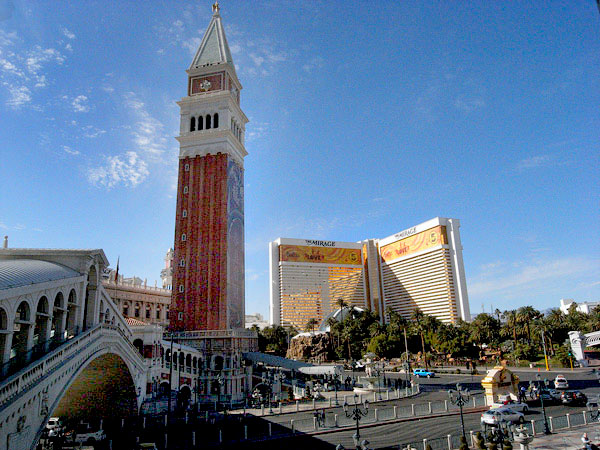
Photo: John Atkinson


It looks sort of pretty, doesn't it?


Imagine how much prettier it would be if it were real. Imagine again how much prettier it would be if those bridges and roads and towers weren't there at all.


Every time I stepped from the slow elevator and onto the casino floor at Harrah's, where Stereophile's editors spent their sleepless nights, my hatred for Las Vegas was revitalized. This was like some kind of bad joke, some kind of post-modern torture. Oh, god, I am still here. I would turn right and see the same flashing lights, the same low ceilings, the same people who had been there the night before, still sitting, still smoking, still hoping, still staring blank-faced into spinning screens of cherries, spades, and jokers, and I would wonder why.


Why? Most people who visit Las Vegas seem to be looking for money, sex, drugs, or simple escape. Why are we here?

Meridian's Room-Friendly M6 Speaker

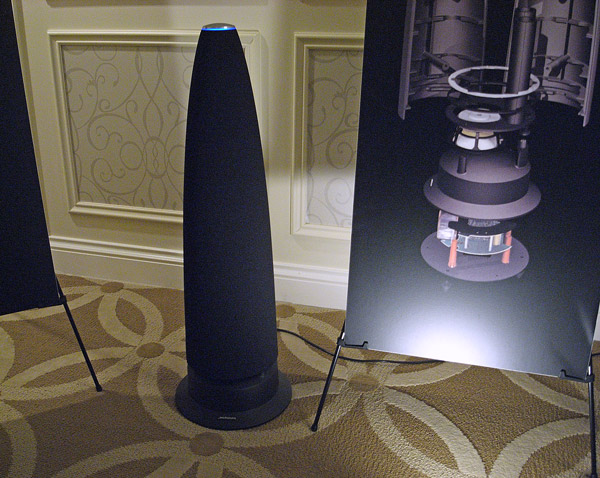
Other than the soft ring of blue light at the top, Meridian's new M6 powered loudspeaker ($9000/pair) looks unprepossessing but hides a wealth of high technology within its black enclosure. The entire range from 200Hz to 25kHz—two decades!—is handled by a single front-firing 3" driver at the top of the cabinet. This is a development of the drive-unit Meridian designed for the F80 music system and is coupled to a downward-firing woofer, which can be seen in the exploded diagram next to the speaker. The M6 has a digital input and the use of DSP for its crossover and equalization means it can be placed near room boundaries, maximizing its Spouse-Acceptance Factor. I listened to the Sheffield Drum Record from Bob Stuart's Sooloos server, controlled with the new iPad app, followed by Dire Straits, the pizzicato movement from Ravel's String Quartet. and the 2L hi-rez recording of Britten's Simple Symphony, and the M6 demonstrated surprising dynamics and clarity, coupled with an overall ease to its presentation. Yes, the lows were a bit too rich, but this is a fit'n'forget speaker system that non-audiophile music lovers will go ga-ga over.

Bryston's Headphone Amplifier

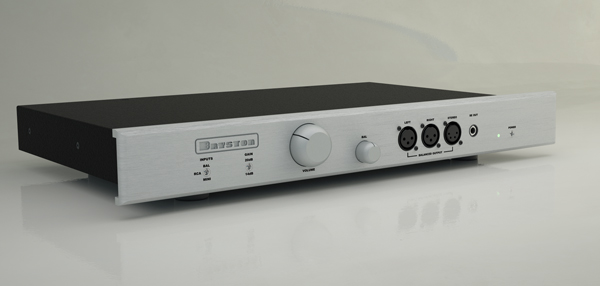
Thiel and Bryston always share an exhibit area in the Sands Convention Center’s Bassano Ballroom, and this year's CES was no exception. James Tanner, Bryston's upbeat product manager, had gathered a terrific playlist of musical selections on a thumb-drive, which drove the company's $2195 BDP-1 digital file transport, $2195 BDA-1 DAC. Livingston Taylor's whistling on "Isn't She Lovely" opened the playlist, just as it did at the Joseph Audio suite, and many others—it was a common selection at the Venetian exhibits. Sound from the $9500 Bryston SP-3 preamp/processor ($7900), three-channel Bryston 6BSST2 amplifier, Thiel CS1.7 speaker prototype and Thiel USS SmartSub Subwoofer produced soundstage depth and imaging that was among the best, almost as good I heard at the much more expensive system in the VTL suite. Tanner walked me through Bryston's newly announced BHA-1 headphone amplifier featured in the photo ($1295), which is highly versatile, including twin XLR outputs for balanced headphones, and both XLR and ¼ jacks for conventional headphones.
Advertisement
Advertisement
Advertisement