Jim Austin
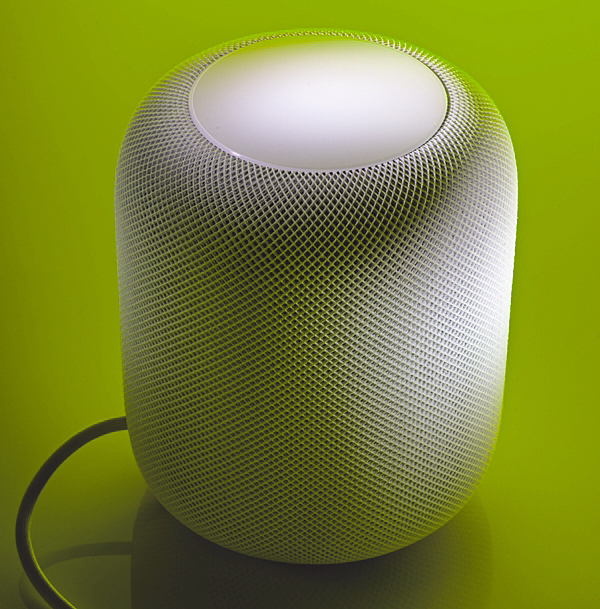
Apple HomePod smart speaker
I mention this because the HomePod's "smart" featuresits integration with Siri and the Apple Music streaming serviceis a big part of its appeal. In its natural element, the HomePod provides a way of accessing music that, although as old as our century, to me is still new and unfamiliar: Forget your hoary music collection, your Rolling Stones and Beethoven. Decide what kind of music you want to heara genre or a moodthen leave the choice to Siri and her algorithmic minions.
Highway 61 Revisited
I'm sitting in a rented Nissan just off Highway 61yes, that Highway 61looking out at a Shell station through the bug-stained windshield and across a litter-strewn, not-yet-planted cotton field. It's late March, and I've just left Clarksdale, Mississippi, on my way to Memphis. Leaving Clarksdale made me thoughtful, so I've pulled over to jot down a few notes.
The Sound and the Image
A Preamplifier Faceoff: Ayre & PS Audio
MQA: Aliasing, B-Splines, Centers of Gravity
The sampling theory formulated by Claude Shannon in the late 1940s had a key requirement: The signal to be sampled must be band-limitedthat is, it must have an absolute upper-frequency limit. With that single constraint, Shannon's work yields a remarkable result: If you sample at twice that ratetwo samples per period for the highest frequency the signal containsyou can reproduce that signal perfectly. Perfectly. That result set the foundation for digital audio, right up to the present. Cue the music.
MQA, DRM, and Other Four-Letter Words
MQA Contextualized
Over one busy week in 1986, Karlheinz Brandenburg laid the foundation of a technology that a few years later would upend the record business. Brandenburg, a PhD student in electrical engineering at the Friedrich-Alexander University Erlangen-Nuremberg, was figuring out how to code digital music efficiently enough that it could be delivered over digital telephone lines. A patent examiner had concluded that what the application proposed was impossible, so over a week of late nights, Brandenburg produced the proof of concept and more. It was another decade before the technologyMPEG-2 level III, more commonly known as MP3would find its true home, the Internet.
MQA Tested Part 2: Into the Fold
Master Quality Authenticated (MQA), the audio codec from industry veterans Bob Stuart and Peter Craven, rests on two pillars: improved time-domain behavior, which is said to improve sound quality and what MQA Ltd. calls "audio origami," which yields reduced file size (for downloads) and data rate (for streaming). Last month I took a first peek at those time-domain issues, examining the impulse response of MQA's "upsampling renderer," the output side of this analog-to-analog system (footnote 1). This month I take a first look at the second pillar: MQA's approach to data-rate reduction. In particular, I'll consider critics' claims that MQA is a "lossy" codec.